
Free Safe Operating Procedure (Smoke Machine) Template
Formalise your safety protocols for operating smoke and fog machines with our structured template. Download your free Safe Operating Procedure today.
Free Safe Operating Procedure (Smoke Machine) Template
DOCX • 126 KB + PDF
Updated Oct 2026
No signup required
Purpose of the Free Safe Operating Procedure (Smoke Machine) Template
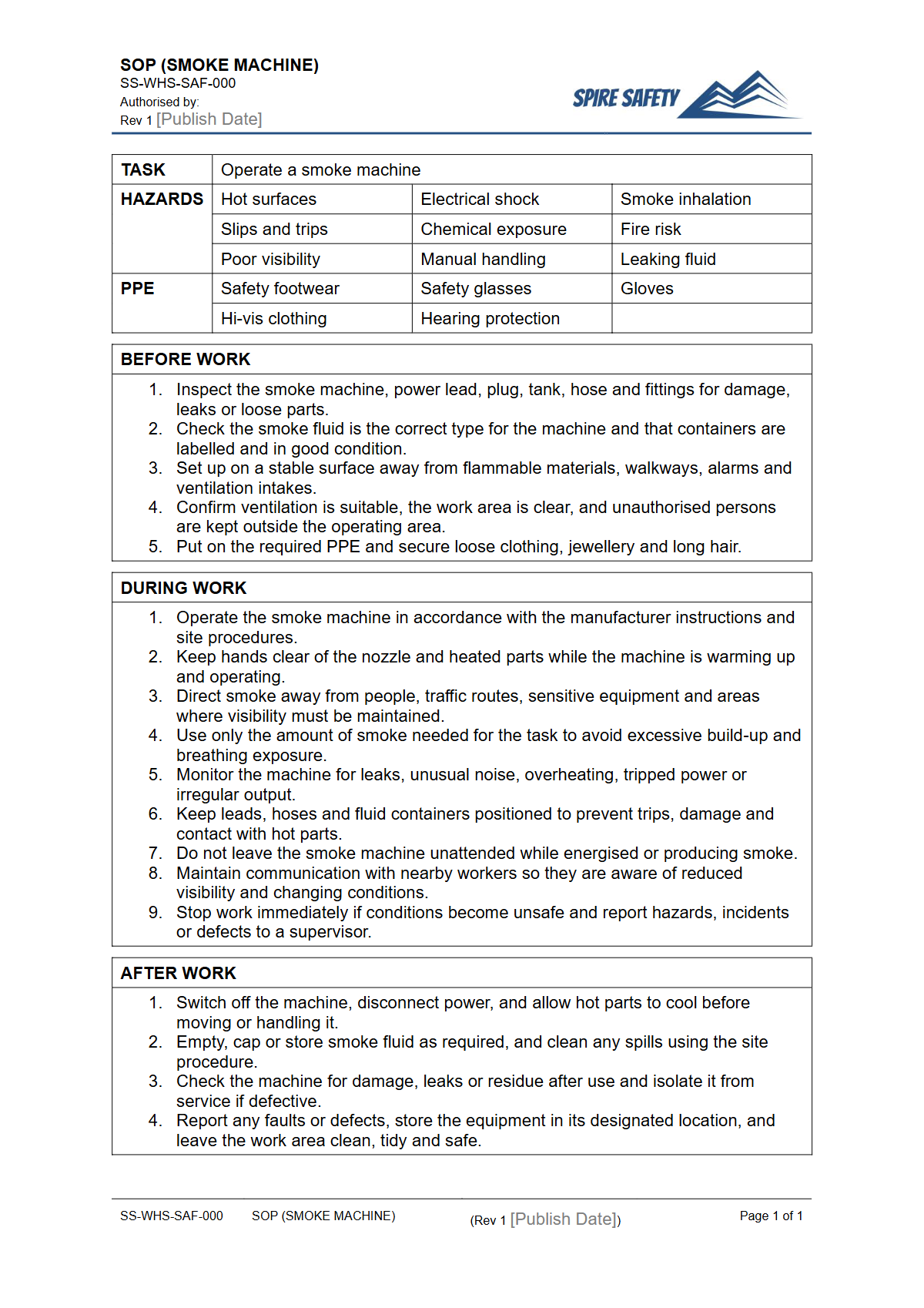
Smoke and fog machines are common in entertainment, training, and industrial testing, but they introduce specific workplace hazards. This free Safe Operating Procedure (Smoke Machine) Template provides a structured framework for documenting the risks and control measures associated with their use.
It helps organisations formalise instructions to manage hazards such as respiratory irritation from glycols, slip hazards from fluid residue, burns from hot components, and electrical faults. By implementing a clear SOP, you can ensure workers understand the correct steps for pre-operational checks, safe operation, and post-use shutdown procedures, forming a key part of your safety management system.
A documented SOP serves as a critical training tool and a reference for workers, helping to standardise safe work practices across your team. It also demonstrates a commitment to meeting Work Health and Safety (WHS) obligations by systematically identifying and controlling risks.
This process is fundamental to creating a safer work environment, especially when dealing with equipment that can affect air quality and floor surfaces. Proper documentation is a cornerstone of an effective safety framework, which is often scrutinised during a WHS compliance audit.
Video walkthrough
How to use the Free Safe Operating Procedure (Smoke Machine) Template
This Safe Operating Procedure template is available for download as a fully editable DOCX file and a print-ready PDF. Its purpose is to act as a solid foundation, which you can then build upon to create a site-specific document.
You must add details relevant to your particular make and model of smoke machine, the specific smoke fluid in use (referencing its Safety Data Sheet), your work environment, and your organisation's unique procedures.
Important: This is a template, not a finished document. We have aligned it with general Australian WHS principles, but it cannot cover every specific scenario.
To be effective, you must customise this Safe Operating Procedure by adding your site-specific details, machine models, fluid types, and control measures. Integrating tailored SOPs is a key activity in developing robust WHS management systems that truly reflect your operational risks.
When should you use this Safe Operating Procedure?
A Safe Operating Procedure for a smoke machine should be used as a primary reference in several key situations. It is essential during the induction and training of new employees or contractors who will be required to operate the equipment.
It should also be readily available in the work area for quick reference during operation. Furthermore, the SOP serves as the basis for regular refresher training to prevent complacency and reinforce safe behaviour.
It is also a critical document to review and update after any incident or near-miss, or when a new type of machine or fluid is introduced into the workplace.
SOPs aren't just for daily tasks; they are vital for less frequent but equally important activities like equipment maintenance, cleaning, and transport. Using an SOP ensures these tasks are also performed safely and consistently.
For businesses with a range of machinery, maintaining a library of clear SOPs is best practice. As an example, the principles of documenting pre-start checks and operational steps are similar whether you are using this document or our free Air Compressor SOP (Safe Operating Procedure) template.
Who should use this Safe Operating Procedure?
This SOP is designed for use by multiple people within an organisation. Primarily, operators of the smoke machine must be trained on and follow the procedures outlined in the finalised document.
It provides them with clear, step-by-step instructions to perform their tasks safely. Supervisors and managers are responsible for implementing the SOP, ensuring workers are trained, and monitoring compliance.
They use the SOP as a tool for enforcement and for conducting workplace inspections.
A Person Conducting a Business or Undertaking (PCBU) holds the ultimate responsibility for providing safe systems of work, and a well-drafted SOP is evidence of this. Health and Safety Representatives (HSRs) should also be involved in the consultation process when the SOP is drafted or reviewed. For complex environments like large-scale productions, the same safety principles apply to all equipment, whether it's a smoke machine or heavy plant covered by a resource like our FREE Telehandler SOP Template. In all cases, the goal is to provide clear, accessible safety guidance to those who need it. You can explore our entire free WHS resources library to find more templates to support your safety system.
Common mistakes
Common mistakes to avoid
- Using the wrong type of fluid for the machine, which can damage the equipment or produce unexpected by-products.
- Failing to ensure adequate ventilation, leading to high concentrations of smoke in enclosed spaces.
- Ignoring residue build-up on floors and surfaces, creating significant slip and fall hazards.
- Placing the machine where the hot nozzle could cause burns to people or ignite nearby flammable materials.
Legal references
Legal considerations
The following legal requirements may be relevant to this type of work.
- Work Health and Safety Act (Harmonised) — Provides the primary duties for protecting workers and other people from work health and safety risks.
- Work Health and Safety Regulations (Harmonised) — Sets out requirements supporting the management of workplace hazards and risks.
The following codes may be relevant to this type of work.
- Managing WHS Risks Code of Practice — Provides practical guidance on identifying hazards, assessing risks and applying effective controls.
- Work Health and Safety Consultation, Cooperation and Coordination Code of Practice — Provides practical guidance on consulting workers and coordinating with other duty holders.
- Managing the Work Environment and Facilities Code of Practice — Provides practical guidance on safe work environments, workplace facilities and related controls.
Did you know
Fluid Matters
Most modern smoke machines use water or mineral-oil based fluids, which are generally considered less irritating than older oil-based thermal crackers. Always check the Safety Data Sheet (SDS) for your specific fluid.
Not Just for Parties
Smoke machines are critical tools for non-destructive leak testing in pipes and HVAC systems, and for emergency response training for firefighters to simulate low-visibility conditions safely.
FAQ
Frequently asked questions
01What are the main hazards of using a smoke machine?
02Does this SOP cover different types of smoke fluid?
03Who is responsible for creating a Safe Operating Procedure?
04How often should a smoke machine SOP be reviewed?
Share this resource
Free Safe Operating Procedure (Smoke Machine) Template
Browse Categories
How To Use It
- 1Download and open in Word or PDF.
- 2Replace the placeholders with your business details.
- 3Get it reviewed by a WHS specialist before rollout.
Need it customised?
Our WHS consultants can adapt this template to your site, run a gap analysis, or audit what you already have in place.
Book a Free Consultation WHS consulting servicesor call 1300 156 382
Related templates
- Free Safe Operating Procedure (Smoke Stain Removal) Template
- Free Safe Operating Procedure (Snorkel Equipment) Template
- Free Safe Operating Procedure (Soccer Goal Inspection) Template
- Free Safe Operating Procedure (Soda Dispenser Cleaning) Template
- Free Safe Operating Procedure (Soft Drink Dispenser) Template
- Free Safe Operating Procedure (Soft Serve Machine) Template