
Free Safe Operating Procedure (Snorkel Equipment) Template
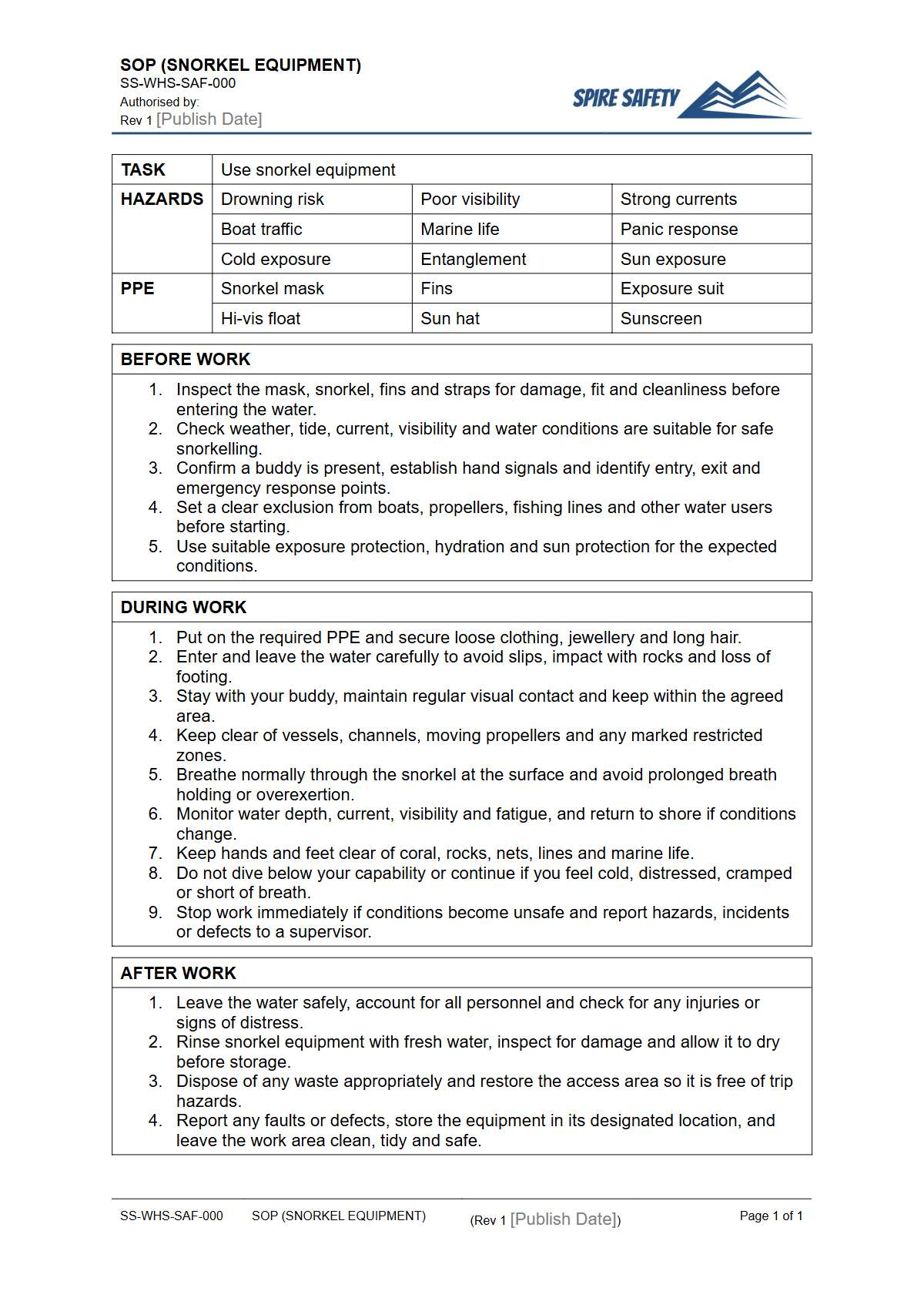
Download our free Safe Operating Procedure for Snorkel Equipment. This customisable template helps outline operational steps and safety controls for work at height.
Free Safe Operating Procedure (Snorkel Equipment) Template
DOCX • 126 KB + PDF
Updated Oct 2026
No signup required
Purpose of the Free Safe Operating Procedure (Snorkel Equipment) Template
This Free Safe Operating Procedure (Snorkel Equipment) Template provides a structured framework for documenting the safe operation of snorkel lifts and similar boom-type elevating work platforms (EWPs). Using this SOP helps your organisation establish clear, repeatable steps for operators, reducing the risk of incidents associated with working at height, such as falls, electrocution, or equipment tipovers.
A documented procedure is a fundamental part of managing WHS duties and demonstrating that you have a safe system of work in place.
A well-drafted SOP is a critical control measure that forms part of your overall risk management process. For businesses using various types of plant, it’s beneficial to have consistent documentation across all equipment.
For example, your site may also require a free Telehandler SOP for materials handling tasks that also involve lifting and potential height risks.
Video walkthrough
How to use the Free Safe Operating Procedure (Snorkel Equipment) Template
You can download this Safe Operating Procedure for snorkel equipment as a DOCX file for easy editing or as a PDF for straightforward distribution. The template is designed as a comprehensive starting point, pre-filled with common sections you would expect in an SOP, including pre-start checks, step-by-step operating instructions, emergency response, and shutdown procedures.
It is crucial to remember that this template is a starting point. We have developed it to be a helpful guide, but you must customise it to reflect the specific snorkel lift model, attachments, tasks, and unique environmental conditions of your workplace.
Effective SOPs are not generic; they are living documents that integrate into your broader WHS management systems to ensure training, supervision, and daily activities are aligned with your safety goals.
What this Safe Operating Procedure covers:
- Essential PPE requirements for operators and spotters.
- Pre-operational safety and equipment integrity checks.
- A logical sequence for safe operation, from setup to task completion.
- Emergency procedures, including rescue plans.
- Post-operational shutdown, cleaning, and reporting steps.
When to use it
A Safe Operating Procedure for snorkel equipment should be used as a primary reference document at several key stages. It is essential for inducting and training new operators, ensuring they understand the approved method for using the machinery before they begin.
It should also be used for refresher training and as a reference tool for experienced operators to reinforce safe work practices.
The SOP should be readily accessible to operators at all times, either in the site office or in a weatherproof container on or near the equipment itself. For sites with a range of machinery, maintaining a library of current procedures is vital for operational consistency.
This might include procedures for ancillary equipment, such as a free Air Compressor SOP if pneumatic tools are used on the EWP platform.
Who should use it
This Safe Operating Procedure is intended for several key roles within an organisation. The primary users are the licensed operators of the snorkel equipment, who must follow the procedure to ensure their own safety and the safety of others around them.
Supervisors and managers should use the SOP to oversee work, conduct safety observations, and ensure workers are competent and compliant.
WHS managers and safety officers will use the SOP as a key document during safety audits, incident investigations, and management system reviews. Regular review of the SOP, much like formal WHS compliance auditing, ensures the procedure remains effective and accounts for any changes in the workplace or equipment. The principles of creating task-specific SOPs apply to all types of machinery, including groundwork equipment covered by documents like our free Trencher SOP template.
By implementing and enforcing a clear, customised SOP for snorkel equipment, you create a safer, more predictable work environment for everyone. For more templates and safety documents, you can browse our complete free WHS resources library.
Common mistakes
Common mistakes to avoid
- Failing to conduct a thorough visual and functional pre-start inspection before every use.
- Operating the equipment on soft, uneven, or sloping ground that exceeds the manufacturer's specified limits.
- Overloading the platform with personnel or materials, or using planks and ladders to extend reach from the basket.
- Neglecting to customise the generic SOP template to address the specific hazards of the worksite and the unique features of the equipment model.
Legal references
Legal considerations
The following legal requirements may be relevant to this type of work.
- Work Health and Safety Act (Harmonised) — Provides the primary duties for protecting workers and other people from work health and safety risks.
- Work Health and Safety Regulations (Harmonised) — Sets out requirements supporting the management of workplace hazards and risks.
The following codes may be relevant to this type of work.
- Managing WHS Risks Code of Practice — Provides practical guidance on identifying hazards, assessing risks and applying effective controls.
- Work Health and Safety Consultation, Cooperation and Coordination Code of Practice — Provides practical guidance on consulting workers and coordinating with other duty holders.
- Managing the Work Environment and Facilities Code of Practice — Provides practical guidance on safe work environments, workplace facilities and related controls.
Did you know
Falls from Height
Falls from height remain a leading cause of fatalities and serious injuries in Australian workplaces. Using EWPs like snorkel lifts with a documented and enforced Safe Operating Procedure is a critical control measure to manage this risk.
What's in a Name?
"Snorkel lift" is a common industry term for a specific type of articulated or telescopic boom lift. While it originated from the brand Snorkel, the term is now often used generically to describe this category of EWP.
FAQ
Frequently asked questions
01What should be included in an SOP for snorkel equipment?
02Is a specific licence required to operate snorkel equipment in Australia?
03How often should a Safe Operating Procedure for snorkel equipment be reviewed?
04Can a generic SOP template be used for all types of EWPs?
Share this resource
Free Safe Operating Procedure (Snorkel Equipment) Template
Browse Categories
How To Use It
- 1Download and open in Word or PDF.
- 2Replace the placeholders with your business details.
- 3Get it reviewed by a WHS specialist before rollout.
Need it customised?
Our WHS consultants can adapt this template to your site, run a gap analysis, or audit what you already have in place.
Book a Free Consultation WHS consulting servicesor call 1300 156 382
Related templates
- Free Safe Operating Procedure (Soccer Goal Inspection) Template
- Free Safe Operating Procedure (Soda Dispenser Cleaning) Template
- Free Safe Operating Procedure (Soft Drink Dispenser) Template
- Free Safe Operating Procedure (Soft Serve Machine) Template
- Free Safe Operating Procedure (Soil Amendment Mixing) Template
- Free Safe Operating Procedure (Soil Compaction Test) Template