
Free Safe Operating Procedure (Smoke Stain Removal) Template
Download our free Safe Operating Procedure (Smoke Stain Removal) template to manage fire restoration risks.
Free Safe Operating Procedure (Smoke Stain Removal) Template
DOCX • 126 KB + PDF
Updated Oct 2026
No signup required
Purpose of the Free Safe Operating Procedure (Smoke Stain Removal) Template
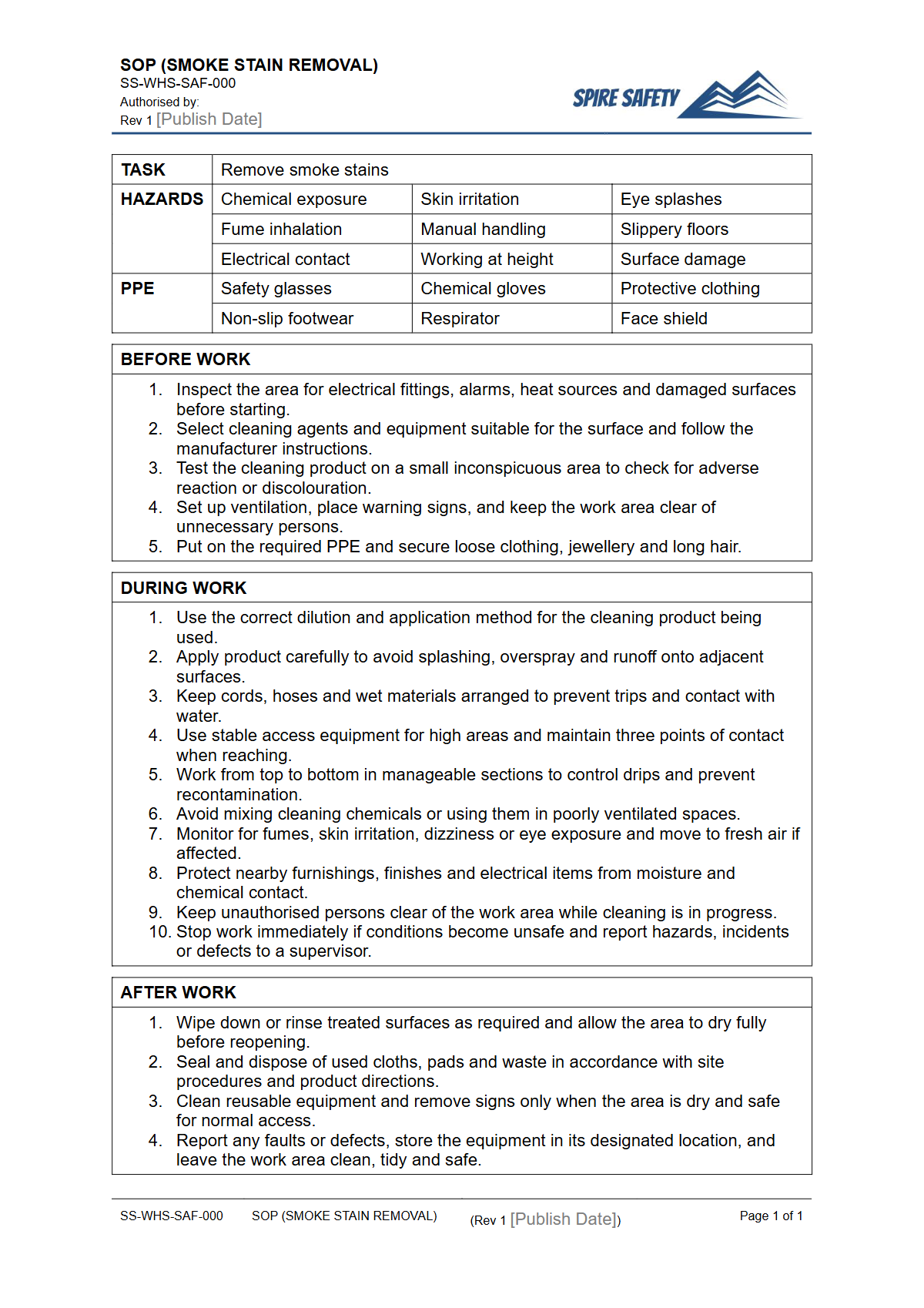
Removing smoke and soot stains is a common task in fire restoration and property maintenance, but it carries significant health and safety risks. This Free Safe Operating Procedure (Smoke Stain Removal) Template provides a structured framework for documenting a safe system of work.
The primary purpose is to help Persons Conducting a Business or Undertaking (PCBUs) control hazards associated with the task, such as exposure to hazardous chemicals, airborne contaminants, and slips, trips, and falls.
By implementing a clear SOP, your organisation can ensure that all workers follow a consistent, pre-approved method for safely handling cleaning agents, preparing the work area, and using required Personal Protective Equipment (PPE). A documented procedure is a critical component of effective risk management and demonstrates a commitment to worker safety.
This SOP forms a fundamental part of more comprehensive WHS management systems, helping to standardise safety practices across all operations.
Video walkthrough
How to use the Free Safe Operating Procedure (Smoke Stain Removal) Template
This document is a template, not a finished procedure. It must be customised to address the specific circumstances of your workplace.
To adapt this SOP effectively, you should consult with workers and other relevant stakeholders. Your final procedure should reflect the unique equipment, chemicals, and environmental conditions present at your site.
Key customisation steps include:
- Chemicals: List all specific cleaning agents, degreasers, and neutralisers used. Attach the Safety Data Sheet (SDS) for each chemical and incorporate handling, storage, and first aid information directly into the SOP.
- Equipment: Detail the exact models of equipment to be used, such as pressure washers, vacuums, or mechanical scrubbers. For some machinery, you may need a specific Safe Operating Procedure for Floor Scrubber Operation to complement this one.
- PPE: Specify the mandatory PPE based on your risk assessment and the relevant SDSs. This often includes chemical-resistant gloves, eye protection, and respiratory protection (e.g., P2 respirators).
- Environment: Describe the work area and any specific hazards, such as poor ventilation, confined spaces, live electrical services, or unstable surfaces.
- Emergency Procedures: Outline clear steps for responding to incidents like chemical spills, accidental exposure, or injuries.
Important: You must customise this template to reflect your specific site, equipment, and processes. We provide this document as a starting point, but you are responsible for ensuring it is comprehensive and suitable for your workplace. If you require assistance in developing or reviewing your safety documentation, consider using professional WHS consulting services.
When to use it
This Safe Operating Procedure should be used whenever workers are tasked with cleaning smoke, soot, or carbon stains from building surfaces. This applies to a range of scenarios, including post-fire cleanup operations, restoration of heritage buildings, and deep cleaning of commercial kitchens or industrial facilities with heavy exhaust.
Prior to chemical cleaning, initial preparation may involve removing loose debris with compressed air; ensure you have a separate Air Compressor SOP for this task.
The SOP should be reviewed by the supervisor and workers before starting any smoke removal job, especially if conditions or materials change. For stubborn, caked-on residues, manual removal might be necessary before chemical treatment.
Tasks involving this type of work should be guided by a specific Scraper SOP to manage risks from sharp edges and repetitive motions.
Who should use it
This SOP is intended for several key roles within an organisation:
- Workers and Technicians: As a step-by-step guide to perform the task safely and consistently.
- Supervisors and Team Leaders: To assist in providing pre-task briefings, conducting training, and monitoring that the agreed safety procedures are being followed on-site.
- WHS Managers and Officers: As a tool for implementing risk controls and integrating the procedure into the broader safety management system.
- PCBUs: To help fulfil their primary duty of care under WHS legislation by providing and maintaining a safe system of work.
The document also serves as a critical piece of evidence during safety reviews and audits. It helps demonstrate that risks have been identified and that systematic controls are in place, which is a key focus of any WHS compliance auditing process.
Common mistakes
Common mistakes to avoid
- Using incorrect cleaning agents that can set the stain or damage the underlying surface.
- Failing to ensure adequate ventilation, leading to a build-up of hazardous chemical vapours.
- Neglecting to wear appropriate respiratory protection, risking inhalation of fine soot particles and chemicals.
- Starting cleaning before the area has been tested and declared safe from structural or electrical hazards.
Legal references
Legal considerations
The following legal requirements may be relevant to this type of work.
- Work Health and Safety Act (Harmonised) — Provides the primary duties for protecting workers and other people from work health and safety risks.
- Work Health and Safety Regulations (Harmonised) — Sets out requirements supporting the management of workplace hazards and risks.
The following codes may be relevant to this type of work.
- Managing WHS Risks Code of Practice — Provides practical guidance on identifying hazards, assessing risks and applying effective controls.
- Work Health and Safety Consultation, Cooperation and Coordination Code of Practice — Provides practical guidance on consulting workers and coordinating with other duty holders.
- Managing the Work Environment and Facilities Code of Practice — Provides practical guidance on safe work environments, workplace facilities and related controls.
Did you know
Acidic Soot
Soot from a fire is often acidic. If left on surfaces, particularly metal, it can cause corrosion and permanent etching over time, making prompt and proper cleaning essential.
Invisible Dangers
Smoke is a complex mixture of heated particles and gases. Many of the most harmful components, like carbon monoxide and various volatile organic compounds (VOCs), are invisible.
FAQ
Frequently asked questions
01What PPE is required for smoke stain removal?
02How do I choose the right cleaning chemicals for smoke damage?
03Does this SOP template cover mould remediation as well?
04What training should workers receive before removing smoke stains?
Share this resource
Free Safe Operating Procedure (Smoke Stain Removal) Template
Browse Categories
How To Use It
- 1Download and open in Word or PDF.
- 2Replace the placeholders with your business details.
- 3Get it reviewed by a WHS specialist before rollout.
Need it customised?
Our WHS consultants can adapt this template to your site, run a gap analysis, or audit what you already have in place.
Book a Free Consultation WHS consulting servicesor call 1300 156 382
Related templates
- Free Safe Operating Procedure (Snorkel Equipment) Template
- Free Safe Operating Procedure (Soccer Goal Inspection) Template
- Free Safe Operating Procedure (Soda Dispenser Cleaning) Template
- Free Safe Operating Procedure (Soft Drink Dispenser) Template
- Free Safe Operating Procedure (Soft Serve Machine) Template
- Free Safe Operating Procedure (Soil Amendment Mixing) Template