
Free Safe Operating Procedure (Slump Testing) Template
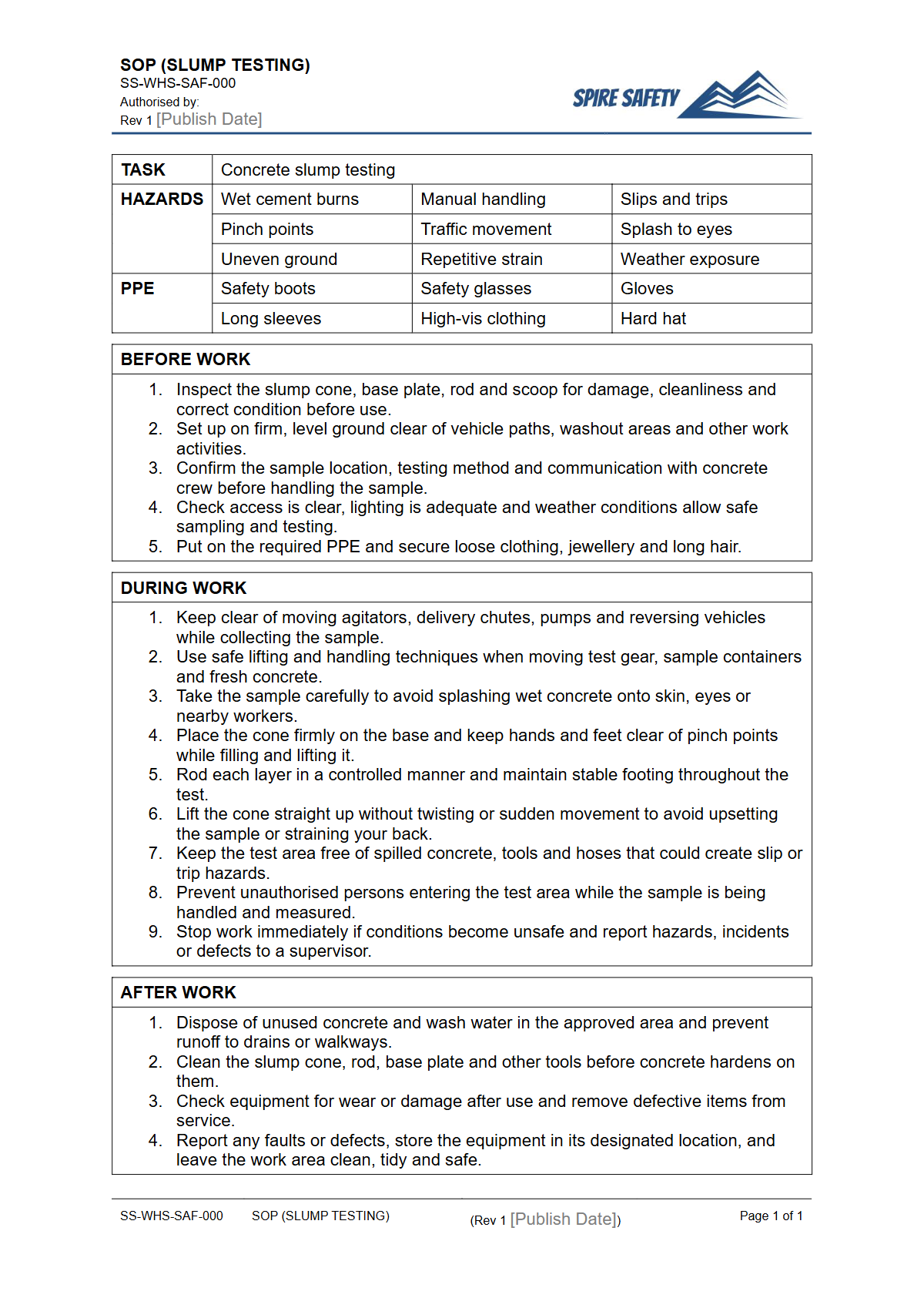
Our free Safe Operating Procedure for slump testing provides a structured starting point for managing concrete workability checks.
Free Safe Operating Procedure (Slump Testing) Template
DOCX • 126 KB + PDF
Updated Oct 2026
No signup required
Purpose of the Free Safe Operating Procedure (Slump Testing) Template
Performing a slump test is a fundamental quality control process in construction and civil works, ensuring that fresh concrete meets the specified consistency and workability before it's poured. This free Safe Operating Procedure (Slump Testing) Template provides a clear, step-by-step framework for conducting the test safely and accurately.
It helps organisations standardise their methods, minimise procedural errors, and manage associated health and safety risks, such as manual handling and exposure to wet concrete.
Using this SOP helps demonstrate a commitment to both quality assurance and worker safety. The document outlines hazard identification, risk control measures, required personal protective equipment (PPE), and emergency response actions.
Integrating such procedures is a core component of effective WHS management systems, creating a safer and more predictable work environment.
Video walkthrough
How to use the Free Safe Operating Procedure (Slump Testing) Template
This template is provided in both DOCX and PDF formats for your convenience. Download the DOCX file to edit and adapt the procedure to your specific operational needs.
While it is based on Australian WHS principles and industry best practices, it is not a finished document. You must customise it to align with your site's unique environment, the specific concrete mixes used, and the equipment available.
Important: We have created this template as a robust starting point, but you must review and customise every section to reflect your workplace's specific hazards and control measures. A generic document is not sufficient for compliance.
Once customised, the SOP should be used for training workers and be readily accessible at the point of work. For added assurance, consider engaging a professional for a WHS compliance audit to review your completed safety documentation.
When is a Slump Test SOP Used?
A Safe Operating Procedure for slump testing should be implemented whenever fresh concrete is delivered to a worksite. The test is typically performed on a sample from the first concrete truck of the day and then at specified intervals (e.g., every 50 cubic metres or as per the project engineer's specifications) to verify batch consistency.
It is a critical checkpoint before the concrete is placed via pump, chute, or kibble. Having a formal SOP ensures this routine task is performed correctly every time, preventing the use of non-compliant material that could compromise structural integrity.
This process often occurs on sites where other machinery is active, making standardised procedures for all equipment, such as those in our FREE Telehandler SOP Template, equally important.
Who Should Use This Procedure?
This SOP is designed for any personnel involved in the handling and testing of fresh concrete. This includes, but is not limited to:
- Geotechnical Technicians
- Materials Testers
- Site Engineers and Supervisors
- Concreters and Leading Hands
- Quality Control Officers
Supervisors and site managers are also responsible for ensuring that the procedure is understood, followed, and that all required equipment and PPE are provided and maintained. Documenting procedures for all site tasks, from testing to excavation, is crucial; you can find other relevant procedural guides like our FREE Trencher SOP Template to build out your site safety files.
By ensuring all team members are trained using a consistent document, you reduce variability and improve safety outcomes across the board.
What's Covered in the Template?
Our slump testing SOP template provides a comprehensive structure for you to build upon. Key sections include task description, potential hazards (e.g., manual handling, chemical burns), risk controls (e.g., proper lifting technique, use of pH-neutral soap), required PPE, pre-operational checks, and a detailed, sequential guide to performing the test itself.
Just as you'd detail processes for moving materials with equipment outlined in a FREE Conveyer System SOP, this document formalises the steps for testing those materials. This structured approach helps satisfy due diligence requirements and provides a clear record for training and auditing.
If you need assistance adapting this or other procedures, our WHS consulting services can provide expert guidance.
By implementing this SOP, you establish a clear, safe, and repeatable method for one of the most common tests in the construction industry. Feel free to explore our complete free WHS resources library for more templates to support your safety management system.
Common mistakes
Common mistakes to avoid
- Using a non-level, unstable, or absorbent surface, which can affect the accuracy of the result.
- Incorrectly tamping the concrete layers inside the cone with either too few or too many strokes.
- Lifting the cone too slowly, too quickly, or with a twisting motion, which can cause the concrete to shear unnaturally.
- Measuring the slump from the side of the slumped pile instead of from the displaced centre, leading to an incorrect reading.
Legal references
Legal considerations
The following legal requirements may be relevant to this type of work.
- Work Health and Safety Act (Harmonised) — Provides the primary duties for protecting workers and other people from work health and safety risks.
- Work Health and Safety Regulations (Harmonised) — Sets out requirements supporting the management of workplace hazards and risks.
The following codes may be relevant to this type of work.
- Managing WHS Risks Code of Practice — Provides practical guidance on identifying hazards, assessing risks and applying effective controls.
- Work Health and Safety Consultation, Cooperation and Coordination Code of Practice — Provides practical guidance on consulting workers and coordinating with other duty holders.
- Managing the Work Environment and Facilities Code of Practice — Provides practical guidance on safe work environments, workplace facilities and related controls.
Did you know
A Century of Consistency
The slump cone test was developed in the United States by Charles Abrams in the early 1920s. Over 100 years later, it remains the most widely used method in the world for measuring the workability of fresh concrete on-site due to its simplicity and reliability.
FAQ
Frequently asked questions
01What is the purpose of a Safe Operating Procedure for slump testing?
02Is a slump test required by law in Australia?
03What PPE is required for performing a concrete slump test?
04How often should a slump test be performed on a construction site?
Share this resource
Free Safe Operating Procedure (Slump Testing) Template
Browse Categories
How To Use It
- 1Download and open in Word or PDF.
- 2Replace the placeholders with your business details.
- 3Get it reviewed by a WHS specialist before rollout.
Need it customised?
Our WHS consultants can adapt this template to your site, run a gap analysis, or audit what you already have in place.
Book a Free Consultation WHS consulting servicesor call 1300 156 382
Related templates
- Free Safe Operating Procedure (Slurry Pump) Template
- Free Safe Operating Procedure (Slush Machine) Template
- Free Safe Operating Procedure (Smoke Damper Test) Template
- Free Safe Operating Procedure (Smoke Detector Test) Template
- Free Safe Operating Procedure (Smoke Machine) Template
- Free Safe Operating Procedure (Smoke Stain Removal) Template