
Free Safe Operating Procedure (Slurry Pump) Template
Download our free Safe Operating Procedure (Slurry Pump) Template to define safe work methods. Get your customisable DOCX and PDF template today.
Free Safe Operating Procedure (Slurry Pump) Template
DOCX • 126 KB + PDF
Updated Oct 2026
No signup required
Purpose of the Free Safe Operating Procedure (Slurry Pump) Template
Slurry pumps are powerful pieces of equipment used in demanding industrial environments like mining, construction, and wastewater treatment. Operating them involves significant risks, including high-pressure fluid injection, entanglement, chemical exposure, and noise.
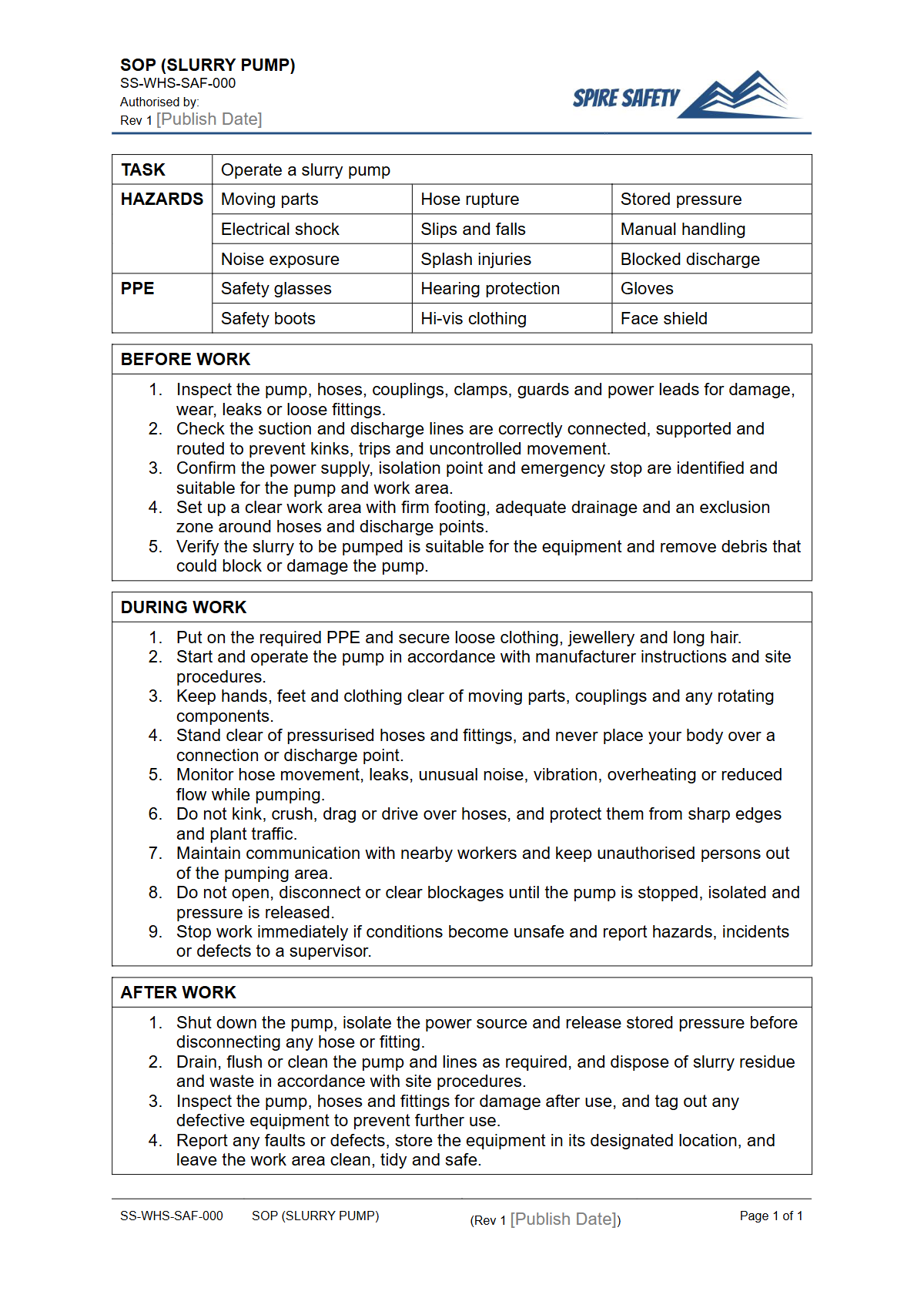
This free Safe Operating Procedure (Slurry Pump) Template provides a structured starting point for your organisation to document and formalise the required steps for safely operating this machinery. It helps you manage risks by outlining pre-start checks, operational steps, shutdown procedures, and emergency responses.
Using a documented SOP is a key part of an effective safety management system. It ensures work is performed consistently and safely, provides a clear training resource for new operators, and demonstrates due diligence in meeting your WHS obligations.
This template is designed to be adapted to the specific slurry pumps and working conditions at your site, forming a critical component of your overall risk management strategy. A well-developed SOP can be integrated into broader WHS management systems to ensure comprehensive safety coverage.
Video walkthrough
How to use the Free Safe Operating Procedure (Slurry Pump) Template
This template is provided as a customisable DOCX file, with a PDF version also available for easy printing and distribution. It is intended to be a foundational document that you must adapt to your specific operational needs.
Your final SOP should reflect the exact make and model of your slurry pumps, the types of slurries being handled, your site-specific hazards, and your organisation's existing safety policies.
Important: To be effective, this document requires customisation. We have included comments and prompts within the DOCX file to guide you through the process.
You must conduct a site-specific risk assessment and consult with operators, maintenance staff, and supervisors to ensure the final procedure is practical, comprehensive, and understood by all personnel. Generic procedures are not sufficient to manage risk effectively.
For related pumping equipment, you may also find our free Boom Pump SOP Template useful as a reference.
When to use a Safe Operating Procedure for a Slurry Pump
An SOP for a slurry pump should be used and readily accessible at all times the equipment is in operation or undergoing maintenance. Specifically, it should be consulted:
- During operator training: As a core training document for new or refresher training.
- Before starting the pump: To guide operators through mandatory pre-operational safety checks.
- During operation: As a reference for correct operating parameters and hazard controls.
- For maintenance and cleaning: To ensure lockout/tagout, de-pressurisation, and safe handling procedures are followed.
- In an emergency: To guide the response to blockages, spills, or equipment failure.
- During safety audits and incident investigations: As a benchmark for expected safe work practices. Regular reviews can be part of your formal WHS compliance auditing program.
Who should use this Safe Operating Procedure
This SOP is intended for all personnel involved with the lifecycle of slurry pumps within your organisation. This includes:
- Plant Operators: The primary users, who must understand and follow the procedure for every task.
- Maintenance Staff: Personnel responsible for servicing, repairing, and cleaning the pumps must adhere to the specified safety, isolation, and de-pressurisation steps.
- Supervisors and Managers: Responsible for ensuring the SOP is implemented, operators are trained, and compliance is maintained. They also play a key role in the review and update process.
- WHS Professionals: To integrate the SOP into the broader safety management system and use it as a tool for risk assessment and training needs analysis.
Effective management of equipment like slurry pumps often involves associated machinery. For example, procedures for feeding or clearing material from the pump may require a separate SOP, such as our free Conveyer System SOP Template if a conveyor is used. Similarly, if the pump is powered pneumatically, our Free Air Compressor SOP Template will be a valuable companion document. You can find these and more in our complete free WHS resources library.
Common mistakes
Common mistakes to avoid
- Failing to fully isolate and de-pressurise the system, including both suction and discharge lines, before starting maintenance.
- Neglecting to wear the correct PPE for the specific chemical and physical hazards of the slurry being pumped.
- Attempting to clear a blockage without shutting down and locking out the pump's power source.
- Ignoring unusual noises, vibrations, or leaks, which are often early warning signs of impending mechanical failure.
Legal references
Legal considerations
The following legal requirements may be relevant to this type of work.
- Work Health and Safety Act (Harmonised) — Provides the primary duties for protecting workers and other people from work health and safety risks.
- Work Health and Safety Regulations (Harmonised) — Sets out requirements supporting the management of workplace hazards and risks.
The following codes may be relevant to this type of work.
- Managing WHS Risks Code of Practice — Provides practical guidance on identifying hazards, assessing risks and applying effective controls.
- Work Health and Safety Consultation, Cooperation and Coordination Code of Practice — Provides practical guidance on consulting workers and coordinating with other duty holders.
- Managing the Work Environment and Facilities Code of Practice — Provides practical guidance on safe work environments, workplace facilities and related controls.
Did you know
Abrasive Power
The abrasive nature of many slurries, like those containing sand or ore, means pump components such as impellers and liners can wear out extremely quickly. This makes frequent inspection a critical safety task to prevent high-pressure failures.
Blockage Danger
A blocked discharge line on a running slurry pump can cause system pressure to build to dangerous levels in seconds. This stored energy creates a major hazard during attempts to clear the blockage, potentially leading to violent ejection of material or equipment rupture.
FAQ
Frequently asked questions
01What are the main hazards of operating a slurry pump?
02Does a Safe Operating Procedure replace the manufacturer's manual?
03How often should a slurry pump SOP be reviewed?
04Is training required in addition to an SOP?
Share this resource
Free Safe Operating Procedure (Slurry Pump) Template
Browse Categories
How To Use It
- 1Download and open in Word or PDF.
- 2Replace the placeholders with your business details.
- 3Get it reviewed by a WHS specialist before rollout.
Need it customised?
Our WHS consultants can adapt this template to your site, run a gap analysis, or audit what you already have in place.
Book a Free Consultation WHS consulting servicesor call 1300 156 382
Related templates
- Free Safe Operating Procedure (Slush Machine) Template
- Free Safe Operating Procedure (Smoke Damper Test) Template
- Free Safe Operating Procedure (Smoke Detector Test) Template
- Free Safe Operating Procedure (Smoke Machine) Template
- Free Safe Operating Procedure (Smoke Stain Removal) Template
- Free Safe Operating Procedure (Snorkel Equipment) Template