
Free Safe Operating Procedure (Slotting Machine) Template
Download our free Slotting Machine Safe Operating Procedure template to formalise safe work practices. This document helps you meet your WHS duties.
Free Safe Operating Procedure (Slotting Machine) Template
DOCX • 126 KB + PDF
Updated Oct 2026
No signup required
Purpose of the Free Safe Operating Procedure (Slotting Machine) Template
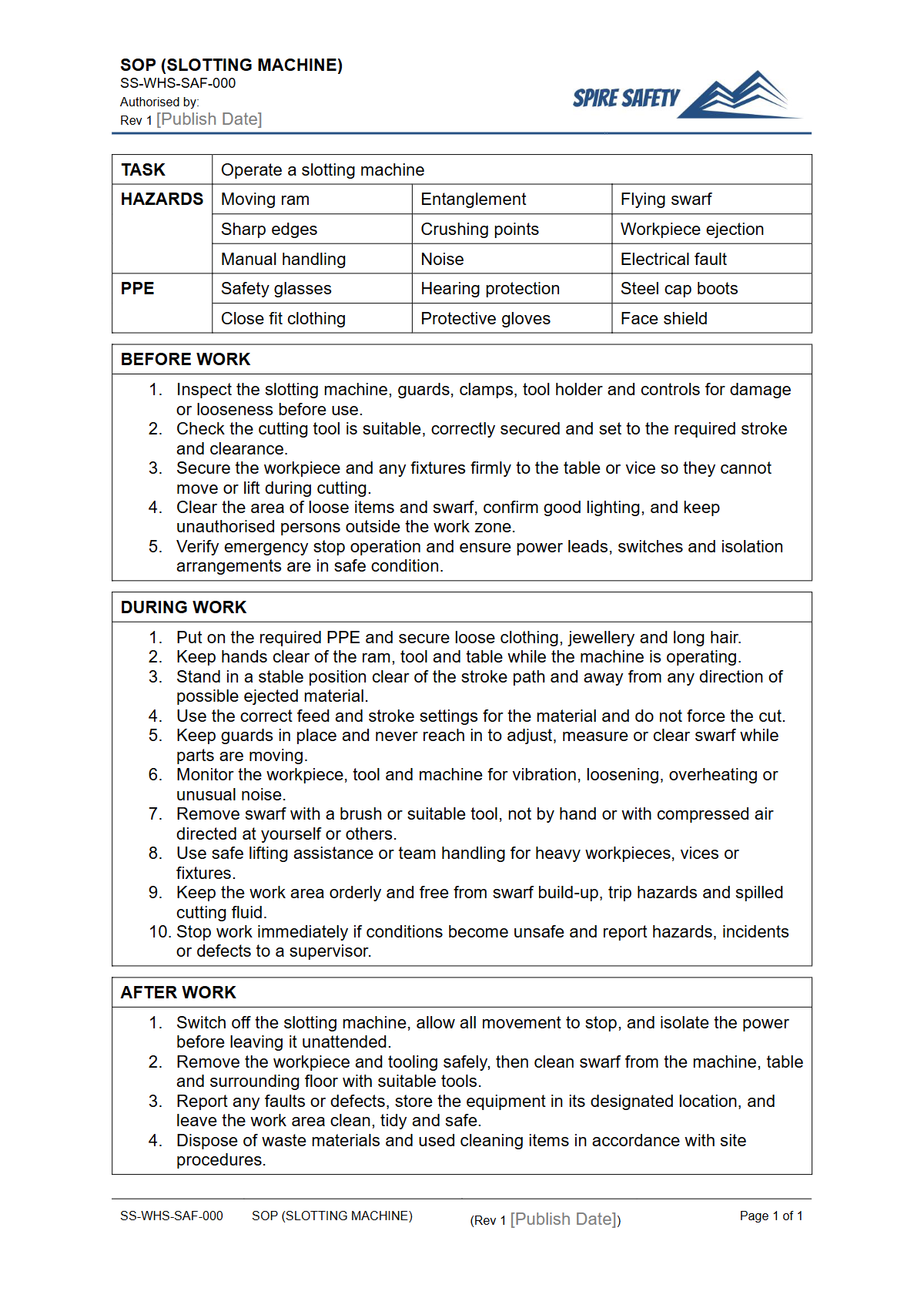
This Free Safe Operating Procedure (Slotting Machine) Template provides a structured framework for documenting the required steps to operate a slotting machine safely. Developing and implementing a clear SOP is a critical step in managing workplace risks, helping Persons Conducting a Business or Undertaking (PCBUs) fulfil their primary duty of care under Australian WHS legislation.
The document guides you through outlining hazards, specifying personal protective equipment (PPE), and detailing step-by-step instructions for pre-start checks, operation, shutdown, and maintenance tasks.
A robust SOP is a fundamental component of a comprehensive WHS management system, providing a consistent benchmark for training, supervision, and performance monitoring. By formally documenting safe work methods, you reduce the risk of incidents, injuries, and damage to plant associated with slotting machine use.
This template is designed as a starting point, based on the model WHS framework and principles of risk management.
Video walkthrough
How to use the Free Safe Operating Procedure (Slotting Machine) Template
To effectively implement the Free Safe Operating Procedure (Slotting Machine) Template, download the DOCX file and adapt it to your specific operational context. It is crucial to engage in consultation with the workers who operate the machinery and their supervisors during the drafting process.
Their practical experience is invaluable for identifying all relevant hazards and establishing effective, realistic control measures. A thorough risk assessment should be conducted or reviewed before finalising the SOP.
Important: This is a template, not a finished document. You must customise it to reflect your specific slotting machine model, the materials being processed, your workplace environment, and existing control measures.
We have provided a general framework, but it is your responsibility as the PCBU to ensure the final SOP is specific and adequate for your site's unique risks.
Key Components in the Template
Our template prompts you to detail several critical safety areas, ensuring a thorough procedure. These sections include:
- Required PPE: Specify mandatory personal protective equipment, such as safety glasses, hearing protection, and steel-capped boots.
- Hazard Identification: List potential hazards associated with the machine, including moving parts, entanglement risks, swarf, noise, and electrical dangers.
- Pre-Operational Checks: Outline a checklist for operators to complete before starting work, such as inspecting guarding, checking emergency stops, and ensuring the work area is clear.
- Operating Steps: Detail the sequential actions for safely setting up, operating, and making adjustments to the slotting machine. Just as with handheld tools, where a Circular Saw SOP outlines specific dangers, this section prompts you to detail the unique steps for your machine.
- Shut Down and Cleaning: Provide clear instructions for powering down the machine, isolating it from energy sources, and performing end-of-shift cleaning.
- Emergency Procedures: Describe the immediate actions to take in case of an emergency, such as machine malfunction or operator injury.
When to use a Slotting Machine SOP
A Safe Operating Procedure for a slotting machine should be used as a core part of your safety processes. It is essential before any worker operates the equipment for the first time and serves as a key document during their induction and training.
Operators should refer to the SOP to refresh their knowledge, particularly for non-routine tasks or after a period of absence. It is also a vital reference tool for supervisors conducting workplace observations. For larger operations that integrate different types of machinery, ensuring procedural consistency is key, much like you would for a Conveyer System SOP.
Furthermore, the SOP is an indispensable document during incident investigations. It provides a benchmark of the expected safe practice against which the actual events of an incident can be compared, helping to identify procedural gaps or training deficiencies.
If your workshop also utilises other equipment, you may find our free Dowelling Machine SOP template a useful reference for creating consistent documentation across the facility.
Who should use this SOP
This SOP is primarily intended for machine operators, apprentices, and any other workers tasked with using the slotting machine. It gives them a clear, accessible guide to performing their work safely and correctly.
Supervisors and team leaders should also use the SOP to train new staff, monitor work practices, and ensure consistent adherence to safety standards. WHS managers and safety representatives will use the document as part of the broader risk management framework.
Regular reviews of SOPs are a key activity checked during a WHS compliance audit to verify that safety processes are current and effective.
By implementing and consistently enforcing this SOP, you create a safer, more predictable, and more productive environment for everyone. For more tools to support your safety framework, browse our complete free WHS resources library, which includes documents like our Free Air Compressor SOP template that cover common workshop plant.
Common mistakes
Common mistakes to avoid
- Using the generic template without customising it for the specific machine model and workplace.
- Failing to train all operators on the finalised SOP and document the training.
- Not consulting experienced operators during the development of the procedure.
- Forgetting to review and update the SOP after an incident or when a process changes.
Legal references
Legal considerations
The following legal requirements may be relevant to this type of work.
- Work Health and Safety Act (Harmonised) — Provides the primary duties for protecting workers and other people from work health and safety risks.
- Work Health and Safety Regulations (Harmonised) — Sets out requirements supporting the management of workplace hazards and risks.
The following codes may be relevant to this type of work.
- Managing WHS Risks Code of Practice — Provides practical guidance on identifying hazards, assessing risks and applying effective controls.
- Work Health and Safety Consultation, Cooperation and Coordination Code of Practice — Provides practical guidance on consulting workers and coordinating with other duty holders.
- Managing the Work Environment and Facilities Code of Practice — Provides practical guidance on safe work environments, workplace facilities and related controls.
Did you know
Hierarchy of Control
An SOP is an administrative control, which is the fourth level in the hierarchy of risk control. Before relying on an SOP, a PCBU must first try to eliminate the hazard, substitute it, or isolate it with engineering controls like machine guarding.
Machine Guarding
Inadequate machine guarding is one of the most common causes of workplace injury. A thorough SOP pre-start check must always include verifying that all guards are in place, secure, and functioning correctly.
FAQ
Frequently asked questions
01What is a Safe Operating Procedure (SOP) for a slotting machine?
02Who is responsible for writing a slotting machine SOP?
03How often should a slotting machine SOP be reviewed?
04Is training required after creating a slotting machine SOP?
Share this resource
Free Safe Operating Procedure (Slotting Machine) Template
Browse Categories
How To Use It
- 1Download and open in Word or PDF.
- 2Replace the placeholders with your business details.
- 3Get it reviewed by a WHS specialist before rollout.
Need it customised?
Our WHS consultants can adapt this template to your site, run a gap analysis, or audit what you already have in place.
Book a Free Consultation WHS consulting servicesor call 1300 156 382
Related templates
- Free Safe Operating Procedure (Slump Testing) Template
- Free Safe Operating Procedure (Slurry Pump) Template
- Free Safe Operating Procedure (Slush Machine) Template
- Free Safe Operating Procedure (Smoke Damper Test) Template
- Free Safe Operating Procedure (Smoke Detector Test) Template
- Free Safe Operating Procedure (Smoke Machine) Template