
Free Safe Operating Procedure (Sling Label Inspection) Template
Ensure your lifting operations are safe by regularly inspecting sling labels for crucial safety information.
Free Safe Operating Procedure (Sling Label Inspection) Template
DOCX • 126 KB + PDF
Updated Oct 2026
No signup required
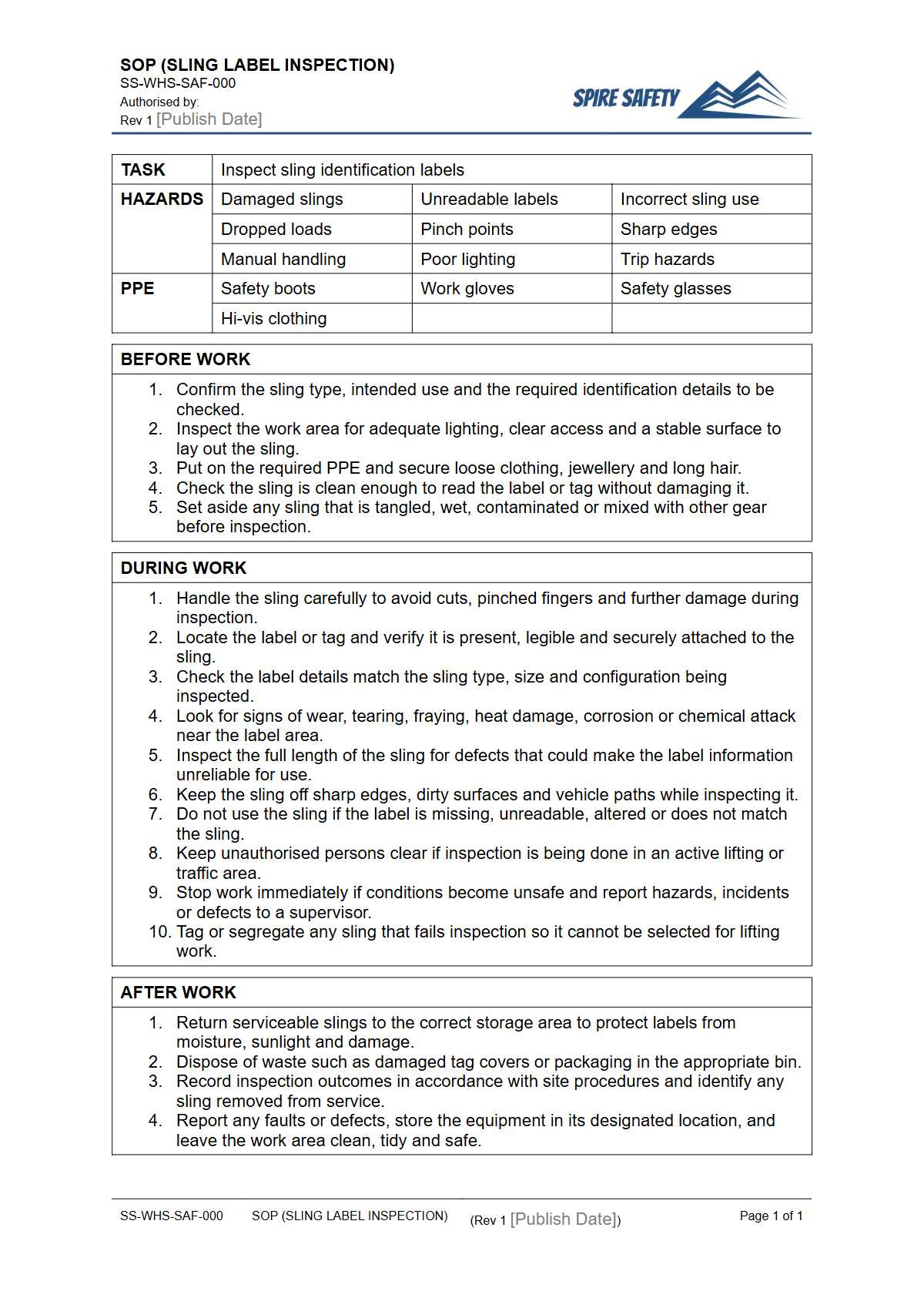
Purpose of the Free Safe Operating Procedure (Sling Label Inspection) Template
Lifting slings are fundamental to many industrial, construction, and logistical tasks. The small label or tag attached to a sling contains its most critical safety information, including the Working Load Limit (WLL), manufacturer details, and date of manufacture.
A faded, damaged, or missing label renders a sling non-compliant and dangerous, as its capacity cannot be verified. This Free Safe Operating Procedure (Sling Label Inspection) Template provides a structured framework for ensuring these labels are consistently and correctly inspected before use.
Formalising this process helps prevent catastrophic failures caused by overloading or using inappropriate equipment.
Implementing robust SOPs is a cornerstone of effective safety management. This procedure helps an organisation meet its duty of care by establishing a clear, repeatable process for a high-risk task.
It forms part of a broader commitment to workplace safety, fitting seamlessly into comprehensive WHS management systems that protect workers and ensure operational continuity.
Video walkthrough
How to use the Free Safe Operating Procedure (Sling Label Inspection) Template
This resource is available in both DOCX and PDF formats. The DOCX file is fully editable, allowing you to tailor the procedure to your specific operational context.
The PDF version is ideal for quick printing and distribution once your customisations are complete.
To adapt the template:
- Review each section and add or remove steps to align with your site's specific types of slings (e.g., synthetic, chain, wire rope), environment, and existing safety protocols.
- Insert company-specific details, such as the names or roles of responsible persons and the location of quarantine areas for defective equipment.
- Integrate the procedure into your training and induction programs for all relevant personnel, including operators, riggers, and supervisors.
Important: This document is a template and serves as a starting point. We are not your workplace.
You MUST customise this document to reflect your specific equipment, risk profile, and local regulatory requirements. For machinery-specific procedures, you might also require documents like our FREE Telehandler SOP Template to cover the entire task.
When to conduct a Sling Label Inspection
A sling label inspection is not a one-off event. This Safe Operating Procedure should be integrated into your daily workflow and periodic safety checks. The procedure should be followed:
- Before every use: As a mandatory pre-use check, the operator or rigger must verify the label is present, legible, and that the sling's WLL is appropriate for the intended lift.
- During scheduled periodic inspections: As part of a more thorough examination of all lifting gear (e.g., monthly or quarterly), labels should be checked for degradation, security, and continued legibility.
- After any incident: If a sling is involved in a shock load, is nearly damaged, or used in harsh conditions (e.g., exposure to chemicals or extreme heat), a full inspection of both the sling and its label is required before it is returned to service.
Regularly verifying that these procedures are being followed is also critical. An independent review can identify gaps in your process, which is a key function of a WHS compliance auditing program.
Who should use this SOP
This Safe Operating Procedure is intended for all personnel involved in or responsible for lifting operations. This includes:
- Equipment Operators: Crane, hoist, and forklift operators who attach and use slings.
- Doggers and Riggers: Workers specifically trained in selecting, inspecting, and directing the use of lifting equipment.
- Supervisors and Team Leaders: Individuals responsible for overseeing work and ensuring safety procedures are followed on the ground.
- WHS Officers and Managers: Safety professionals responsible for developing, implementing, and reviewing workplace safety systems.
- Maintenance Personnel: Staff who conduct periodic inspections and manage the storage and certification of lifting gear.
For organisations facing complex lifting scenarios or needing guidance on developing a complete lifting equipment management program, our expert WHS consulting services can provide tailored support. This template is one of many documents we offer to support your internal processes, which may also include procedures for other workshop equipment like the one outlined in our Free Air Compressor SOP Template. For more guides, checklists, and templates, explore our complete free WHS resources library.
Common mistakes
Common mistakes to avoid
- Assuming a new-looking sling has a valid and legible label without checking.
- Guessing the Working Load Limit (WLL) when a label is illegible or smudged.
- Failing to formally quarantine and tag a sling that has a defective or missing label.
- Only checking the label and neglecting to inspect the body of the sling for wear, cuts, or damage.
Legal references
Legal considerations
The following legal requirements may be relevant to this type of work.
- Work Health and Safety Act (Harmonised) — Provides the primary duties for protecting workers and other people from work health and safety risks.
- Work Health and Safety Regulations (Harmonised) — Sets out requirements supporting the management of workplace hazards and risks.
The following codes may be relevant to this type of work.
- Managing WHS Risks Code of Practice — Provides practical guidance on identifying hazards, assessing risks and applying effective controls.
- Work Health and Safety Consultation, Cooperation and Coordination Code of Practice — Provides practical guidance on consulting workers and coordinating with other duty holders.
- Managing the Work Environment and Facilities Code of Practice — Provides practical guidance on safe work environments, workplace facilities and related controls.
Did you know
Colour Coding
Many sites use a colour-coding system for periodic inspections, attaching a coloured tag for each quarter. This provides an immediate visual cue that a sling is within its current inspection period.
Material Matters
Different sling materials like synthetic webbing, chain, and wire rope have different vulnerabilities. Labels often specify these materials, which dictates inspection criteria for cuts, corrosion, or heat damage.
FAQ
Frequently asked questions
01What information should be on a lifting sling label in Australia?
02How often should sling labels be inspected?
03What happens if a sling label is missing or unreadable?
04Can I use a durable tag instead of a sewn-in label on a sling?
Share this resource
Free Safe Operating Procedure (Sling Label Inspection) Template
Browse Categories
How To Use It
- 1Download and open in Word or PDF.
- 2Replace the placeholders with your business details.
- 3Get it reviewed by a WHS specialist before rollout.
Need it customised?
Our WHS consultants can adapt this template to your site, run a gap analysis, or audit what you already have in place.
Book a Free Consultation WHS consulting servicesor call 1300 156 382
Related templates
- Free Safe Operating Procedure (Sling Selection Check) Template
- Free Safe Operating Procedure (Slitting Line) Template
- Free Safe Operating Procedure (Slotting Machine) Template
- Free Safe Operating Procedure (Slump Testing) Template
- Free Safe Operating Procedure (Slurry Pump) Template
- Free Safe Operating Procedure (Slush Machine) Template