
Free Safe Operating Procedure (Sling Selection Check) Template
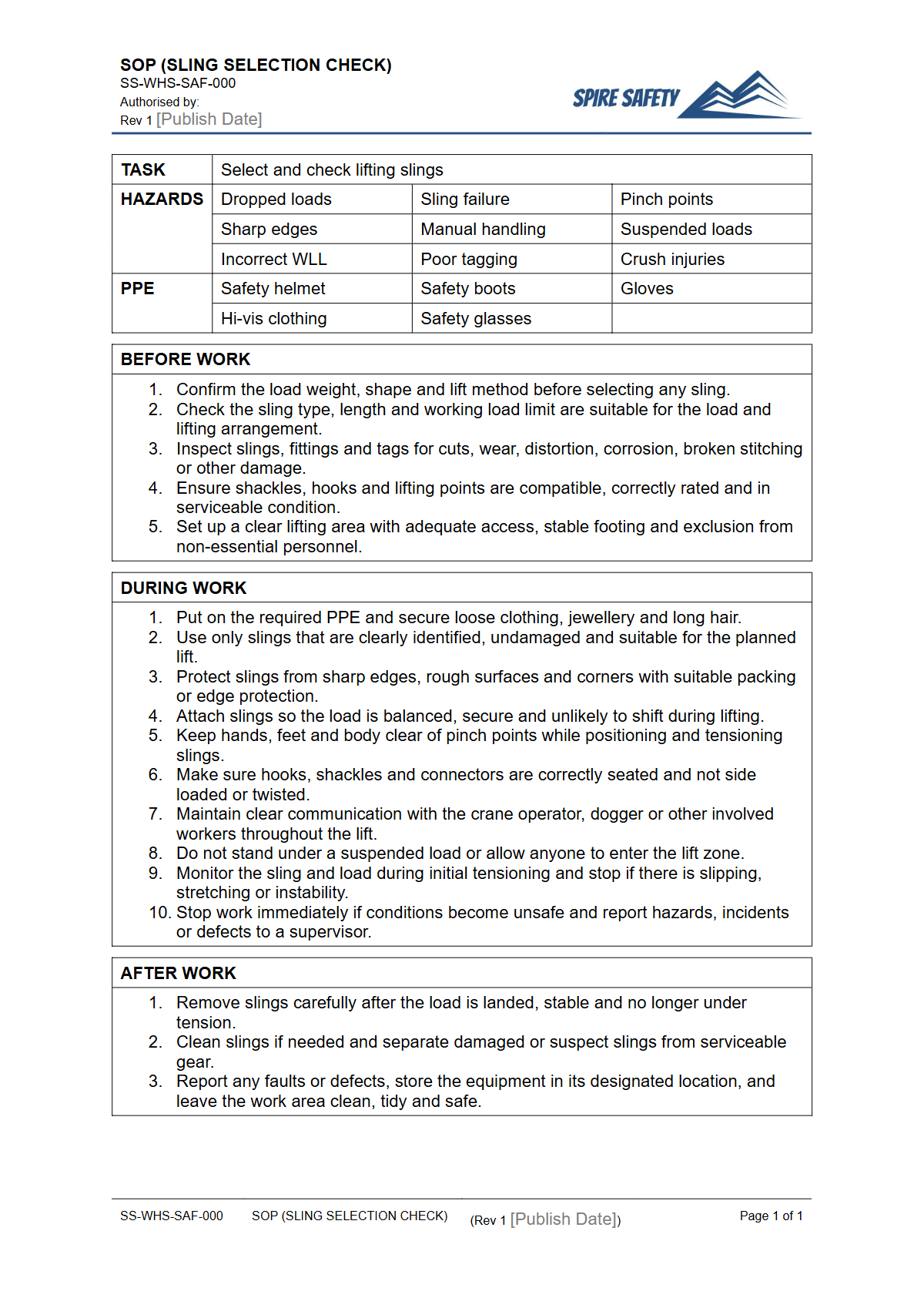
Download our free Safe Operating Procedure (Sling Selection Check) template to formalise lifting safety. This customisable DOCX helps ensure correct sling use.
Free Safe Operating Procedure (Sling Selection Check) Template
DOCX • 126 KB + PDF
Updated Oct 2026
No signup required
Purpose of the Free Safe Operating Procedure (Sling Selection Check) Template
Lifting operations present significant risks, and incorrect sling selection is a common factor in incidents involving dropped loads. This Free Safe Operating Procedure (Sling Selection Check) Template provides a structured framework for ensuring that personnel consistently choose the appropriate lifting gear for every task.
Using this SOP helps your organisation formalise safety protocols, reduce the risk of equipment damage and worker injury, and demonstrate a commitment to safe systems of work. A well-defined procedure is a critical element for training, competency assessments, and creating a predictable, safe working environment.
Implementing specific procedures like this is a practical step in building a comprehensive safety framework. This SOP should be integrated into your organisation's overall WHS management system to ensure it aligns with broader policies and objectives for workplace health and safety.
How to use the Free Safe Operating Procedure (Sling Selection Check) Template
This template is available as a DOCX file for easy customisation and a PDF for straightforward printing and distribution. It is designed as a starting point, providing a logical structure and key safety considerations based on Australian WHS principles.
IMPORTANT: This document is a template only. We have created it as a guide, and you must customise it to reflect the specific hazards, equipment (e.g., chain, synthetic, or wire rope slings), personnel, and procedures of your workplace.
We recommend a consultation process with your team, including operators and supervisors, to ensure the final SOP is practical, understood, and effective.
This procedure is often used in conjunction with equipment-specific instructions. For example, the checks outlined here would be essential when using lifting attachments on machinery, as detailed in our FREE Telehandler SOP Template.
Video walkthrough
When to use a Sling Selection Check
A thorough sling selection check is not a one-time activity. It is a critical safety behaviour that should be embedded into daily operations. This SOP should be referenced and its principles applied:
- Before every lift: The primary use is by the operator or rigger as a pre-task checklist to verify the suitability of the selected slings.
- During periodic inspections: The criteria within the SOP can inform the process for scheduled, in-depth inspections of all lifting gear by a competent person.
- For training and inductions: Use the documented procedure as a tool to train new workers or refresh the skills of existing employees on safe lifting practices.
- Following an incident or near-miss: The SOP serves as a benchmark to review what went wrong and identify gaps in procedure or understanding. Regular reviews and updates are also vital for maintaining safety standards, often forming part of routine WHS compliance auditing.
Who should use this Safe Operating Procedure
This Safe Operating Procedure is intended for all personnel involved in planning, supervising, or executing lifting operations. This includes:
- Doggers and Riggers: As the primary users responsible for selecting, inspecting, and attaching slings.
- Crane and Plant Operators: Individuals operating equipment like mobile cranes, gantry cranes, or forklifts with lifting jibs who need to verify the rigging is safe before taking the load.
- Supervisors and Team Leaders: To oversee lifting operations, confirm procedures are being followed, and provide guidance.
- WHS and Safety Officers: For use in developing site-wide safety standards, conducting risk assessments, and delivering training.
A PCBU has a primary duty of care to ensure the provision and maintenance of safe plant and structures, and safe systems of work. Documenting procedures for high-risk tasks is a fundamental part of fulfilling this duty, whether it's for lifting gear or for other machinery outlined in resources like our FREE Conveyer System SOP (Safe Operating Procedure) Template.
Common mistakes
Common mistakes to avoid
- Using damaged, worn, or untagged slings.
- Ignoring the sling angle and its significant effect on the Working Load Limit (WLL).
- Selecting a sling based only on its WLL without considering the load's shape, centre of gravity, or sharp edges.
- Failing to use protective padding on sharp corners, which can lead to catastrophic sling failure.
Legal references
Legal considerations
The following legal requirements may be relevant to this type of work.
- Work Health and Safety Act (Harmonised) — Provides the primary duties for protecting workers and other people from work health and safety risks.
- Work Health and Safety Regulations (Harmonised) — Sets out requirements supporting the management of workplace hazards and risks.
The following codes may be relevant to this type of work.
- Managing WHS Risks Code of Practice — Provides practical guidance on identifying hazards, assessing risks and applying effective controls.
- Work Health and Safety Consultation, Cooperation and Coordination Code of Practice — Provides practical guidance on consulting workers and coordinating with other duty holders.
- Managing the Work Environment and Facilities Code of Practice — Provides practical guidance on safe work environments, workplace facilities and related controls.
Did you know
Sling Angle Matters
Increasing the angle between a sling's legs significantly reduces its safe lifting capacity. A 60-degree angle reduces capacity by about 13%, but an angle of 120 degrees can reduce it by 50%.
FAQ
Frequently asked questions
01Is this sling selection SOP template ready to use immediately?
02What should be included in a sling selection check?
03How often should lifting slings be inspected in Australia?
04Who is considered a 'competent person' for sling inspections?
Share this resource
Free Safe Operating Procedure (Sling Selection Check) Template
Browse Categories
How To Use It
- 1Download and open in Word or PDF.
- 2Replace the placeholders with your business details.
- 3Get it reviewed by a WHS specialist before rollout.
Need it customised?
Our WHS consultants can adapt this template to your site, run a gap analysis, or audit what you already have in place.
Book a Free Consultation WHS consulting servicesor call 1300 156 382
Related templates
- Free Safe Operating Procedure (Slitting Line) Template
- Free Safe Operating Procedure (Slotting Machine) Template
- Free Safe Operating Procedure (Slump Testing) Template
- Free Safe Operating Procedure (Slurry Pump) Template
- Free Safe Operating Procedure (Slush Machine) Template
- Free Safe Operating Procedure (Smoke Damper Test) Template