
Free Safe Operating Procedure (Skirting Board Clean) Template
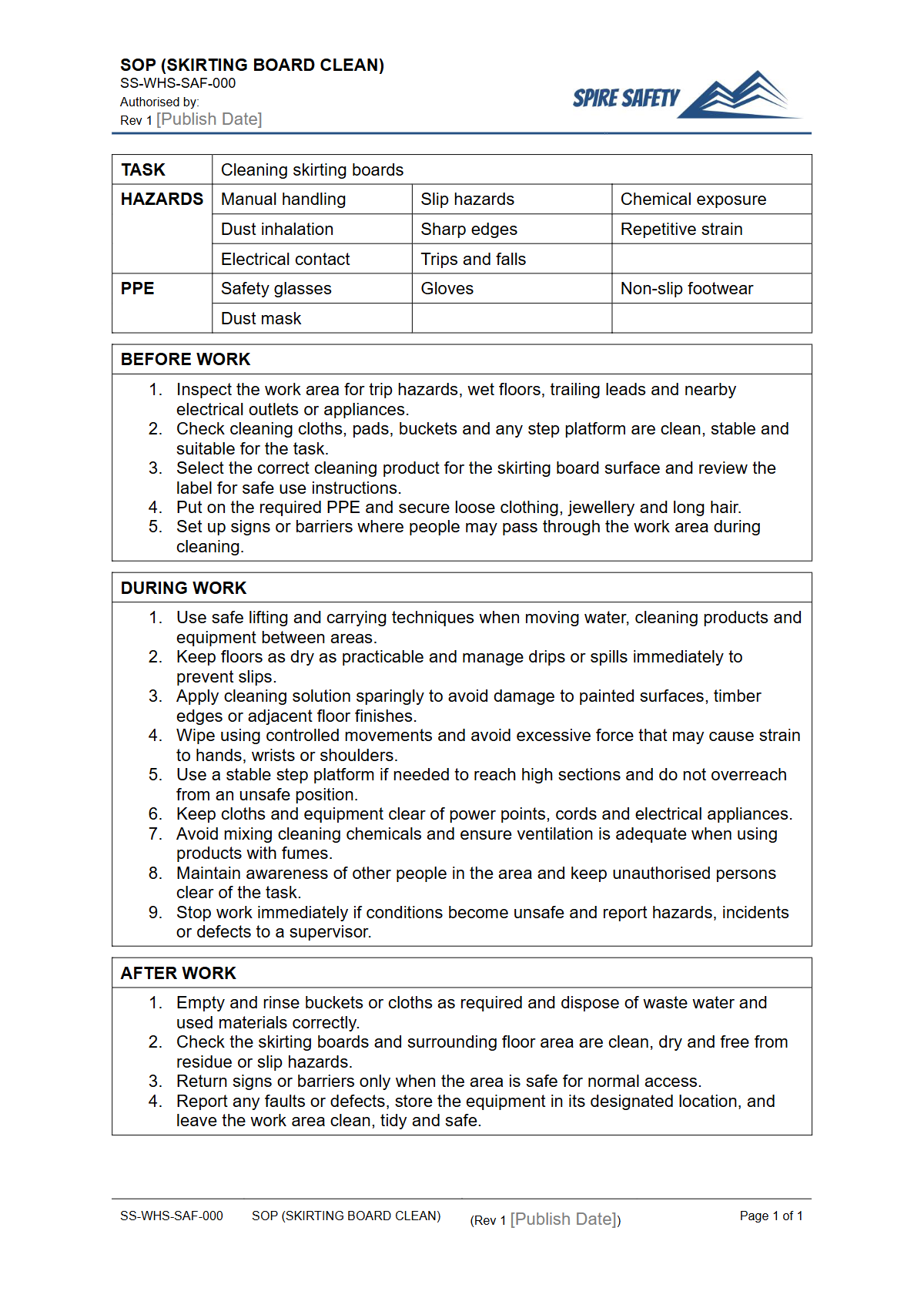
Download our free Safe Operating Procedure (Skirting Board Clean) Template. This structured DOCX and PDF document helps outline safe work practices.
Free Safe Operating Procedure (Skirting Board Clean) Template
DOCX • 126 KB + PDF
Updated Oct 2026
No signup required
Purpose of the Free Safe Operating Procedure (Skirting Board Clean) Template
This free Safe Operating Procedure (Skirting Board Clean) template provides a foundation for documenting the safest way to perform this common but often overlooked maintenance task. While seemingly simple, cleaning skirting boards can introduce hazards such as musculoskeletal injuries from awkward postures, exposure to cleaning chemicals, and slips, trips, and falls.
Using a formal SOP helps to standardise the cleaning process, providing a clear and repeatable guide for workers to follow.
A documented procedure is a critical tool for training new staff and serves as a benchmark for performance and safety compliance. Implementing this SOP demonstrates a commitment to managing workplace risks, forming an essential part of your organisation's overall WHS management systems. It ensures that every person performing the task understands the identified hazards and the required control measures, from personal protective equipment (PPE) to correct manual handling techniques.
Video walkthrough
How to use the Free Safe Operating Procedure (Skirting Board Clean) Template
This resource is available for download as a DOCX file, which is fully editable in Microsoft Word, and a PDF for easy reference. The template is designed as a structured starting point, aligned with Australian WHS best practices, to guide you in developing a procedure specific to your operational needs.
It is not a complete, out-of-the-box solution.
Important: We have provided a general framework, but you must customise this SOP to reflect the unique environment of your workplace. This involves identifying the specific cleaning chemicals used (and referencing their Safety Data Sheets), the types of flooring surfaces, the tools required, and any site-specific hazards.
Consultation with the workers who will be performing the task is a crucial step in this process to ensure the SOP is practical and effective.
If you need expert assistance in developing or reviewing your safety documentation to ensure it is robust and fit-for-purpose, our WHS consulting team can help tailor procedures to your exact requirements.
When to use it
A Safe Operating Procedure for cleaning skirting boards should be developed and implemented before any worker is assigned the task. It should be used as a primary training document for new employees, contractors, or any staff member unfamiliar with the procedure.
It also serves as a vital reference during safety talks or toolbox meetings to refresh knowledge on correct techniques and hazard controls.
The SOP is also a key document for review after any incident or near-miss related to the task. Furthermore, it should be periodically reviewed and updated as part of your scheduled safety management processes, especially if new chemicals, tools, or work methods are introduced.
Just as a step ladder SOP is required before using ladders, this procedure should be established and understood before any skirting board cleaning commences.
Who should use it
This SOP is intended for several groups within an organisation. Primarily, it is for the workers who physically perform the cleaning tasks, including dedicated cleaners, maintenance personnel, or general staff.
It provides them with clear, step-by-step instructions to complete their work safely. Supervisors and managers should also use the SOP to induct workers, monitor safe work practices, and supports your compliance efforts with the established procedure.
WHS managers and safety representatives will use this template as the basis for creating a formal, site-specific document. The principles of documenting a safe process apply to all tasks, regardless of their perceived complexity.
Creating an SOP for a manual task like this follows the same logic as documenting the use of equipment covered in our free air compressor SOP template; the goal is always to identify risks and document controls. You can explore our complete free WHS resources library for more templates to support your safety management efforts.
Common mistakes
Common mistakes to avoid
- Using the template without customising it for the specific workplace, chemicals, and equipment.
- Failing to consult with workers who perform the task when developing the procedure.
- Not providing practical training on the finalised SOP before work commences.
- Neglecting to specify the exact type of PPE required, such as the correct type of gloves for the chemicals being used.
Legal references
Legal considerations
The following legal requirements may be relevant to this type of work.
- Work Health and Safety Act (Harmonised) — Provides the primary duties for protecting workers and other people from work health and safety risks.
- Work Health and Safety Regulations (Harmonised) — Sets out requirements supporting the management of workplace hazards and risks.
The following codes may be relevant to this type of work.
- Managing WHS Risks Code of Practice — Provides practical guidance on identifying hazards, assessing risks and applying effective controls.
- Work Health and Safety Consultation, Cooperation and Coordination Code of Practice — Provides practical guidance on consulting workers and coordinating with other duty holders.
- Managing the Work Environment and Facilities Code of Practice — Provides practical guidance on safe work environments, workplace facilities and related controls.
Did you know
Awkward Postures are a Major Risk
Work-related musculoskeletal disorders, often caused by sustained or repetitive awkward postures like bending and kneeling, are one of the most common forms of workplace injury in Australia.
SDS is Essential
For any cleaning chemical used, the Safety Data Sheet (SDS) is a critical document. It provides vital information on handling, storage, PPE, and first aid, which must be reflected in your SOP.
FAQ
Frequently asked questions
01What hazards are involved in cleaning skirting boards?
02Why do I need an SOP for a simple task like cleaning skirting boards?
03Can I use this template for other cleaning procedures?
04What key information should my customised SOP include?
Share this resource
Free Safe Operating Procedure (Skirting Board Clean) Template
Browse Categories
How To Use It
- 1Download and open in Word or PDF.
- 2Replace the placeholders with your business details.
- 3Get it reviewed by a WHS specialist before rollout.
Need it customised?
Our WHS consultants can adapt this template to your site, run a gap analysis, or audit what you already have in place.
Book a Free Consultation WHS consulting servicesor call 1300 156 382
Related templates
- Free Safe Operating Procedure (Slasher Mower) Template
- Free Safe Operating Procedure (Sling Label Inspection) Template
- Free Safe Operating Procedure (Sling Selection Check) Template
- Free Safe Operating Procedure (Slitting Line) Template
- Free Safe Operating Procedure (Slotting Machine) Template
- Free Safe Operating Procedure (Slump Testing) Template