
Free Safe Operating Procedure (Slasher Mower) Template
Download our free Safe Operating Procedure (Slasher Mower) template. This DOCX & PDF resource provides a structured guide for outlining safe work practices.
Free Safe Operating Procedure (Slasher Mower) Template
DOCX • 126 KB + PDF
Updated Oct 2026
No signup required
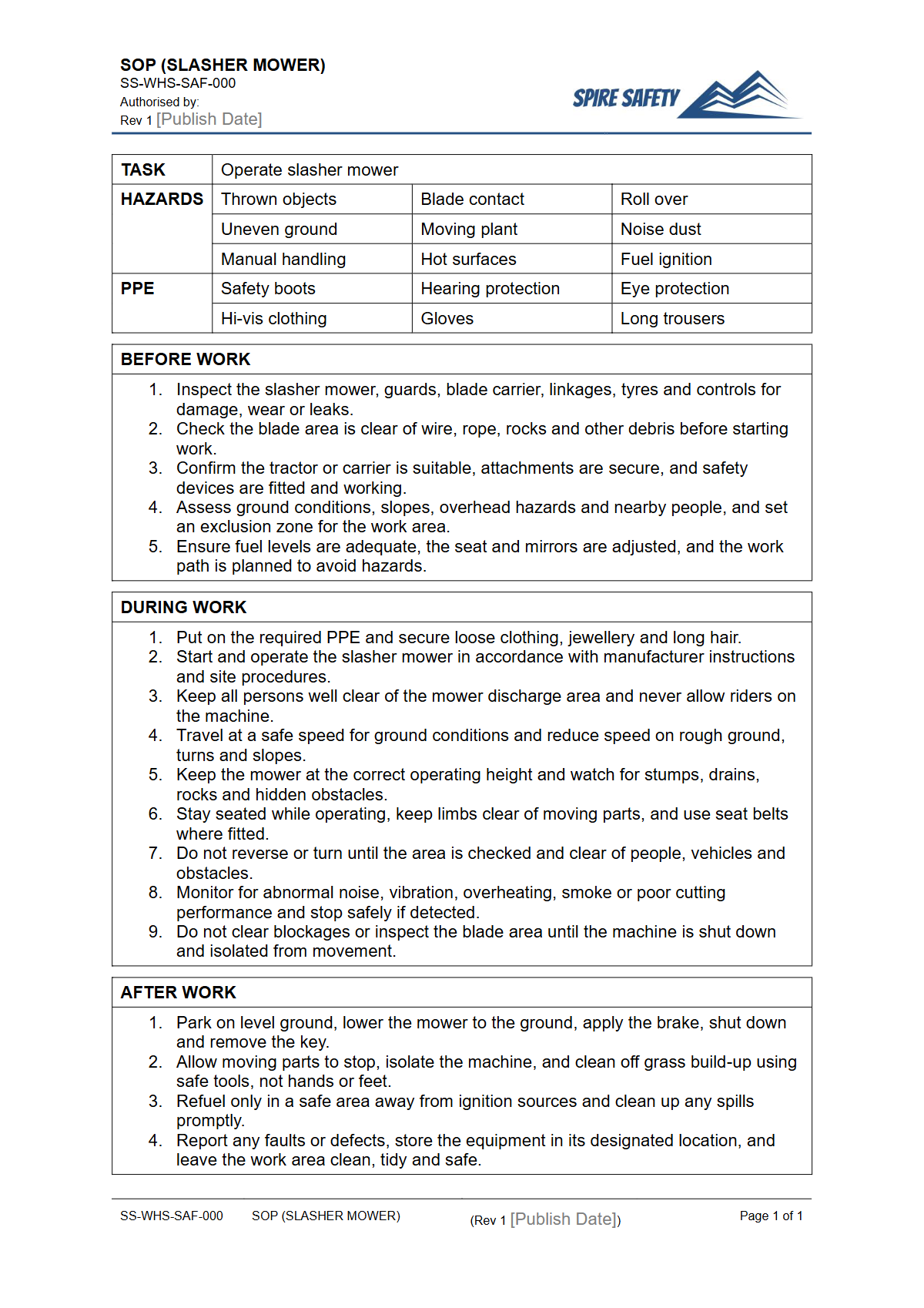
Purpose of the Free Safe Operating Procedure (Slasher Mower) Template
Operating a slasher mower, whether tractor-mounted or self-propelled, introduces significant workplace hazards including blade contact, entanglement, thrown objects, and rollovers. A documented Safe Operating Procedure (SOP) is an essential administrative control for managing these risks.
This free Safe Operating Procedure (Slasher Mower) Template provides a structured starting point for documenting the required steps for safe operation, from pre-start checks through to shutdown and maintenance.
Using a detailed SOP demonstrates a commitment to providing a safe system of work, which is a primary duty for any Person Conducting a Business or Undertaking (PCBU) under Australian WHS legislation. It serves as a vital tool for worker training, competency assessment, and ongoing supervision.
A well-implemented SOP helps to standardise behaviour, reduce the likelihood of incidents, and forms a critical component of broader, comprehensive WHS management systems that protect your workers and your organisation.
Hazards Addressed
This SOP template guides you to consider and control common hazards associated with slasher mowers, including:
- Contact with rotating blades or moving parts.
- Objects being struck and ejected at high velocity.
- Machine rollover on uneven, steep, or slippery terrain.
- Entanglement of clothing or limbs in power take-off (PTO) shafts.
- Noise and vibration exposure.
- Fire risk from fuel, hot components, and dry vegetation.
Video walkthrough
How to use the Free Safe Operating Procedure (Slasher Mower) Template
This resource is available for download as a fully editable DOCX file, allowing for easy customisation. After downloading, you will need to methodically work through each section and adapt the content to your specific operational context.
This includes adding details about the make and model of your slasher mower, your site-specific emergency procedures, and the exact personal protective equipment (PPE) required for the task.
Please note: We have developed this document as a template, not a finished, universally procedure. You must customise it to reflect the specific slasher mower models, work tasks, and unique environmental conditions at your worksite.
The responsibility for creating a safe system of work rests with the PCBU. This involves consulting with workers, undertaking a site-specific risk assessment, and ensuring the final SOP is practical and understood by all users.
When to use a Slasher Mower SOP
A Safe Operating Procedure for a slasher mower should be a living document integrated into your daily operations. It is not a document to be filed away and forgotten. Key times to use the SOP include:
- Worker Training and Induction: As a primary training document for new operators.
- Pre-operational Checks: To guide operators through mandatory daily inspections.
- Task Reference: As an on-the-job reference to reinforce correct procedures.
- Incident Investigations: To review whether established procedures were followed.
- Review and Improvement: As a baseline for periodic reviews of work practices.
The effectiveness of your SOPs should be reviewed regularly as part of a cycle of continuous improvement. This process can be formally verified through regular WHS compliance auditing to ensure the procedure remains current and effective.
Who should use this SOP
This template is designed for use by anyone responsible for workplace safety and the management of machinery. This includes:
- Business Owners and PCBUs: To fulfil their duty of care to provide safe systems of work.
- Managers and Supervisors: To train, supervise, and monitor the safe operation of slasher mowers.
- WHS Professionals: To develop and implement risk control measures for plant and equipment.
- Operators: As a clear and accessible guide for performing their work safely.
While this document is specifically for slasher mowers, you may also need a free Safe Operating Procedure for ride-on mower operation for other types of mowers on site. Managing a fleet of agricultural or construction plant often requires specific procedures for each machine, such as a dozer SOP template, to address their unique hazards.
This principle applies to all high-risk plant, where safety depends on clear instructions, such as those developed from a Telehandler SOP Template. Explore our full free WHS resources library for more templates to help you build out your safety management system.
Common mistakes
Common mistakes to avoid
- Failing to walk the area and identify hazards like stumps, rocks, or wire before starting work.
- Attempting to clear a blockage or perform maintenance without shutting down the engine and ensuring blades have completely stopped.
- Operating on excessively steep slopes or traversing them incorrectly, leading to instability.
- Allowing other people to be within the large exclusion zone required to protect from thrown objects.
Legal references
Legal considerations
The following legal requirements may be relevant to this type of work.
- Work Health and Safety Act (Harmonised) — Provides the primary duties for protecting workers and other people from work health and safety risks.
- Work Health and Safety Regulations (Harmonised) — Sets out requirements supporting the management of workplace hazards and risks.
The following codes may be relevant to this type of work.
- Managing WHS Risks Code of Practice — Provides practical guidance on identifying hazards, assessing risks and applying effective controls.
- Work Health and Safety Consultation, Cooperation and Coordination Code of Practice — Provides practical guidance on consulting workers and coordinating with other duty holders.
- Managing the Work Environment and Facilities Code of Practice — Provides practical guidance on safe work environments, workplace facilities and related controls.
Did you know
Projectile Hazard
Slasher mower blades can spin at speeds exceeding 250 km/h, capable of launching rocks, wire, and debris over 100 metres with enough force to cause serious injury or property damage.
Rollover Risk
Operating a tractor and slasher on slopes greater than 15 degrees dramatically increases the risk of a rollover, which is a leading cause of fatalities in agricultural machinery incidents.
FAQ
Frequently asked questions
01What should be included in a slasher mower SOP?
02Is a Safe Operating Procedure a legal requirement in Australia?
03How often should a slasher mower SOP be reviewed?
04Can this template be used for a standard ride-on mower?
Share this resource
Free Safe Operating Procedure (Slasher Mower) Template
Browse Categories
How To Use It
- 1Download and open in Word or PDF.
- 2Replace the placeholders with your business details.
- 3Get it reviewed by a WHS specialist before rollout.
Need it customised?
Our WHS consultants can adapt this template to your site, run a gap analysis, or audit what you already have in place.
Book a Free Consultation WHS consulting servicesor call 1300 156 382
Related templates
- Free Safe Operating Procedure (Sling Label Inspection) Template
- Free Safe Operating Procedure (Sling Selection Check) Template
- Free Safe Operating Procedure (Slitting Line) Template
- Free Safe Operating Procedure (Slotting Machine) Template
- Free Safe Operating Procedure (Slump Testing) Template
- Free Safe Operating Procedure (Slurry Pump) Template