
Free Safe Operating Procedure (Skip Bin Loading) Template
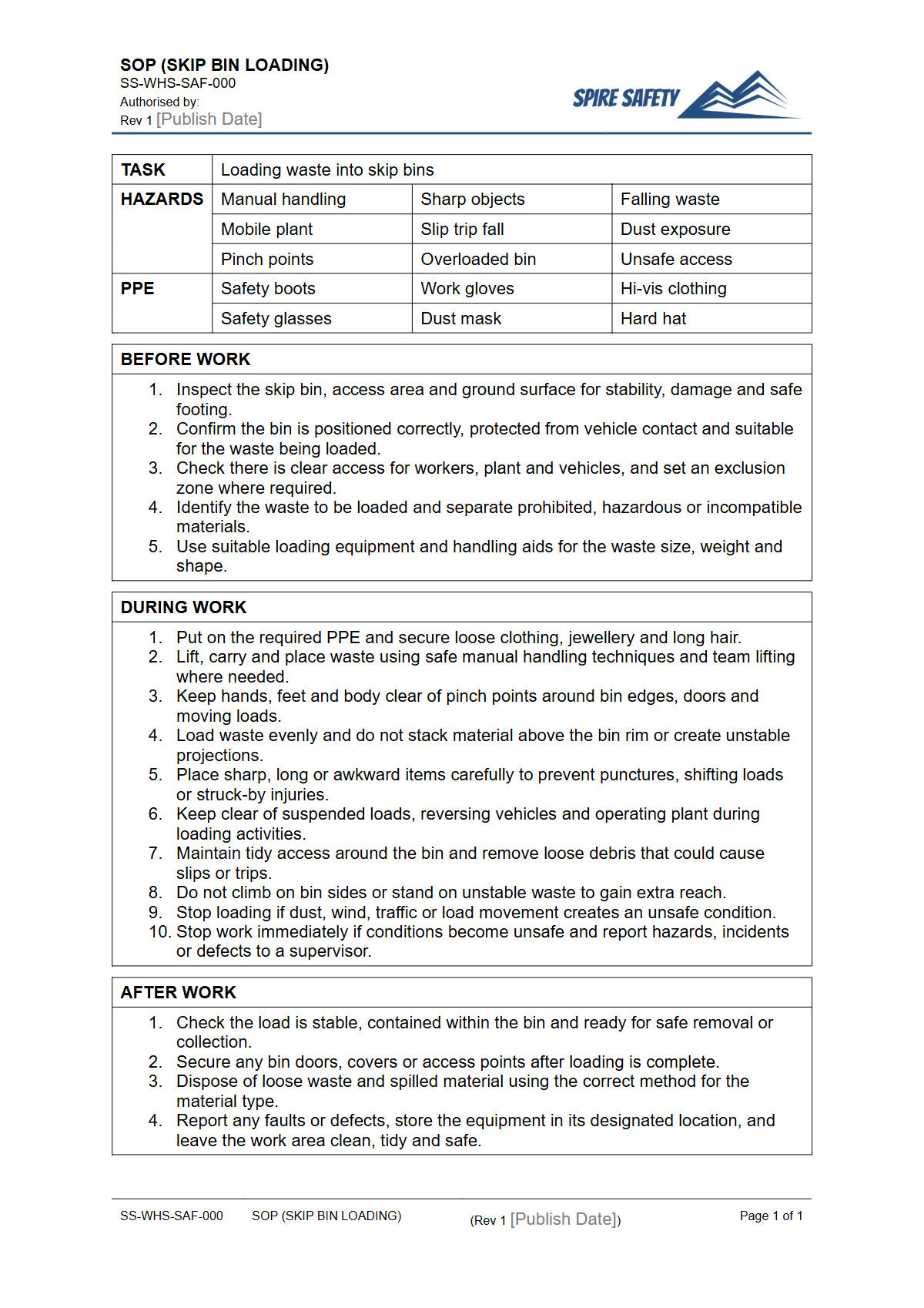
Download our free Safe Operating Procedure for skip bin loading. This template provides a structured starting point for developing workplace-specific safety controls.
Free Safe Operating Procedure (Skip Bin Loading) Template
DOCX • 126 KB + PDF
Updated Oct 2026
No signup required
Purpose of the Free Safe Operating Procedure (Skip Bin Loading) Template
Loading a skip bin, whether by hand or with machinery, involves significant risks that must be managed. This Free Safe Operating Procedure (Skip Bin Loading) Template provides a structured framework for documenting the safest way to perform this common task.
It helps your organisation standardise its approach, control hazards like manual handling injuries, falls, and being struck by objects, and provides a clear training resource for workers. By formalising these steps, you create a safer work environment and demonstrate a commitment to proactive risk management.
An effective SOP is a critical component of any workplace health and safety system.
This document guides users through identifying necessary personal protective equipment (PPE), outlining pre-operational checks, detailing the step-by-step loading process, and defining emergency procedures. For tasks involving heavy machinery, clear procedures are vital. If plant like a telehandler is used for loading, you should also have a specific procedure for its use, such as our free Telehandler SOP Template.
Video walkthrough
How to use the Free Safe Operating Procedure (Skip Bin Loading) Template
This template is provided in both DOCX and PDF formats for your convenience. The DOCX file is fully editable, allowing you to tailor it precisely to your workplace's unique requirements. To use the template effectively:
- Download the document and review its contents.
- Consult with workers and supervisors who perform or oversee skip bin loading tasks. Their practical experience is invaluable for identifying all relevant hazards.
- Conduct a site-specific risk assessment to identify controls for your specific bin types, waste materials, equipment, and work environment.
- Fill in the blank sections of the template with details specific to your organisation, including emergency contacts, required PPE, and site-specific rules.
- Once customised, have the SOP approved by the relevant manager or person in charge.
- Use the finalised SOP as a basis for training all relevant workers and keep it readily accessible for reference.
Important: This document is a template and not a complete Safe Operating Procedure. It must be customised to reflect the specific hazards and control measures relevant to your workplace.
Integrating this SOP into your broader WHS management systems ensures a consistent and systematic approach to safety across all operations.
When to use it
A Safe Operating Procedure for skip bin loading should be used consistently as a reference and training tool. It is particularly important in several key situations.
Use it during the induction of new employees or contractors who will be involved in waste disposal tasks. It should also form the basis of regular refresher training to prevent complacency and reinforce safe work habits.
Following any incident, near miss, or change in the work process (such as a new type of skip bin or loading equipment), the SOP should be reviewed and updated to ensure it remains effective. This process of review is a core part of continuous improvement in safety management, and if you require assistance, our WHS consulting team can provide expert guidance.
Who should use it
This SOP is designed for use by several key roles within an organisation. Workers who are directly responsible for loading skip bins must be trained on and follow the procedure to ensure their own safety and the safety of others around them.
Supervisors and Team Leaders should use the SOP to oversee the task, conduct pre-start checks, and ensure the documented safety controls are being implemented correctly. Finally, WHS Managers and Business Owners are responsible for ensuring that adequate procedures like this are developed, implemented, and regularly reviewed as part of their duty of care.
Using appropriate equipment for moving waste, like that covered in our free Scraper SOP (Safe Operating Procedure) Template, also requires clear operational guidelines for relevant personnel.
By ensuring everyone understands their role in the process, you can significantly reduce the risk of incidents. You can find more templates and checklists to support your safety system in our free WHS resources library.
Common mistakes
Common mistakes to avoid
- Overfilling the bin beyond the rim, creating a transport hazard.
- Placing the skip on soft, uneven, or sloped ground, leading to instability.
- Incorrect manual handling techniques, such as twisting the back while lifting.
- Throwing heavy or sharp objects into the bin from a distance, risking bounce-back or injury to others.
Legal references
Legal considerations
The following legal requirements may be relevant to this type of work.
- Work Health and Safety Act (Harmonised) — Provides the primary duties for protecting workers and other people from work health and safety risks.
- Work Health and Safety Regulations (Harmonised) — Sets out requirements supporting the management of workplace hazards and risks.
The following codes may be relevant to this type of work.
- Managing WHS Risks Code of Practice — Provides practical guidance on identifying hazards, assessing risks and applying effective controls.
- Work Health and Safety Consultation, Cooperation and Coordination Code of Practice — Provides practical guidance on consulting workers and coordinating with other duty holders.
- Managing the Work Environment and Facilities Code of Practice — Provides practical guidance on safe work environments, workplace facilities and related controls.
Did you know
Manual Task Risks
According to Safe Work Australia, serious claims for injuries resulting from hazardous manual tasks represent over a third of all serious workers' compensation claims. A clear SOP is a key control measure to reduce this risk.
FAQ
Frequently asked questions
01What are the main hazards of loading a skip bin?
02Do I need a Safe Operating Procedure for loading a skip bin?
03How do you safely load heavy items into a skip bin?
04What is the maximum fill height for a skip bin?
Share this resource
Free Safe Operating Procedure (Skip Bin Loading) Template
Browse Categories
How To Use It
- 1Download and open in Word or PDF.
- 2Replace the placeholders with your business details.
- 3Get it reviewed by a WHS specialist before rollout.
Need it customised?
Our WHS consultants can adapt this template to your site, run a gap analysis, or audit what you already have in place.
Book a Free Consultation WHS consulting servicesor call 1300 156 382
Related templates
- Free Safe Operating Procedure (Skip Bin Placement) Template
- Free Safe Operating Procedure (Skip Bin Removal) Template
- Free Safe Operating Procedure (Skirting Board Clean) Template
- Free Safe Operating Procedure (Slasher Mower) Template
- Free Safe Operating Procedure (Sling Label Inspection) Template
- Free Safe Operating Procedure (Sling Selection Check) Template