
Free Safe Operating Procedure (Skip Bin Placement) Template
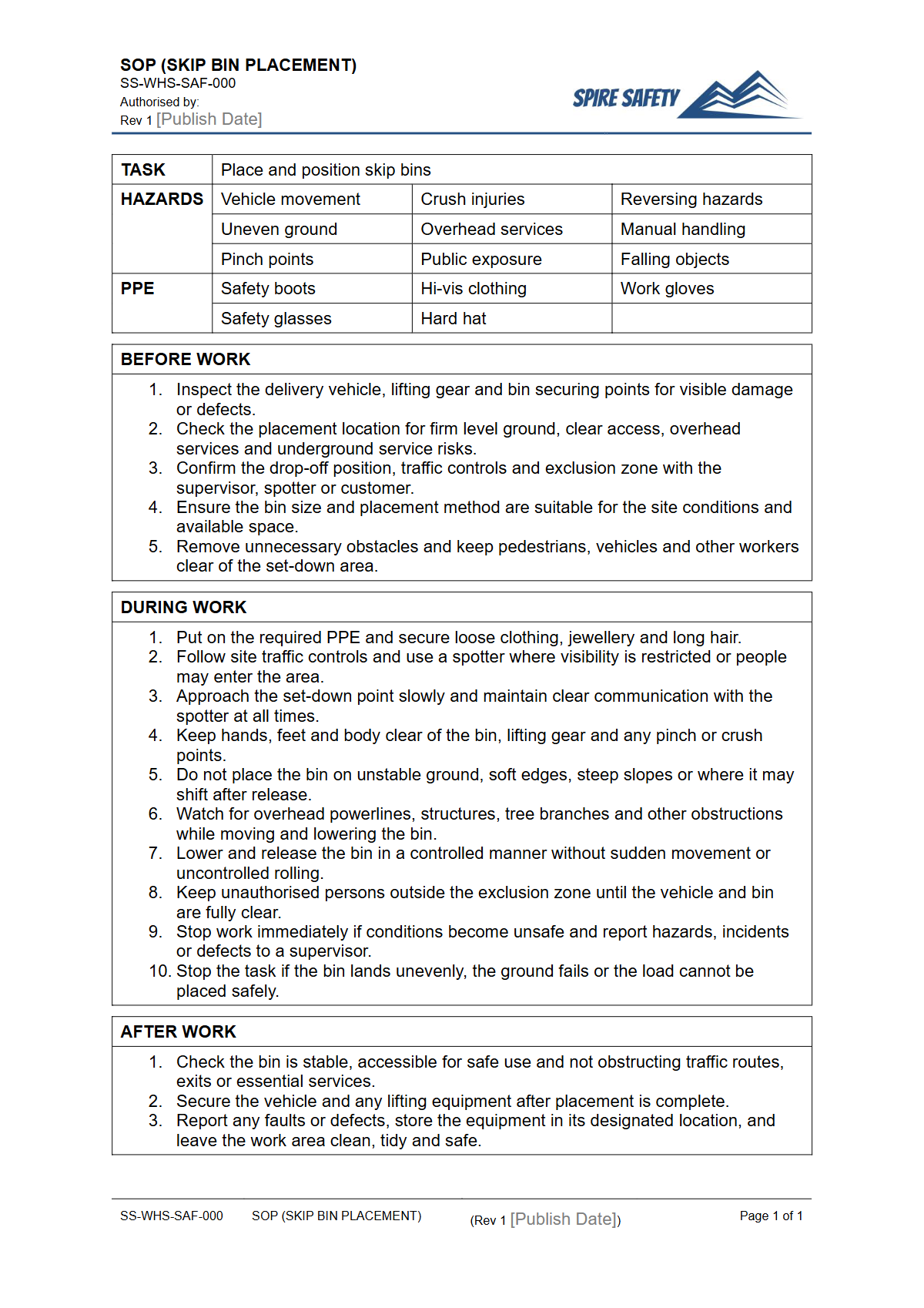
Download our free Safe Operating Procedure for Skip Bin Placement. This customisable template helps formalise the process for safely placing skip bins on site.
Free Safe Operating Procedure (Skip Bin Placement) Template
DOCX • 126 KB + PDF
Updated Oct 2026
No signup required
Purpose of the Free Safe Operating Procedure (Skip Bin Placement) Template
Placing a skip bin seems straightforward, but it involves significant risks that must be managed. Our Free Safe Operating Procedure (Skip Bin Placement) Template provides a structured framework for identifying hazards and outlining control measures.
It prompts a systematic review of the entire process, from the delivery driver arriving on site to the final positioning of the bin. This document helps your organisation detail step-by-step instructions to ensure skip bins are placed safely, minimising risks to workers and the public.
Using this template ensures key safety considerations are not overlooked. It covers critical checks such as assessing ground stability, maintaining clearance from overhead powerlines, managing vehicle and pedestrian traffic, and ensuring the bin does not obstruct access routes or essential services.
Formalising these steps is a key part of building robust and comprehensive WHS management systems that protect your team and demonstrate due diligence.
Key elements addressed in this Safe Operating Procedure:
- Pre-placement site assessment
- Required Personal Protective Equipment (PPE)
- Communication protocols between driver and site personnel
- Hazard identification (e.g., uneven ground, overhead services, traffic)
- Safe positioning and stabilisation techniques
- Post-placement checks and barricading requirements
Video walkthrough
How to use the Free Safe Operating Procedure (Skip Bin Placement) Template
This document is a template and not a finished procedure. To be effective, it must be customised to the specific conditions of your workplace, the types of skip bins used, and the nature of the work being performed.
We recommend a Person Conducting a Business or Undertaking (PCBU) consults with workers and health and safety representatives to complete the template.
Start by downloading the DOCX file and filling in your company-specific details. Walk through each section and adapt the content to reflect your site's unique environment and operational requirements.
For example, a busy construction site will have different traffic management needs than a quiet industrial yard. The procedure should be reviewed and signed off by a competent person before implementation. Regular reviews are also essential to ensure the SOP remains current and effective, often forming part of routine WHS compliance auditing.
Ensure you consider all associated site tasks that could impact the safety of the placement. For instance, if heavy machinery is operating nearby, the risks are heightened and must be integrated into your planning. This may involve coordinating with operators who follow their own specific procedures, such as those detailed in a Telehandler SOP.
When to use a Safe Operating Procedure for Skip Bin Placement
A Safe Operating Procedure for skip bin placement should be developed and implemented before any skip bin is delivered to a worksite. It is a proactive tool used during the planning phase to ensure a suitable, safe location has been designated.
The SOP should then be actively used by personnel on the ground during the delivery and placement process.
This procedure is particularly critical on dynamic sites like construction projects, demolition areas, and large-scale manufacturing or industrial facilities where conditions can change daily. It is also essential for any placement in publicly accessible areas, where the risk to non-workers is higher.
This could include placements on road verges, car parks, or event sites. The SOP acts as a critical checklist to ensure all legislative and practical safety requirements are met before, during, and after the bin is positioned.
On sites with significant earthworks, the stability of the ground is a primary concern. This SOP ensures that the chosen location is assessed for compaction and levelness, especially where groundwork activities might create hazards, requiring specific procedures like a trencher safe operating procedure.
Who should use this template
This Safe Operating Procedure template is designed for use by a range of personnel involved in workplace safety and logistics. It is an essential tool for Site Managers, Project Managers, and WHS Officers who are responsible for the overall safety of a worksite.
They can use it to establish a standardised, safe process for all skip bin deliveries and placements under their control.
Supervisors and team leaders should use the completed SOP to induct and instruct workers, including contractors like the skip bin delivery drivers. Workers and machinery operators tasked with assisting the placement must be familiar with the procedure to understand their roles, the identified hazards, and the control measures they are required to follow.
For complex sites or organisations needing support to integrate such procedures, guidance from specialist WHS consulting services can be invaluable.
Finally, procurement and administrative staff who arrange for skip bin hire can use this document to understand the site requirements they must communicate to the waste management supplier. This helps ensure suppliers arrive prepared and are aware of the safety protocols they will be expected to adhere to.
You can browse our full range of document templates in our free WHS resources library for more tools to support your safety systems.
Common mistakes
Common mistakes to avoid
- Placing bins on soft, unstable, or sloping ground, leading to tipping.
- Ignoring proximity to overhead hazards like powerlines, cables, and tree branches.
- Failing to use high-visibility markings or barriers for bins in traffic-heavy areas.
- Obstructing emergency exits, fire hydrants, essential access ways, or neighbouring properties.
Legal references
Legal considerations
The following legal requirements may be relevant to this type of work.
- Work Health and Safety Act (Harmonised) — Provides the primary duties for protecting workers and other people from work health and safety risks.
- Work Health and Safety Regulations (Harmonised) — Sets out requirements supporting the management of workplace hazards and risks.
The following codes may be relevant to this type of work.
- Managing WHS Risks Code of Practice — Provides practical guidance on identifying hazards, assessing risks and applying effective controls.
- Work Health and Safety Consultation, Cooperation and Coordination Code of Practice — Provides practical guidance on consulting workers and coordinating with other duty holders.
- Managing the Work Environment and Facilities Code of Practice — Provides practical guidance on safe work environments, workplace facilities and related controls.
Did you know
Council Permits
In most Australian council areas, placing a skip bin on public property, such as a road or footpath, requires a specific permit. Failing to obtain one can result in significant fines for the homeowner or the business.
Traffic Interaction Risks
According to Safe Work Australia, collisions with moving objects, including vehicles on a worksite, are a leading cause of workplace fatalities. Managing the interface between delivery trucks and site personnel is a critical part of a skip bin placement SOP.
FAQ
Frequently asked questions
01Is an SOP for skip bin placement legally required in Australia?
02What are the main hazards to include in a skip bin placement SOP?
03Who is responsible for the skip bin placement SOP?
04Can this template be used for bins placed on public land?
Share this resource
Free Safe Operating Procedure (Skip Bin Placement) Template
Browse Categories
How To Use It
- 1Download and open in Word or PDF.
- 2Replace the placeholders with your business details.
- 3Get it reviewed by a WHS specialist before rollout.
Need it customised?
Our WHS consultants can adapt this template to your site, run a gap analysis, or audit what you already have in place.
Book a Free Consultation WHS consulting servicesor call 1300 156 382
Related templates
- Free Safe Operating Procedure (Skip Bin Removal) Template
- Free Safe Operating Procedure (Skirting Board Clean) Template
- Free Safe Operating Procedure (Slasher Mower) Template
- Free Safe Operating Procedure (Sling Label Inspection) Template
- Free Safe Operating Procedure (Sling Selection Check) Template
- Free Safe Operating Procedure (Slitting Line) Template