
Free Safe Operating Procedure (Skip Bin Inspection) Template
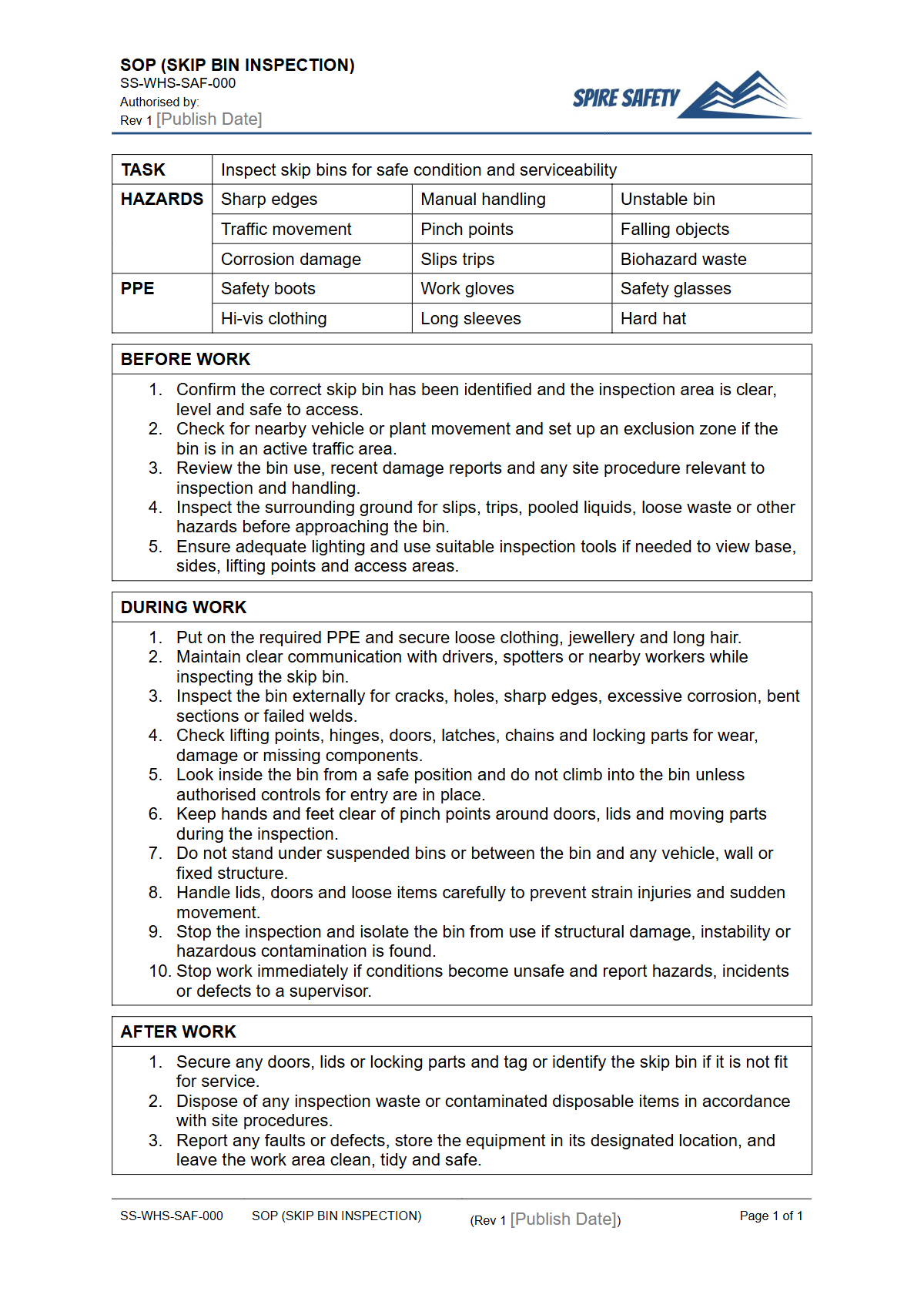
Download our free Safe Operating Procedure for skip bin inspections. This customisable template helps you document pre-use checks and ensure safe operation.
Free Safe Operating Procedure (Skip Bin Inspection) Template
DOCX • 126 KB + PDF
Updated Oct 2026
No signup required
Purpose of the Free Safe Operating Procedure (Skip Bin Inspection) Template
This Free Safe Operating Procedure (Skip Bin Inspection) Template provides a structured framework for formally checking skip bins before and during use on a worksite. The primary goal is to identify and control hazards to prevent incidents, injuries, and property damage.
Regular inspections are critical for identifying structural defects, damage to lifting points, or other unsafe conditions that could lead to bin failure, dropped loads, or uncontrolled movement. By implementing a consistent inspection process, your organisation can systematically manage risks associated with skip bin handling, transport, and storage, demonstrating a proactive approach to workplace health and safety.
Video walkthrough
How to use the Free Safe Operating Procedure (Skip Bin Inspection) Template
Using this template is straightforward. First, download the document in your preferred format (DOCX for easy editing or PDF).
Next, you must customise the content to align with your specific workplace. This involves identifying the types of skip bins used, the tasks involved (e.g., transport by forklift, crane, or truck), and the specific hazards present in your operational environment.
Integrating this procedure into your broader safety framework is key to its success. Well-documented procedures form the backbone of effective WHS management systems, ensuring consistency and accountability.
Important: This is a template, not a finished document. We have provided a foundation based on Australian WHS principles, but it is your responsibility to complete a thorough risk assessment and customise the control measures to suit your business.
You must ensure the final Safe Operating Procedure is specific to your equipment, personnel, and site conditions.
Key Elements of a Skip Bin Inspection
A thorough inspection, guided by this Safe Operating Procedure, should cover several critical areas to ensure the bin is fit for purpose. While your customised SOP will detail specifics, key checkpoints generally include:
- Structural Integrity: Check for cracks in welds, significant corrosion, dents, or punctures in the walls and floor that could compromise the bin's strength.
- Lifting Points: Inspect all lifting lugs, pins, and attachment points for signs of wear, distortion, stretching, or cracking. These are safety-critical components.
- Doors and Latches: If the bin has doors, verify they open, close, and secure correctly. Check that hinges and locking mechanisms are intact and functional.
- Markings and Data Plates: Ensure the Safe Working Load (SWL) or capacity rating is clearly visible and legible. Check that identification numbers and owner details are also present.
- General Condition: Look for any sharp edges, protruding metal, or other damage that could present a cut or puncture hazard to workers.
When to Conduct an Inspection
Inspections are not a once-off task. This Safe Operating Procedure should be applied at several key stages to maintain safety throughout the bin's lifecycle on your site. An inspection is required:
- Upon delivery to site: Before the bin is first used.
- Before each use: A pre-start check by the person responsible for filling or moving the bin.
- After any known incident: If the bin is struck, dropped, or overloaded, it must be inspected before being returned to service.
- As part of scheduled maintenance: At regular intervals determined by your risk assessment and the frequency of use.
Maintaining clear records of these inspections is vital for demonstrating due diligence and can be reviewed during regular WHS compliance audits.
Who Should Use This Safe Operating Procedure
This procedure should be used by all personnel involved in the handling, use, or supervision of skip bins. Competence is essential, and individuals must be trained on the procedure and what to look for. Key roles include:
- Site Supervisors and Managers: Responsible for ensuring inspections are carried out and that unsafe bins are removed from service.
- Plant and Equipment Operators: Workers operating trucks, cranes, or forklifts to move bins must conduct pre-start checks. Operators of machinery used to move bins, such as those following our free Telehandler SOP, must also be competent in inspecting the bin's lifting points before attachment.
- Waste Management Personnel: Staff responsible for coordinating waste streams and bin placement.
- Designated Inspectors: Any worker assigned the specific task of conducting routine skip bin inspections.
On larger industrial or construction sites, skip bins are often part of a wider waste management process that may also include equipment covered by our free Conveyer System SOP. Effective hazard management requires a holistic view of all interacting plant and processes. If your team is unsure how to identify all relevant hazards, seeking specialist WHS consulting can provide expert guidance.
This SOP is one of many tools available in our comprehensive free WHS resources library, designed to support Australian businesses.
Common mistakes
Common mistakes to avoid
- Failing to check all lifting points, assuming if one is okay, the others are too.
- Ignoring 'minor' damage like bent panels or significant surface rust, which can indicate underlying structural weakness.
- Placing bins on unstable or sloping surfaces, creating a tipping hazard.
- Forgetting to verify that the bin's Safe Working Load (SWL) is clearly marked and legible before use.
Legal references
Legal considerations
The following legal requirements may be relevant to this type of work.
- Work Health and Safety Act (Harmonised) — Provides the primary duties for protecting workers and other people from work health and safety risks.
- Work Health and Safety Regulations (Harmonised) — Sets out requirements supporting the management of workplace hazards and risks.
The following codes may be relevant to this type of work.
- Managing WHS Risks Code of Practice — Provides practical guidance on identifying hazards, assessing risks and applying effective controls.
- Work Health and Safety Consultation, Cooperation and Coordination Code of Practice — Provides practical guidance on consulting workers and coordinating with other duty holders.
- Managing the Work Environment and Facilities Code of Practice — Provides practical guidance on safe work environments, workplace facilities and related controls.
Did you know
Hidden Dangers
A significant number of skip bin incidents are not caused by dramatic failures, but by placing them on soft or uneven ground, leading to instability and tipping when loaded or lifted.
Lifting Lug Stress
The lifting lugs on a skip bin are subjected to immense stress. A seemingly minor crack or slight deformation can propagate rapidly under load, representing a critical failure point that inspections are designed to catch.
FAQ
Frequently asked questions
01What should be included in a skip bin inspection checklist?
02How often should skip bins be formally inspected?
03Who is responsible for ensuring skip bins are safe on a worksite?
04Can this SOP template be used for all types of skip bins?
Share this resource
Free Safe Operating Procedure (Skip Bin Inspection) Template
Browse Categories
How To Use It
- 1Download and open in Word or PDF.
- 2Replace the placeholders with your business details.
- 3Get it reviewed by a WHS specialist before rollout.
Need it customised?
Our WHS consultants can adapt this template to your site, run a gap analysis, or audit what you already have in place.
Book a Free Consultation WHS consulting servicesor call 1300 156 382
Related templates
- Free Safe Operating Procedure (Skip Bin Loading) Template
- Free Safe Operating Procedure (Skip Bin Placement) Template
- Free Safe Operating Procedure (Skip Bin Removal) Template
- Free Safe Operating Procedure (Skirting Board Clean) Template
- Free Safe Operating Procedure (Slasher Mower) Template
- Free Safe Operating Procedure (Sling Label Inspection) Template