
Free Safe Operating Procedure (Site Litter Collection) Template
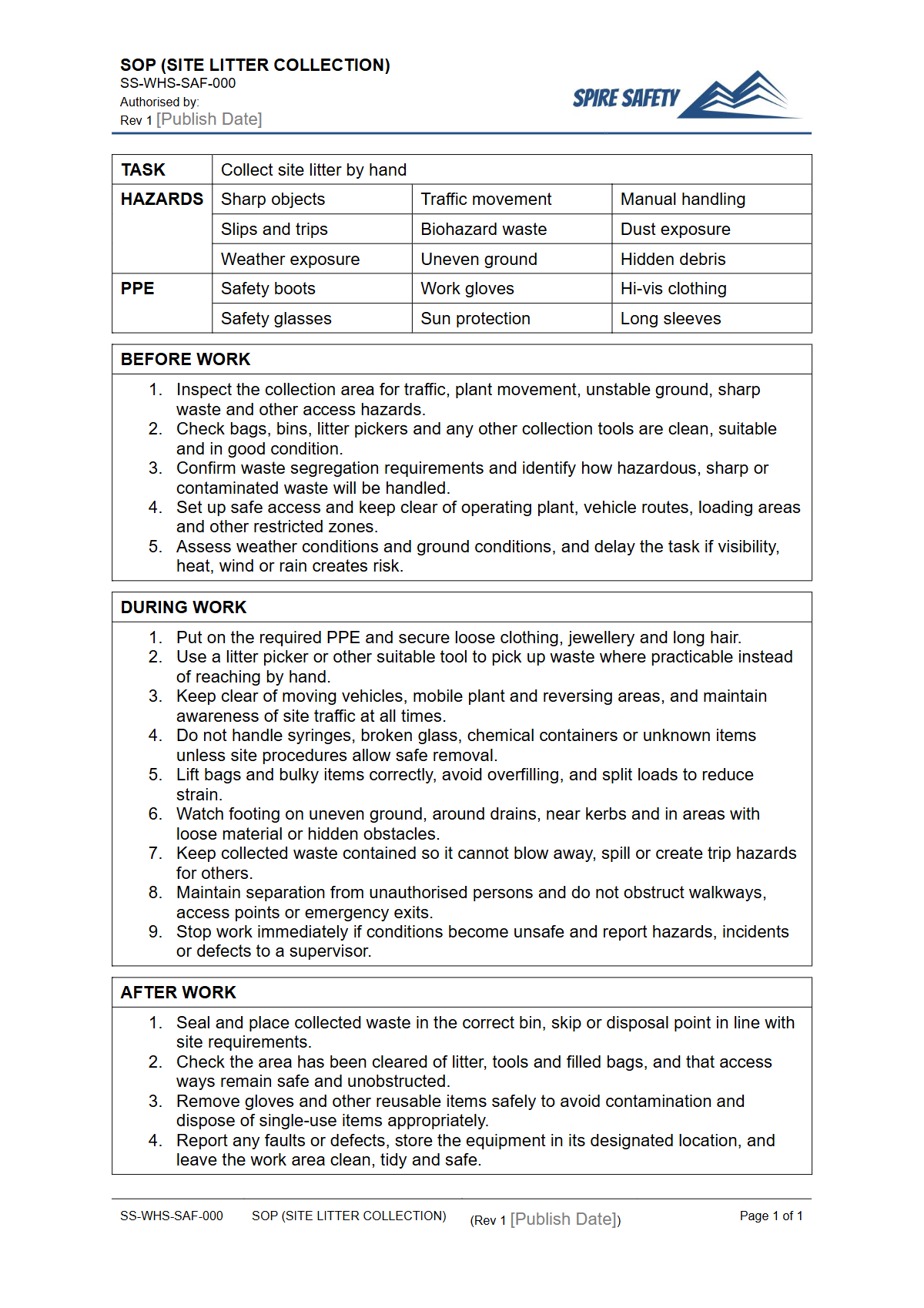
Formalise your site cleaning tasks with our structured Safe Operating Procedure for site litter collection.
Free Safe Operating Procedure (Site Litter Collection) Template
DOCX • 126 KB + PDF
Updated Oct 2026
No signup required
Purpose of the Free Safe Operating Procedure (Site Litter Collection) Template
Maintaining a clean and orderly worksite is fundamental to workplace health and safety. While seemingly simple, site litter collection involves numerous hazards that can lead to serious injury if not properly managed.
This Free Safe Operating Procedure (Site Litter Collection) Template provides a structured framework for documenting the required steps, safety controls, and responsibilities associated with this common but often overlooked task. It helps an organisation formalise its process, ensuring every worker understands the risks and follows a consistent, safe method every time.
Using a documented SOP helps meet your duty of care by demonstrating a commitment to providing a safe system of work. It moves beyond verbal instructions, creating a trainable and auditable record of your safety process for managing risks like manual handling, sharps injuries, and slips, trips, and falls.
Video walkthrough
How to use the Free Safe Operating Procedure (Site Litter Collection) Template
This template is designed as a comprehensive starting point, aligned with Australian WHS principles. To make it effective, you must adapt it to the specific context of your workplace.
Follow these steps:
- Download: Access the template in your preferred format (DOCX for easy editing or PDF).
- Consult: Involve the workers who will be performing the task. Their direct experience is invaluable for identifying practical hazards and effective controls.
- Customise: Modify the document to reflect your site-specific conditions. This includes detailing the types of litter encountered, the specific locations (e.g., car parks, construction zones, public areas), the equipment provided (trolleys, litter pickers, specific bag types), and the emergency procedures relevant to your workplace.
- Approve: Have a manager or supervisor formally approve the finalised SOP.
- Train: Ensure all relevant workers are trained on the final procedure. Keep records of this training.
Important: We have created this template as a guide. You must customise this document to suit the unique risks and operational needs of your business and worksite.
Spire Safety is not liable for any incidents or compliance issues arising from the use of this template.
Common Hazards in Litter Collection
A thorough risk assessment should be conducted to identify all potential hazards. Key risks often associated with site litter collection include:
- Musculoskeletal Injuries: Risks from repetitive bending, twisting, and lifting heavy or awkward bags of rubbish.
- Sharps Injuries: Puncture wounds from discarded needles, broken glass, metal fragments, or sharp plastics hidden within litter.
- Biological Hazards: Exposure to bacteria, viruses, and pathogens from animal waste, soiled materials, or rotting organic matter.
- Chemical Exposure: Contact with unknown substances from leaking containers or improperly discarded chemicals.
- Slips, Trips, and Falls: Caused by uneven ground, obstacles hidden by grass or debris, or wet surfaces.
- Environmental Factors: Risks from working outdoors, including UV radiation, heat stress, insect bites, and adverse weather.
- Vehicle and Plant Interaction: The risk of being struck by moving vehicles or mobile plant, especially in car parks, warehouses, or on construction sites.
These hazards underscore the importance of moving beyond a 'common sense' approach and implementing a formal, documented procedure.
Integrating the SOP into Your WHS System
A Safe Operating Procedure is most effective when it is a living document within a broader safety framework. It should not exist in isolation.
Integrate this SOP by linking it to other key components of your safety program. For instance, the hazards identified in your SOP should directly inform your site's risk register.
The training requirements noted in the procedure should be incorporated into your worker induction and ongoing training schedule. The effectiveness of this and other procedures can be reviewed during regular WHS compliance auditing.
A well-managed system ensures that safety documents are interconnected, regularly reviewed, and consistently applied across the organisation. For businesses looking to establish or improve their safety framework, developing comprehensive WHS management systems provides a robust structure for managing all aspects of workplace safety.
Who Should Use This Safe Operating Procedure?
This document is intended for a range of personnel within an organisation:
- WHS Managers/Advisors: To use as a foundational document for standardising site cleaning protocols.
- Site/Operations Managers: To implement and enforce safe work practices on the ground.
- Supervisors and Team Leaders: To conduct pre-start briefings, toolbox talks, and to monitor worker adherence to the procedure.
- Workers: As a clear, step-by-step guide on how to perform their tasks safely.
If you require assistance adapting this template or developing other critical safety documentation, engaging a specialist WHS consulting service can provide expert guidance. You can also explore our extensive library of free WHS resources for other templates and guides.
Common mistakes
Common mistakes to avoid
- Using the template without customising it for specific site conditions and hazards.
- Failing to provide workers with the specified Personal Protective Equipment (PPE).
- Neglecting to train workers on the SOP and confirm their understanding before they start work.
- Not reviewing the SOP after an incident or near miss involving litter collection.
Legal references
Legal considerations
The following legal requirements may be relevant to this type of work.
- Work Health and Safety Act (Harmonised) — Provides the primary duties for protecting workers and other people from work health and safety risks.
- Work Health and Safety Regulations (Harmonised) — Sets out requirements supporting the management of workplace hazards and risks.
The following codes may be relevant to this type of work.
- Managing WHS Risks Code of Practice — Provides practical guidance on identifying hazards, assessing risks and applying effective controls.
- Work Health and Safety Consultation, Cooperation and Coordination Code of Practice — Provides practical guidance on consulting workers and coordinating with other duty holders.
- Managing the Work Environment and Facilities Code of Practice — Provides practical guidance on safe work environments, workplace facilities and related controls.
Did you know
Slips, Trips, and Falls
Slips, trips, and falls are a leading cause of workplace injuries in Australia, often resulting in serious harm. A clean and tidy site is a primary control measure against these common incidents.
Hidden Dangers
Discarded sharps like needles and broken glass pose a significant risk in public and industrial litter, potentially causing serious injuries and infections if handled without appropriate PPE and procedures.
FAQ
Frequently asked questions
01What hazards should be included in an SOP for litter collection?
02Is a Safe Operating Procedure legally required for picking up rubbish?
03How often should an SOP for site litter collection be reviewed?
04What Personal Protective Equipment (PPE) is needed for site litter collection?
Share this resource
Free Safe Operating Procedure (Site Litter Collection) Template
Browse Categories
How To Use It
- 1Download and open in Word or PDF.
- 2Replace the placeholders with your business details.
- 3Get it reviewed by a WHS specialist before rollout.
Need it customised?
Our WHS consultants can adapt this template to your site, run a gap analysis, or audit what you already have in place.
Book a Free Consultation WHS consulting servicesor call 1300 156 382
Related templates
- Free Safe Operating Procedure (Skidder) Template
- Free Safe Operating Procedure (Skip Bin Changeover) Template
- Free Safe Operating Procedure (Skip Bin Inspection) Template
- Free Safe Operating Procedure (Skip Bin Loading) Template
- Free Safe Operating Procedure (Skip Bin Placement) Template
- Free Safe Operating Procedure (Skip Bin Removal) Template