
Free Safe Operating Procedure (Silo Aeration Fan) Template
Standardise the safe use of silo aeration fans with our structured Safe Operating Procedure. Download your free DOCX or PDF template to get started today.
Free Safe Operating Procedure (Silo Aeration Fan) Template
DOCX • 126 KB + PDF
Updated Oct 2026
No signup required
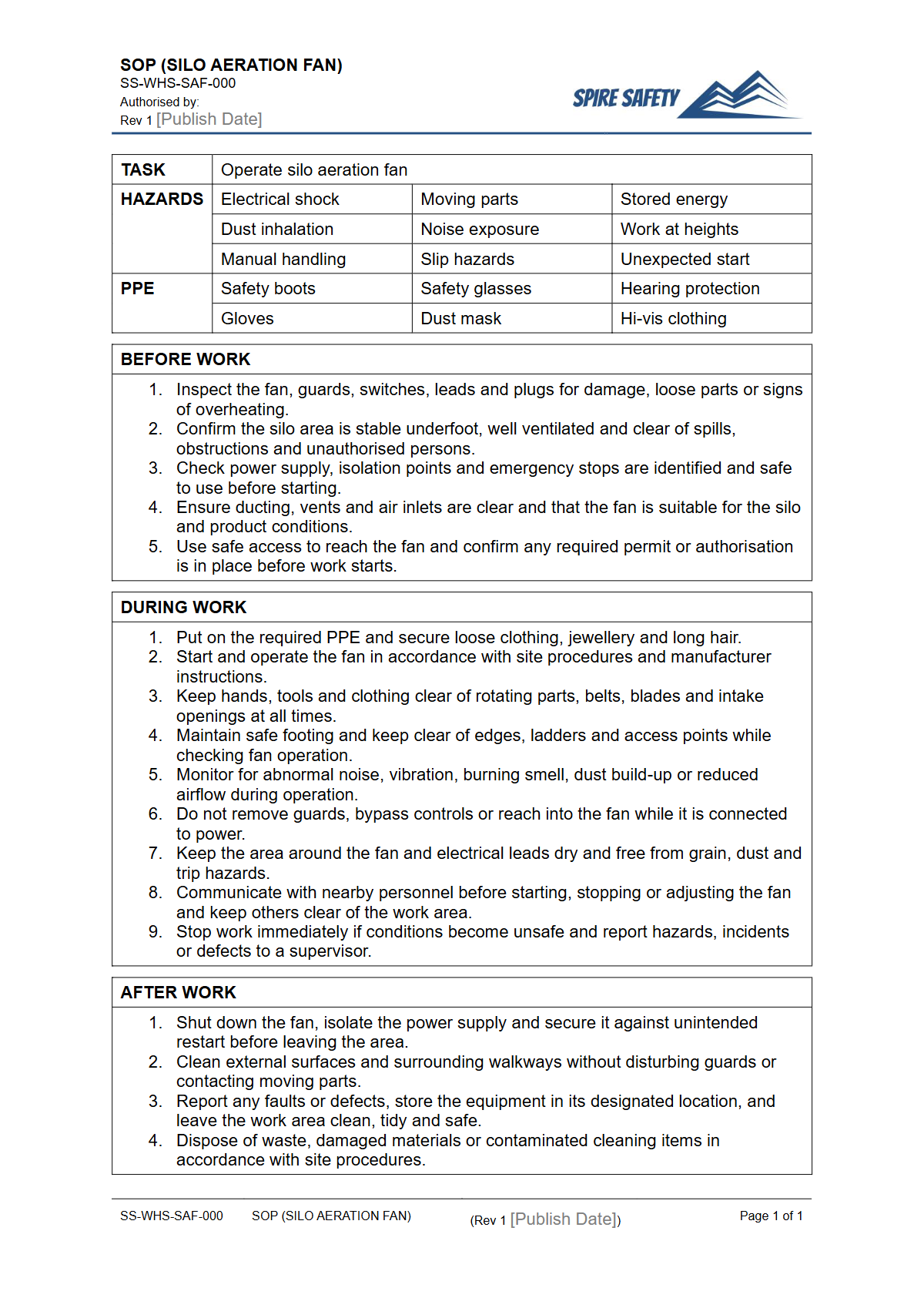
Purpose of the Free Safe Operating Procedure (Silo Aeration Fan) Template
This Free Safe Operating Procedure (Silo Aeration Fan) Template provides a structured framework for documenting the safe use of aeration fans in grain silos. Operating silo fans involves significant risks, including electrical hazards, entanglement in moving parts, hazardous atmospheres, and working in confined spaces.
This SOP helps your organisation formalise procedures to manage these risks, ensuring that workers have clear, step-by-step instructions for performing the task safely.
Using a documented procedure is a practical way to meet your obligations under WHS legislation. It serves as a critical tool for training, supervision, and incident investigation.
By implementing a comprehensive SOP, you establish a consistent and safe method of work, reducing the likelihood of injuries and promoting a safer workplace culture. This document forms a key part of your broader safety framework, which can be managed through dedicated WHS management systems.
Key Hazards of Silo Aeration Fan Operation
Before using the equipment, it is essential to recognise the potential hazards involved. A thorough risk assessment should be conducted to identify and control risks specific to your worksite, which may include:
- Entanglement: Contact with unguarded fan blades, belts, or pulleys can cause serious injury.
- Electrical Hazards: Faulty wiring, improper isolation, or contact with water can lead to electric shock.
- Confined Spaces: Accessing silos or related ducting for maintenance may constitute a confined space entry, requiring specific permits and procedures.
- Hazardous Atmospheres: Grain dust can be explosive and pose a respiratory hazard. Fumigants or poor air quality can also be present.
- Manual Handling: Moving and positioning portable fans or components can lead to musculoskeletal injuries.
Video walkthrough
How to use the Free Safe Operating Procedure (Silo Aeration Fan) Template
This template is available for immediate download in both DOCX and PDF formats. The DOCX file is fully editable, allowing you to tailor the content to your specific operational needs.
The PDF version is a convenient, ready-to-print reference.
Important: It is crucial to recognise that this template is a starting point. We have provided a comprehensive framework, but you must adapt the content to reflect the specific equipment, environment, and organisational procedures at your workplace.
Consultation with operators and other relevant workers is a vital step in this process. Similar to procedures for other farm machinery, such as our free grain drill SOP template, this document requires site-specific customisation to be effective.
Customisation Checklist
When adapting the template, ensure you include the following site-specific details:
- The specific make and model of the silo aeration fan.
- Location and identification numbers for each silo and fan unit.
- Step-by-step pre-operational checks, startup, and shutdown sequences.
- Detailed lockout/tagout (LOTO) procedures for isolation.
- A list of mandatory Personal Protective Equipment (PPE).
- Site-specific emergency procedures and contact details.
When to use this Safe Operating Procedure
An SOP for silo aeration fans should be an active document within your safety system. It is used as a primary reference during several key activities, including worker training and competency verification. Regular reviews are also a key part of the process, often verified during a WHS compliance audit. The SOP should be consulted:
- During the induction and training of new workers tasked with operating the fan.
- For periodic refresher training to ensure ongoing competency.
- Before starting any non-routine maintenance or cleaning tasks on the fan unit.
- As a reference tool for supervisors conducting workplace inspections.
- When reviewing safety protocols following an incident or near miss.
Who should use this SOP
This Safe Operating Procedure is designed for use by various personnel within an organisation to ensure safety duties are understood and fulfilled at all levels.
- Persons Conducting a Business or Undertaking (PCBUs) use it to help meet their primary duty of care to provide a safe work environment and safe systems of work.
- WHS Managers and Safety Officers use it to implement, monitor, and review safety protocols as part of the overall WHS management system. Workers who operate other grain handling equipment may also need procedures like our FREE Conveyer System SOP.
- Supervisors and Team Leaders rely on the SOP to train workers, provide clear instructions, and monitor compliance on a day-to-day basis.
- Workers and Operators use the SOP as a clear guide to understand how to perform their tasks safely and correctly. Ensuring energy sources are isolated is critical, a principle that also applies to equipment covered in our Free Air Compressor SOP.
By standardising procedures, this SOP helps create a safer, more predictable work environment for everyone involved in silo operations. Explore our full range of document templates in our free WHS resources library to support your safety goals.
Common mistakes
Common mistakes to avoid
- Failing to properly isolate and lock out the fan before maintenance or cleaning.
- Using a generic SOP without customising it for the specific fan model and worksite.
- Neglecting to train workers on the SOP or verify their understanding before they operate the equipment.
- Not including specific procedures for dealing with hazardous atmospheres or dust build-up.
Legal references
Legal considerations
The following legal requirements may be relevant to this type of work.
- Work Health and Safety Act (Harmonised) — Provides the primary duties for protecting workers and other people from work health and safety risks.
- Work Health and Safety Regulations (Harmonised) — Sets out requirements supporting the management of workplace hazards and risks.
The following codes may be relevant to this type of work.
- Managing WHS Risks Code of Practice — Provides practical guidance on identifying hazards, assessing risks and applying effective controls.
- Work Health and Safety Consultation, Cooperation and Coordination Code of Practice — Provides practical guidance on consulting workers and coordinating with other duty holders.
- Managing the Work Environment and Facilities Code of Practice — Provides practical guidance on safe work environments, workplace facilities and related controls.
Did you know
Dust Explosions
Fine grain dust is highly combustible and can become explosive when suspended in the air in a confined area. A key function of silo aeration is to control temperature and moisture, which helps mitigate the risk of dust explosions and spoilage.
FAQ
Frequently asked questions
01Is an SOP legally required for a silo aeration fan in Australia?
02What is the difference between a SWMS and an SOP for a silo fan?
03How often should a Safe Operating Procedure for a silo fan be reviewed?
04Can I use this template for different models of silo aeration fans?
Share this resource
Free Safe Operating Procedure (Silo Aeration Fan) Template
Browse Categories
How To Use It
- 1Download and open in Word or PDF.
- 2Replace the placeholders with your business details.
- 3Get it reviewed by a WHS specialist before rollout.
Need it customised?
Our WHS consultants can adapt this template to your site, run a gap analysis, or audit what you already have in place.
Book a Free Consultation WHS consulting servicesor call 1300 156 382
Related templates
- Free Safe Operating Procedure (Silo Level Probe) Template
- Free Safe Operating Procedure (Silo Unloading) Template
- Free Safe Operating Procedure (Site Litter Collection) Template
- Free Safe Operating Procedure (Skidder) Template
- Free Safe Operating Procedure (Skip Bin Changeover) Template
- Free Safe Operating Procedure (Skip Bin Inspection) Template