
Free Safe Operating Procedure (Silo Level Probe) Template
Download our free Safe Operating Procedure (Silo Level Probe) template to manage risks associated with this task. Get your customisable DOCX and PDF now.
Free Safe Operating Procedure (Silo Level Probe) Template
DOCX • 126 KB + PDF
Updated Oct 2026
No signup required
Purpose of the Free Safe Operating Procedure (Silo Level Probe) Template
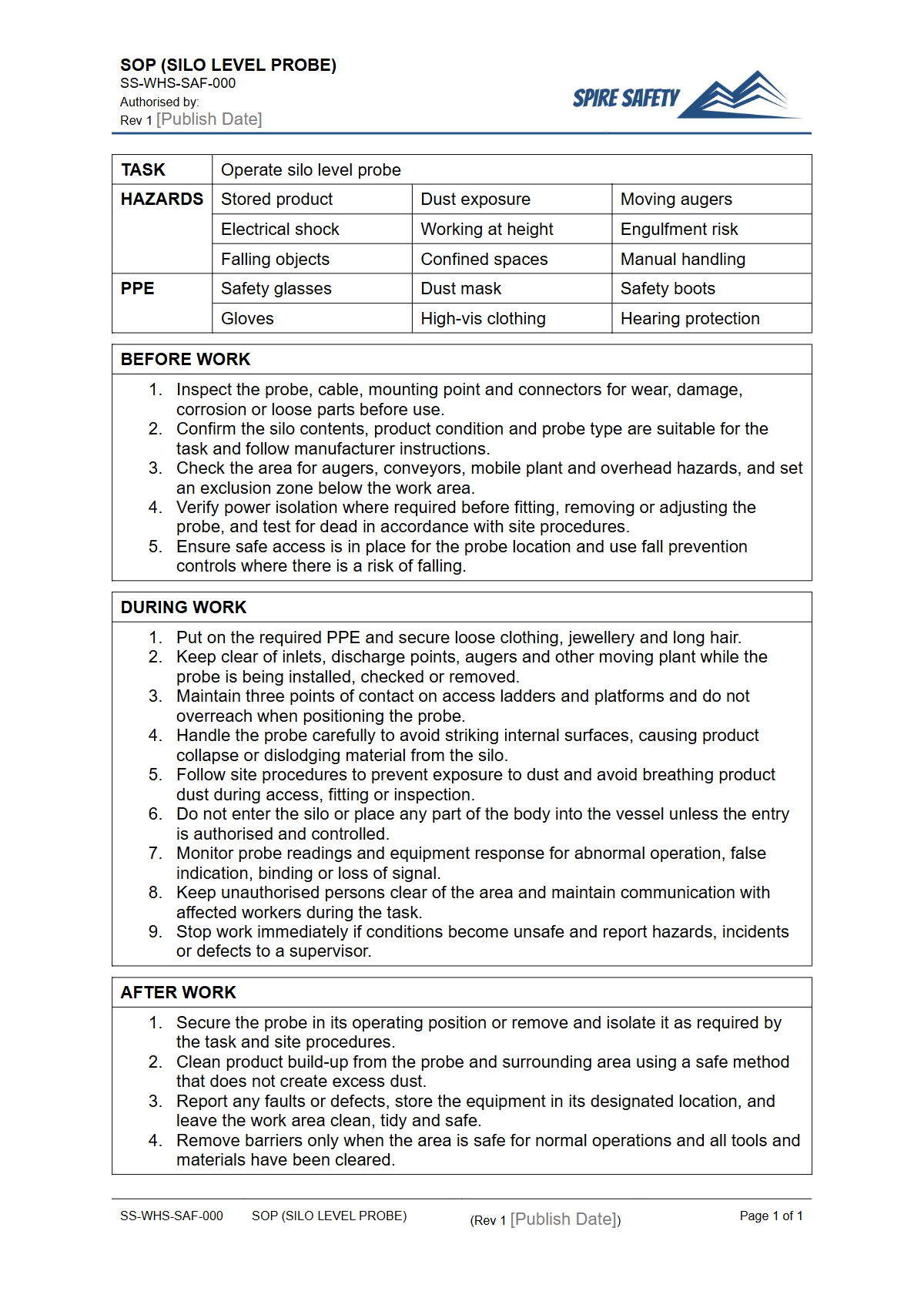
This Safe Operating Procedure (SOP) template provides a structured framework for safely installing, inspecting, maintaining, and calibrating silo level probes. Interacting with silos and their components presents significant risks, including falls from height, confined space hazards, electrical shock, and dust exposure.
Using this free Safe Operating Procedure (Silo Level Probe) template helps your organisation systematically identify these hazards and implement robust control measures to protect workers.
A documented SOP is a critical component of a proactive safety culture. It ensures that all personnel perform the task consistently and safely, minimising the chance of incidents.
This document serves as a practical tool for meeting your duty of care under Australian WHS regulations by formalising safe work methods. It can be integrated into your broader WHS management systems to support training, inductions, and ongoing competency verification.
Video walkthrough
How to use the Free Safe Operating Procedure (Silo Level Probe) Template
Our template is designed for ease of use and customisation. After downloading the DOCX or PDF file, the first step is to conduct a site-specific risk assessment for the task.
Consult directly with the workers who perform the job—their practical experience is invaluable for identifying all potential hazards and effective controls. Edit the document to reflect your specific silo types, probe models, isolation procedures, required personal protective equipment (PPE), and emergency response plans.
Please note: this document is a template. We have drafted it as a starting point, and you must customise it to reflect the specific equipment, personnel, and risks at your workplace.
An uncustomised template does not provide adequate safety control. Your SOP should be as specific as possible to be effective.
For related plant, consider using our FREE Conveyer System SOP to ensure consistency across interconnected equipment.
When to use this Safe Operating Procedure
This SOP should be used as a primary safety document before any work is carried out on silo level probes. It is not just for major maintenance; it should be referenced for routine inspections, cleaning, troubleshooting, and calibration activities.
It is also an essential training resource for new employees or for workers being assigned the task for the first time.
Furthermore, the SOP should be reviewed and updated regularly: after any incident or near-miss, when new equipment is introduced, if the work environment changes, or as part of a scheduled review cycle. Regular reviews, often part of internal or external WHS compliance auditing, ensure the procedure remains relevant and effective.
Who should use this Safe Operating Procedure
This document is intended for use by anyone involved in the lifecycle of silo level probes. This includes:
- Maintenance Personnel and Electricians: For guidance on safe isolation, testing, and repair.
- Site Supervisors and Managers: To ensure work is planned safely and that all controls are in place before work begins.
- WHS/HSE Advisors: As a tool for risk management, training, and compliance documentation.
- Operators: For understanding the basic safety requirements and knowing when to escalate issues to qualified maintenance staff.
By providing a clear, step-by-step guide, the SOP helps standardise safe behaviour across all roles and levels of experience. For other agricultural equipment, you might also find our FREE Grain Drill SOP Template useful in standardising your documentation.
Key Hazards and Control Measures
Working with silo level probes involves several critical hazards that must be controlled. The template guides you to address:
- Falls from Height: Accessing probes often requires working on top of silos. Controls include using compliant elevated work platforms (EWPs), fixed ladders with cages, and implementing fall arrest systems.
- Confined Spaces: Silos are classic confined spaces. The SOP must integrate with your existing confined space entry permit system and procedures, which include atmospheric monitoring, rescue plans, and stand-by personnel.
- Electrical Hazards: Probes are electrical devices. Effective lockout-tagout (LOTO) procedures are non-negotiable to prevent electric shock during maintenance.
- Dust Explosions: Agricultural dust (e.g., from grain) can be explosive. Controls include dust suppression, use of intrinsically safe equipment, and prohibiting ignition sources.
- Entrapment/Engulfment: If work is done from inside, the risk of being engulfed by stored material is severe. Strict isolation of inlet and outlet systems is required.
For operations involving the distribution of materials from silos, our FREE Spreader SOP Template can help complete your safety documentation suite.
By systematically addressing each of these points in your customised SOP, you create a robust defence against potential incidents. For a wider selection of safety documents, explore our complete free WHS resources library, which is updated regularly with new templates and guides.
Common mistakes
Common mistakes to avoid
- Forgetting to perform lockout-tagout (LOTO) to isolate electrical energy before starting maintenance.
- Accessing the top of a silo without appropriate fall protection, such as a harness and lanyard system or guardrails.
- Failing to follow formal confined space entry procedures, including atmospheric testing and having a standby person.
- Using the generic template 'as-is' without customising it for the specific probe, silo, and site conditions.
Legal references
Legal considerations
The following legal requirements may be relevant to this type of work.
- Work Health and Safety Act (Harmonised) — Provides the primary duties for protecting workers and other people from work health and safety risks.
- Work Health and Safety Regulations (Harmonised) — Sets out requirements supporting the management of workplace hazards and risks.
The following codes may be relevant to this type of work.
- Managing WHS Risks Code of Practice — Provides practical guidance on identifying hazards, assessing risks and applying effective controls.
- Work Health and Safety Consultation, Cooperation and Coordination Code of Practice — Provides practical guidance on consulting workers and coordinating with other duty holders.
- Managing the Work Environment and Facilities Code of Practice — Provides practical guidance on safe work environments, workplace facilities and related controls.
Did you know
Dust Explosions
Layers of settled grain dust as thin as a piece of paper can be sufficient to fuel a devastating explosion if disturbed and ignited. This makes dust control and ignition source management critical safety priorities around silos.
Confined Space Dangers
Over 60% of fatalities in confined spaces are would-be rescuers who enter the space without proper training or equipment. A robust SOP and emergency plan are essential to prevent a single incident from becoming a multiple-fatality event.
FAQ
Frequently asked questions
01What is a Safe Operating Procedure for a silo level probe?
02Do I need a different SOP for each type of silo level probe?
03Who is responsible for reviewing and updating this SOP?
04Is this silo level probe SOP template suitable for all Australian states?
Share this resource
Free Safe Operating Procedure (Silo Level Probe) Template
Browse Categories
How To Use It
- 1Download and open in Word or PDF.
- 2Replace the placeholders with your business details.
- 3Get it reviewed by a WHS specialist before rollout.
Need it customised?
Our WHS consultants can adapt this template to your site, run a gap analysis, or audit what you already have in place.
Book a Free Consultation WHS consulting servicesor call 1300 156 382
Related templates
- Free Safe Operating Procedure (Silo Unloading) Template
- Free Safe Operating Procedure (Site Litter Collection) Template
- Free Safe Operating Procedure (Skidder) Template
- Free Safe Operating Procedure (Skip Bin Changeover) Template
- Free Safe Operating Procedure (Skip Bin Inspection) Template
- Free Safe Operating Procedure (Skip Bin Loading) Template