
Free Safe Operating Procedure (Silicone Application) Template
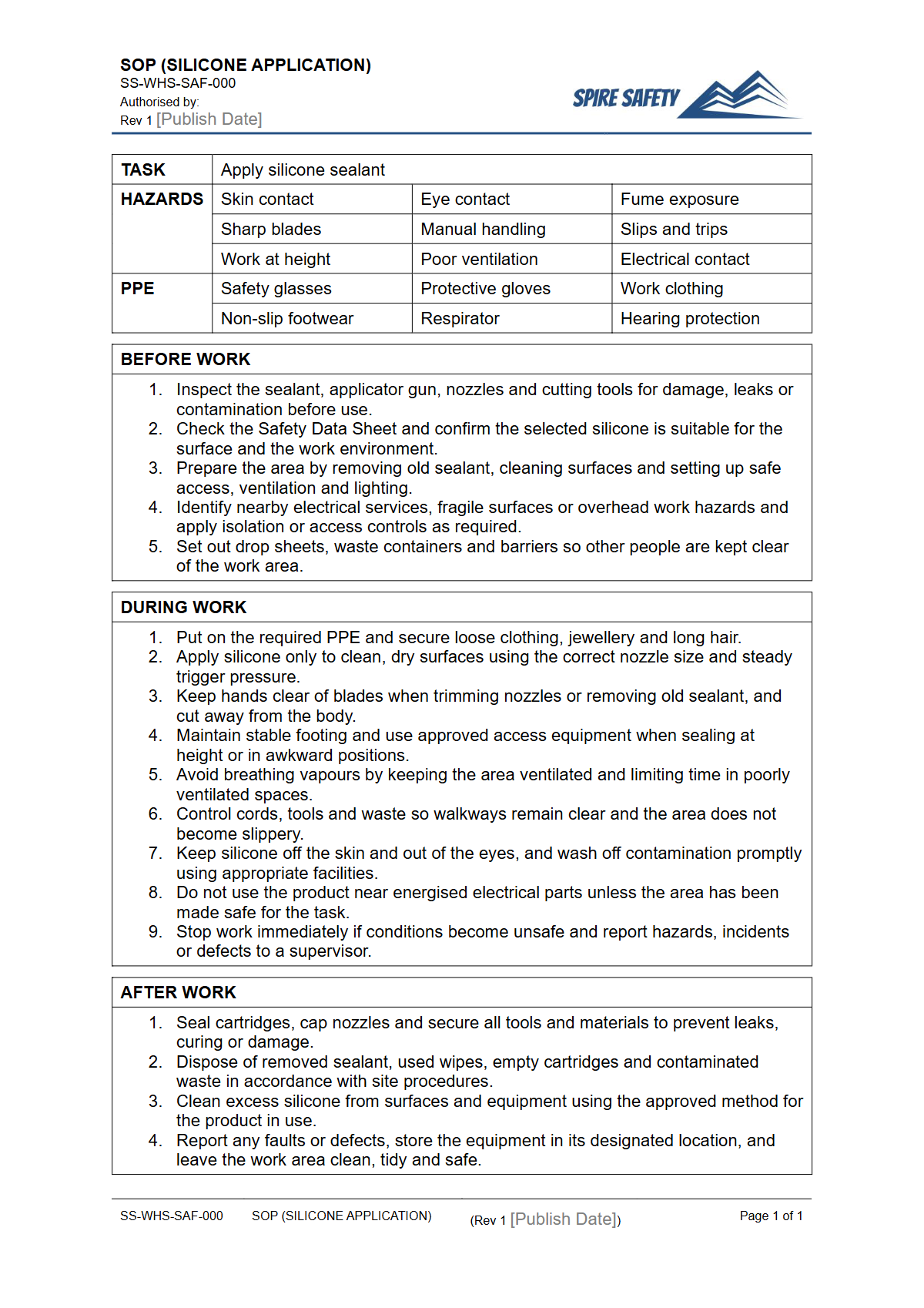
Download our free Safe Operating Procedure (Silicone Application) Template to formalise safety protocols for using silicone sealants and applicators.
Free Safe Operating Procedure (Silicone Application) Template
DOCX • 126 KB + PDF
Updated Oct 2026
No signup required
Purpose of the Free Safe Operating Procedure (Silicone Application) Template
Applying silicone sealants is a common task across construction, manufacturing, and maintenance industries. While it may seem straightforward, the process involves hazards that must be managed to ensure worker safety.
This free Safe Operating Procedure (Silicone Application) Template provides a structured starting point for documenting the risks and control measures associated with this task.
Using a standardised SOP helps your organisation demonstrate its commitment to safety by clearly defining the step-by-step process for applying silicone, from preparation to clean-up. It identifies key hazards such as chemical exposure to Volatile Organic Compounds (VOCs), skin and eye irritation, musculoskeletal strain from repetitive actions, and potential cuts from preparation tools.
Documenting these controls helps in meeting your primary duty of care obligations under Australian WHS legislation.
What is a Safe Operating Procedure?
A Safe Operating Procedure (SOP) is a written document that provides detailed, task-specific instructions to help workers perform a job safely and efficiently. It forms a critical part of a broader safety framework, working alongside risk assessments and worker training.
A well-drafted SOP is a key administrative control used to minimise risks that cannot be entirely eliminated through engineering or substitution.
Video walkthrough
How to use the Free Safe Operating Procedure (Silicone Application) Template
This template is provided in both DOCX and PDF formats for your convenience. The DOCX version is fully editable, allowing you to adapt it to your specific operational needs. To use it effectively, you should:
- Download the template and add your company name, logo, and other site-specific details.
- Consult the Safety Data Sheet (SDS) for the exact silicone product being used and incorporate its specific requirements for handling, storage, and personal protective equipment (PPE).
- Involve your workers in the customisation process. Their direct experience is invaluable for identifying practical hazards and effective controls.
- Review and approve the final document through your organisation's established safety protocols.
- Use the finalised SOP as a core part of your training for any worker required to apply silicone.
Important Note: This document is a template only. It must be customised to suit the specific equipment, chemicals, environment, and tasks at your workplace.
We have included prompts and blank sections for you to fill in to ensure the final procedure is relevant and effective for your business operations. A generic procedure that doesn't reflect your reality offers little practical safety value.
When to use it
A Safe Operating Procedure for silicone application should be used as a primary reference tool in several situations. It is essential for inducting and training new employees or for workers performing the task for the first time.
It also serves as a critical refresher for experienced staff to ensure standards do not slip over time.
Supervisors should use the SOP to conduct pre-start checks and observe work practices. Furthermore, the document is an important reference during formal safety reviews or after an incident or near miss occurs, helping to identify any gaps in the prescribed safety process.
Regular reviews are a key component of effective WHS management systems, ensuring they remain current and effective.
Who should use it
This SOP is intended for use by multiple roles within an organisation. Workers who perform silicone application tasks are the primary end-users; they should be trained on its contents and have easy access to it as a reference guide.
Site Supervisors and Team Leaders are responsible for implementing the SOP, ensuring workers understand and follow the procedures, and providing the necessary resources, such as correct PPE.
WHS Managers and Safety Officers will use the SOP as part of the overall safety system. They are typically responsible for developing, reviewing, and updating the document in consultation with workers and management.
The principles of creating task-specific instructions in this SOP can be applied to other activities, such as those outlined in our FREE Circular Saw SOP Template. For businesses needing broader support with their safety documentation, our WHS consulting services can provide expert guidance.
Whether your work involves manual hand tools or powered equipment, having clear procedures is vital. For tasks involving pneumatic tools, for example, a resource like our Free Air Compressor SOP can be adapted in a similar way.
This systematic approach to task safety is fundamental to building a strong safety culture across any industry, from construction to hospitality, which might use a deep fryer SOP. You can explore our complete range of templates in our free WHS resources library to find documents relevant to your operations.
Common mistakes
Common mistakes to avoid
- Failing to consult the Safety Data Sheet (SDS) for the specific silicone product being used.
- Using the template without customising it for the site's unique tasks, products, and environment.
- Working in a poorly ventilated area, leading to high concentrations of curing vapours.
- Neglecting proper surface preparation, which can cause sealant failure, rework, and wasted materials.
Legal references
Legal considerations
The following legal requirements may be relevant to this type of work.
- Work Health and Safety Act (Harmonised) — Provides the primary duties for protecting workers and other people from work health and safety risks.
- Work Health and Safety Regulations (Harmonised) — Sets out requirements supporting the management of workplace hazards and risks.
The following codes may be relevant to this type of work.
- Managing WHS Risks Code of Practice — Provides practical guidance on identifying hazards, assessing risks and applying effective controls.
- Work Health and Safety Consultation, Cooperation and Coordination Code of Practice — Provides practical guidance on consulting workers and coordinating with other duty holders.
- Managing the Work Environment and Facilities Code of Practice — Provides practical guidance on safe work environments, workplace facilities and related controls.
Did you know
Curing Vapours
Many common silicone sealants release acetic acid (which smells like vinegar) as they cure. This is a type of Volatile Organic Compound (VOC) that requires proper ventilation to avoid respiratory irritation.
Not Just a Sealant
Some high-performance silicones are used in aerospace to bond thermal tiles to spacecraft, demonstrating their incredible durability and resistance to extreme temperatures.
FAQ
Frequently asked questions
01What are the main hazards when applying silicone?
02Is a Safety Data Sheet (SDS) required for silicone?
03What PPE is typically needed for applying silicone?
04How often should a Safe Operating Procedure be reviewed?
Share this resource
Free Safe Operating Procedure (Silicone Application) Template
Browse Categories
How To Use It
- 1Download and open in Word or PDF.
- 2Replace the placeholders with your business details.
- 3Get it reviewed by a WHS specialist before rollout.
Need it customised?
Our WHS consultants can adapt this template to your site, run a gap analysis, or audit what you already have in place.
Book a Free Consultation WHS consulting servicesor call 1300 156 382
Related templates
- Free Safe Operating Procedure (Silo Aeration Fan) Template
- Free Safe Operating Procedure (Silo Level Probe) Template
- Free Safe Operating Procedure (Silo Unloading) Template
- Free Safe Operating Procedure (Site Litter Collection) Template
- Free Safe Operating Procedure (Skidder) Template
- Free Safe Operating Procedure (Skip Bin Changeover) Template