
Free Safe Operating Procedure (Side Rail Adjustment) Template
Formalise procedures for safely adjusting side rails on beds, trolleys, and other equipment. Download our free Safe Operating Procedure template to get started.
Free Safe Operating Procedure (Side Rail Adjustment) Template
DOCX • 126 KB + PDF
Updated Oct 2026
No signup required
Purpose of the Free Safe Operating Procedure (Side Rail Adjustment) Template
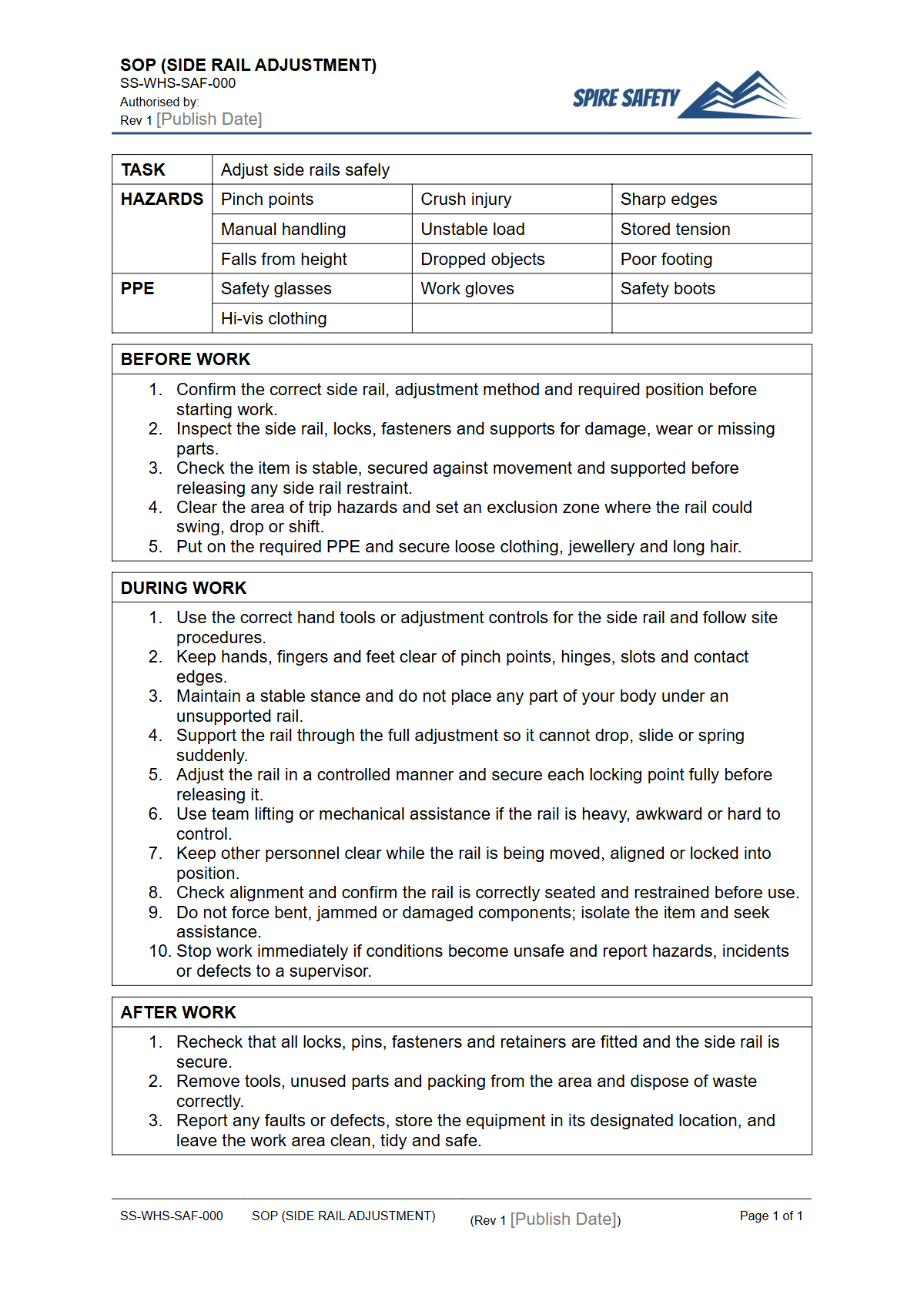
This Free Safe Operating Procedure (Side Rail Adjustment) Template provides a structured framework for documenting the safe steps required to adjust side rails on equipment such as hospital beds, patient trolleys, and some types of mobile plant. It helps Persons Conducting a Business or Undertaking (PCBUs) manage risks and meet their WHS duties.
The primary goal is to prevent injuries like pinching, crushing, or musculoskeletal strains that can occur during manual adjustment. A documented procedure is a key component of effective WHS management systems, ensuring consistency and clarity for all workers.
Video walkthrough
How to use the Free Safe Operating Procedure (Side Rail Adjustment) Template
Our Free Safe Operating Procedure (Side Rail Adjustment) Template is provided as a DOCX file for easy customisation. To use it effectively, download the file and adapt it to your specific operational context.
This involves adding your company name, identifying the specific makes and models of equipment it applies to, and detailing the precise steps your workers must follow. It is crucial to remember that this template is a starting point; we strongly recommend you customise it to reflect the specific equipment, environment, and personnel in your workplace.
If you require assistance tailoring safety documents to your unique needs, our WHS consulting team can provide expert support.
When to use it
An SOP for side rail adjustment should be developed and implemented before workers are first required to perform the task. It is an essential tool for worker induction and ongoing refresher training.
The procedure should be readily accessible in the work area, either as a hard copy or digitally. It's also vital to review and update the SOP whenever a new type of equipment with side rails is introduced, if the work environment changes, or following an incident or near miss.
This process ensures the procedure remains relevant and effective, much like the procedures outlined in our FREE Conveyer System SOP (Safe Operating Procedure) Template for managing different equipment risks.
Who should use it
This Safe Operating Procedure is intended for use by anyone involved in the lifecycle of the task. Managers and supervisors must use it to ensure work is planned safely and that workers are trained and competent.
Workers who physically perform the side rail adjustments—such as nurses, aged care workers, patient transport officers, or maintenance staff—must follow the procedure to protect themselves and others. Safety officers and WHS committees can use the document as a basis for risk assessments, training development, and workplace inspections.
Its structured approach is similar to other task-specific guides, like our FREE Circular Saw SOP (Safe Operating Procedure) Template, which also targets specific users and hazards.
Key Elements in the Safe Operating Procedure
A comprehensive SOP for side rail adjustment should clearly address several key areas to be effective. The provided template guides you through documenting these critical components for your workplace.
- Hazard Identification: The template prompts you to list potential hazards specific to the task. For side rail adjustment, this includes pinch points between moving parts, crush risks from unexpected rail movement, awkward postures leading to musculoskeletal disorders (MSDs), and the risk of patient falls if rails are not secured correctly.
- Risk Control Measures: You must document the controls needed to eliminate or minimise these risks. This section includes requirements for pre-operational checks (e.g., inspecting for damage, stiffness, or faulty latches), required Personal Protective Equipment (PPE) like gloves, and the step-by-step sequence for safe adjustment.
- Training and Competency: The SOP should specify the training required before a worker can perform the task unsupervised. This reinforces that a document alone is not a sufficient control measure; it must be paired with practical instruction and assessment.
- Emergency Procedures: It includes a dedicated section for outlining actions to take in case of an incident, such as a hand injury, equipment malfunction, or patient entrapment. Regular reviews of these elements are crucial, and a formal WHS compliance auditing process can verify their effectiveness in practice.
Integrating the SOP into Your Safety Framework
An SOP is most effective when it is part of a comprehensive safety system, not a standalone document. It should be referenced in your risk registers, training plans, and induction materials.
Worker consultation is a legal requirement and a critical part of developing a practical and effective SOP. Involve the workers who perform the task in drafting and reviewing the procedure to ensure it reflects how the work is actually done.
This collaborative approach improves buy-in and helps identify unforeseen hazards. Documenting procedures for all high-risk tasks, including those involving mobile equipment detailed in resources like our FREE Grader SOP (Safe Operating Procedure) Template, builds a robust safety culture and demonstrates a commitment to workplace health and safety.
Common mistakes
Common mistakes to avoid
- Failing to customise the generic template to specific workplace equipment and conditions.
- Assuming reading the SOP is an adequate substitute for hands-on, practical training.
- Not involving the workers who perform the task in the drafting and review process.
- Forgetting to review and update the SOP after an incident, near miss, or change in equipment.
Legal references
Legal considerations
The following legal requirements may be relevant to this type of work.
- Work Health and Safety Act (Harmonised) — Provides the primary duties for protecting workers and other people from work health and safety risks.
- Work Health and Safety Regulations (Harmonised) — Sets out requirements supporting the management of workplace hazards and risks.
The following codes may be relevant to this type of work.
- Managing WHS Risks Code of Practice — Provides practical guidance on identifying hazards, assessing risks and applying effective controls.
- Work Health and Safety Consultation, Cooperation and Coordination Code of Practice — Provides practical guidance on consulting workers and coordinating with other duty holders.
- Managing the Work Environment and Facilities Code of Practice — Provides practical guidance on safe work environments, workplace facilities and related controls.
Did you know
Entrapment Risks
In Australia, there have been numerous serious incidents, including fatalities, related to bed rail entrapment in healthcare and aged care settings. A documented safe system of work is a critical control for preventing these events.
FAQ
Frequently asked questions
01What is a Safe Operating Procedure for side rail adjustment?
02Is this side rail adjustment SOP template suitable for NDIS providers?
03How often should an SOP for side rail adjustment be reviewed?
04What hazards are associated with adjusting equipment side rails?
Share this resource
Free Safe Operating Procedure (Side Rail Adjustment) Template
Browse Categories
How To Use It
- 1Download and open in Word or PDF.
- 2Replace the placeholders with your business details.
- 3Get it reviewed by a WHS specialist before rollout.
Need it customised?
Our WHS consultants can adapt this template to your site, run a gap analysis, or audit what you already have in place.
Book a Free Consultation WHS consulting servicesor call 1300 156 382
Related templates
- Free Safe Operating Procedure (Signage Cleaning) Template
- Free Safe Operating Procedure (Silage Cover Removal) Template
- Free Safe Operating Procedure (Silicone Application) Template
- Free Safe Operating Procedure (Silo Aeration Fan) Template
- Free Safe Operating Procedure (Silo Level Probe) Template
- Free Safe Operating Procedure (Silo Unloading) Template