
Free Safe Operating Procedure (Signage Cleaning) Template
Download our free Safe Operating Procedure for signage cleaning to formalise your safety processes.
Free Safe Operating Procedure (Signage Cleaning) Template
DOCX • 126 KB + PDF
Updated Oct 2026
No signup required
Purpose of the Free Safe Operating Procedure (Signage Cleaning) Template
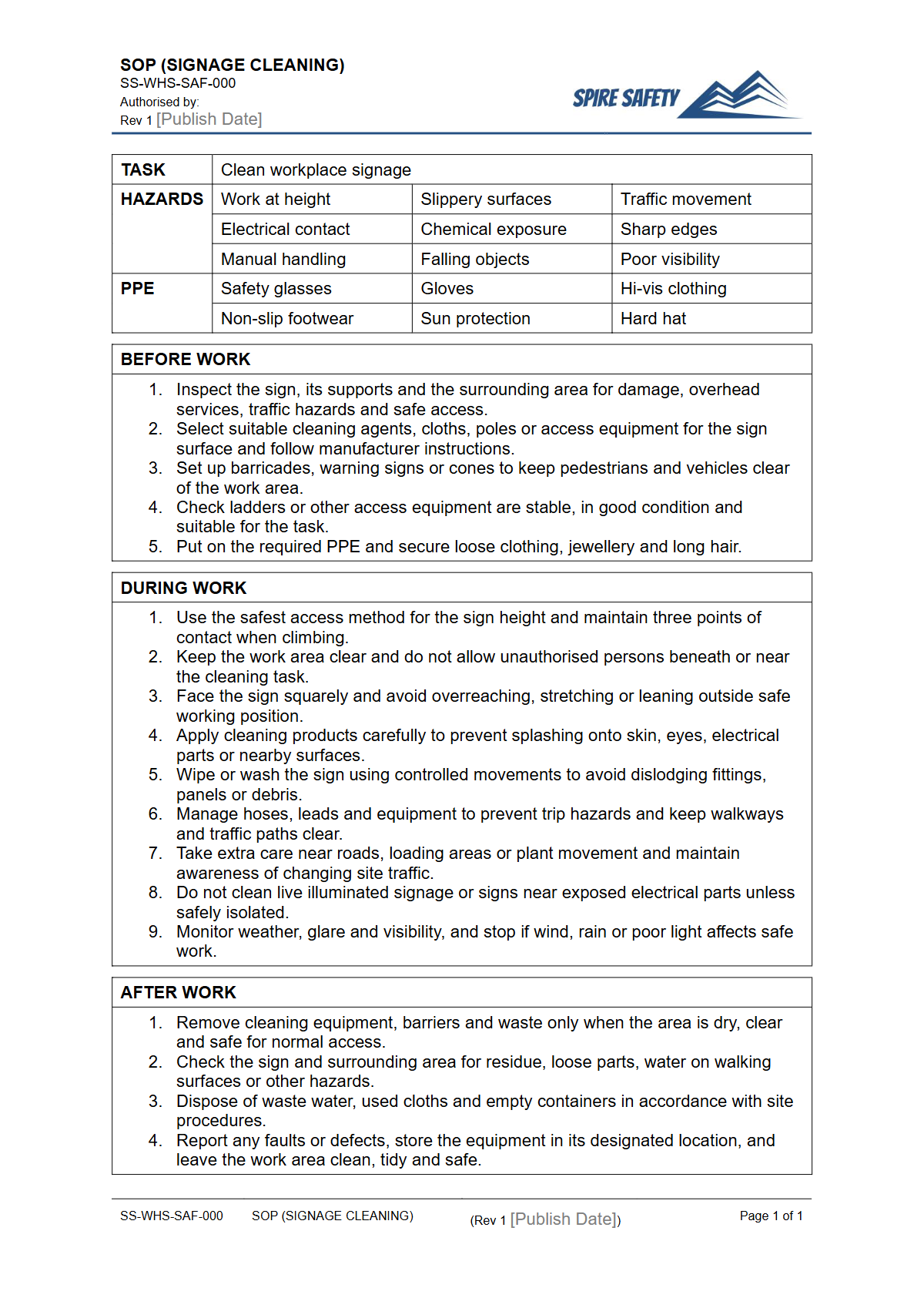
This free Safe Operating Procedure (Signage Cleaning) Template provides a structured starting point for documenting the safety requirements of cleaning signs at your workplace. By formalising your processes, you can effectively manage risks associated with working at heights, handling chemicals, and preventing slips, trips, and falls.
This document is an essential tool for demonstrating your commitment to a safe system of work. The primary purpose is to help your organisation establish and communicate a clear, step-by-step process for cleaning signage safely.
It prompts you to identify potential hazards and implement effective control measures. Key risks addressed include falls from ladders or platforms, musculoskeletal injuries from awkward postures or manual handling, exposure to hazardous cleaning chemicals, and slips on wet surfaces.
Integrating this procedure into your broader WHS management systems ensures a consistent approach to safety for this common but often overlooked task.
Video walkthrough
How to use the Free Safe Operating Procedure (Signage Cleaning) Template
To get started, download the template in your preferred format (DOCX or PDF). The DOCX version is fully editable, allowing you to tailor it to your specific operational needs.
You must customise this document to reflect your workplace's unique environment, equipment, and chemical products. We have provided a framework, but it is your responsibility to ensure the final Safe Operating Procedure is specific and accurate.
This includes listing the exact types of ladders or access equipment used, specifying the required Personal Protective Equipment (PPE) like gloves and safety glasses, and detailing emergency procedures. For complex tasks involving specialised equipment, consider referencing other specific procedures like a FREE Telehandler SOP Template if applicable.
What to include when customising your SOP:
- Site-Specific Hazards: Note any hazards unique to the location, such as uneven ground, overhead power lines, or vehicle traffic.
- Equipment List: Detail all tools and equipment, from ladders and squeegees to pressure washers, including pre-use inspection steps.
- Chemicals: List all cleaning agents by name and reference their Safety Data Sheets (SDS).
- Step-by-Step Instructions: Break down the task into clear, logical steps from preparation to clean-up.
- PPE Requirements: Specify the exact PPE required for each stage of the task (e.g., chemical-resistant gloves, non-slip footwear, safety glasses).
- Emergency Procedures: Outline steps for incidents like chemical spills, falls, or first aid requirements.
When to use it
This Safe Operating Procedure should be used as a primary reference document before any signage cleaning task commences. It is a critical resource for worker training and induction, ensuring all team members understand the approved, safe method for the job.
It should also be used for conducting pre-start checks and site-specific risk assessments for each location. The procedure serves as a benchmark for workplace inspections and should be reviewed and updated regularly, especially after an incident, when new equipment is introduced, or cleaning agents are changed.
Who should use it
This procedure is designed for use by multiple roles within an organisation. Workers and cleaning staff who perform the signage cleaning tasks must be trained in and follow the SOP to ensure their own safety and the safety of others.
Supervisors and team leaders should use it to induct new staff, oversee work, and verify that safety controls are being followed correctly. WHS managers and coordinators will find it useful for building a library of standardised procedures and for conducting periodic safety reviews.
These reviews can be part of a larger program of WHS compliance auditing to verify that documented processes match workplace practice.
Developing robust SOPs is a key part of the risk management process. It involves more than just writing a document; it requires consultation with the workers who actually perform the task, as their direct experience is invaluable for identifying practical hazards and effective controls.
If your organisation needs support developing or implementing effective safety documentation, engaging external expertise can provide clarity. Our team offers practical WHS consulting to help you build systems that work for your business.
When customising this template, pay close attention to the section on hazardous chemicals. Always reference the Safety Data Sheet (SDS) for each cleaning product used.
The SDS contains critical information on hazards, first aid measures, storage, and the correct PPE. Ensuring your SOP aligns with the SDS is a fundamental requirement for chemical safety.
Similarly, if tasks are performed near active machinery, you may need to cross-reference other SOPs, such as a procedure for an Free Air Compressor SOP (Safe Operating Procedure) Template, to manage concurrent operations safely.
This template is just one of many tools available to help you build a safer workplace. A comprehensive safety system is built from a collection of policies, procedures, checklists, and forms that cover all your operational risks.
We encourage you to explore our complete free WHS resources library for other templates that can support your safety objectives and help standardise safe work practices across your organisation.
Common mistakes
Common mistakes to avoid
- Using the wrong type of ladder for the job or over-reaching instead of repositioning it.
- Neglecting to read the Safety Data Sheet (SDS) for cleaning products before use.
- Failing to establish an exclusion zone to protect pedestrians and other workers from falling objects or spray.
- Wearing incorrect or insufficient Personal Protective Equipment (PPE) for the chemicals being handled.
Legal references
Legal considerations
The following legal requirements may be relevant to this type of work.
- Work Health and Safety Act (Harmonised) — Provides the primary duties for protecting workers and other people from work health and safety risks.
- Work Health and Safety Regulations (Harmonised) — Sets out requirements supporting the management of workplace hazards and risks.
The following codes may be relevant to this type of work.
- Managing WHS Risks Code of Practice — Provides practical guidance on identifying hazards, assessing risks and applying effective controls.
- Work Health and Safety Consultation, Cooperation and Coordination Code of Practice — Provides practical guidance on consulting workers and coordinating with other duty holders.
- Managing the Work Environment and Facilities Code of Practice — Provides practical guidance on safe work environments, workplace facilities and related controls.
Did you know
Slips, Trips, and Falls
Slips, trips, and falls are a leading cause of serious injuries in Australian workplaces, making housekeeping and management of wet surfaces critical during any cleaning task.
Chemical Dilution
Using a cleaning chemical at the wrong concentration can be dangerous. A stronger-than-needed solution can increase health risks and damage surfaces, while a weaker one may be ineffective.
FAQ
Frequently asked questions
01What are the main hazards involved in cleaning signage?
02Is a Safe Operating Procedure legally required for cleaning signs in Australia?
03How often should an SOP for signage cleaning be reviewed?
04Can I use this template for cleaning windows as well?
Share this resource
Free Safe Operating Procedure (Signage Cleaning) Template
Browse Categories
How To Use It
- 1Download and open in Word or PDF.
- 2Replace the placeholders with your business details.
- 3Get it reviewed by a WHS specialist before rollout.
Need it customised?
Our WHS consultants can adapt this template to your site, run a gap analysis, or audit what you already have in place.
Book a Free Consultation WHS consulting servicesor call 1300 156 382
Related templates
- Free Safe Operating Procedure (Silage Cover Removal) Template
- Free Safe Operating Procedure (Silicone Application) Template
- Free Safe Operating Procedure (Silo Aeration Fan) Template
- Free Safe Operating Procedure (Silo Level Probe) Template
- Free Safe Operating Procedure (Silo Unloading) Template
- Free Safe Operating Procedure (Site Litter Collection) Template