
Free Safe Operating Procedure (Shrink Wrapper) Template
Need a Safe Operating Procedure for a shrink wrapper? Download our free, customisable template to outline key hazards and control measures.
Free Safe Operating Procedure (Shrink Wrapper) Template
DOCX • 126 KB + PDF
Updated Oct 2026
No signup required
Purpose of the Free Safe Operating Procedure (Shrink Wrapper) Template
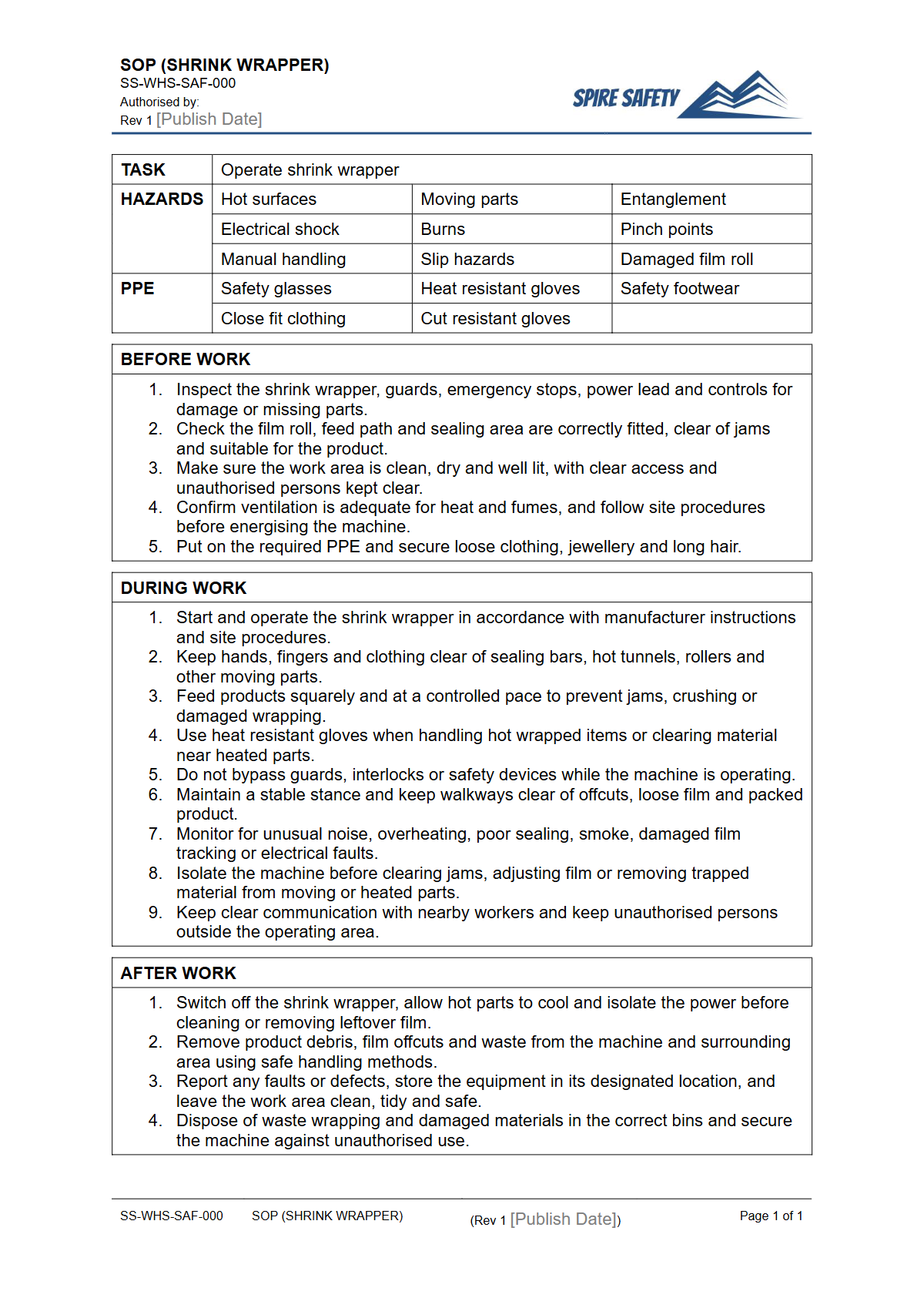
This Free Safe Operating Procedure (Shrink Wrapper) Template provides a structured starting point for documenting the safe use of shrink wrapping machinery in your workplace. A documented SOP is a critical tool for managing risks associated with plant and equipment.
It outlines step-by-step instructions to help operators perform their tasks safely and consistently, minimising the risk of injury from hazards like moving parts, hot surfaces, electrical components, and manual handling tasks.
Using this template helps your organisation meet its duty of care by formalising procedures and providing clear instructions for workers. It covers essential safety elements including pre-operational checks, specific operational steps, and emergency shutdown procedures.
For integrated production lines, this procedure should be used alongside documents for associated equipment; you can download a conveyor system SOP to ensure seamless safety from start to finish.
Video walkthrough
How to use the Free Safe Operating Procedure (Shrink Wrapper) Template
Using our Free Safe Operating Procedure (Shrink Wrapper) Template is straightforward. Simply select your preferred format—DOCX for easy editing or PDF for universal access—and download the file.
Once downloaded, you must systematically work through each section and adapt the content to match your specific workplace conditions and the particular model of shrink wrapper in use. This includes adding machine-specific details, site-specific emergency contacts, and any unique environmental hazards.
Important: It is crucial to understand that this document is a template, not a finished product. We have provided a comprehensive starting point aligned with Australian WHS principles, but you must customise the content.
The effectiveness and suitability of this Safe Operating Procedure depend entirely on your thorough customisation to reflect the specific shrink wrapper models, workplace environment, and operational processes unique to your organisation.
When to use a Shrink Wrapper Safe Operating Procedure
A Safe Operating Procedure for a shrink wrapper should be used consistently as a key part of your daily operations. It is not a document to be filed away and forgotten.
It should be readily accessible near the equipment and integrated into several key processes. Use it during new employee induction and specific operator training to establish a baseline of safe behaviour.
It should also be referenced for pre-start checks before every shift to ensure the machine is in safe working order. Furthermore, the SOP serves as a vital reference during refresher training and for supervisors monitoring correct procedure.
Reviewing and updating the SOP is also critical. A review should be triggered after any incident or near-miss, when a new model of shrink wrapper is introduced, if the process is modified, or on a regular basis (e.g., annually) as part of scheduled WHS compliance audits. This ensures the procedure remains relevant and effective.
Who should use this Safe Operating Procedure
This SOP is intended for a range of personnel within an organisation. The primary users are the machine operators, who will follow the step-by-step instructions to perform their work safely.
Supervisors and line managers should use the document to train staff, conduct competency assessments, and carry out workplace inspections to ensure procedures are being followed correctly. Maintenance personnel will also find it useful, particularly the sections on isolation and lockout/tagout procedures, before they commence any servicing or repair work.
Work Health and Safety (WHS) managers and committees will use the SOP as a key piece of evidence in their overall WHS management systems. It demonstrates that a systematic approach has been taken to identify hazards and implement controls for a specific piece of plant. It forms a cornerstone of the risk management process for the equipment, alongside risk assessments and training records.
For organisations looking to improve their safety documentation, our free WHS resources library offers a wide range of additional templates.
Associated Equipment
Shrink wrappers often rely on other plant to function, most commonly a source of compressed air for pneumatic components. The hazards associated with this equipment must also be managed.
If your setup includes this, it is best practice to have a corresponding air compressor SOP available to your team.
Common mistakes
Common mistakes to avoid
- Using a generic SOP without customising it for the specific machine model.
- Failing to detail emergency shutdown and lockout/tagout procedures correctly.
- Neglecting to include risks from associated tasks like loading heavy film rolls or clearing jams.
- Not providing practical, hands-on training to accompany the written procedure.
Legal references
Legal considerations
The following legal requirements may be relevant to this type of work.
- Work Health and Safety Act (Harmonised) — Provides the primary duties for protecting workers and other people from work health and safety risks.
- Work Health and Safety Regulations (Harmonised) — Sets out requirements supporting the management of workplace hazards and risks.
The following codes may be relevant to this type of work.
- Managing WHS Risks Code of Practice — Provides practical guidance on identifying hazards, assessing risks and applying effective controls.
- Work Health and Safety Consultation, Cooperation and Coordination Code of Practice — Provides practical guidance on consulting workers and coordinating with other duty holders.
- Managing the Work Environment and Facilities Code of Practice — Provides practical guidance on safe work environments, workplace facilities and related controls.
Did you know
Heat Hazard
Many shrink wrappers use heated elements or tunnels that can exceed 200°C. These components are a primary source of severe burns, especially if safety guards are missing or bypassed.
Film Fumes
The type of shrink film used (e.g., polyolefin, PVC) can affect machine settings and introduce different risks. Overheating certain films can release fumes, which should be assessed and controlled as part of your risk management process.
FAQ
Frequently asked questions
01What should be included in a shrink wrapper SOP?
02How often should a shrink wrapper SOP be reviewed?
03Is a shrink wrapper SOP a legal requirement in Australia?
04Can this template be used for all types of shrink wrappers?
Share this resource
Free Safe Operating Procedure (Shrink Wrapper) Template
Browse Categories
How To Use It
- 1Download and open in Word or PDF.
- 2Replace the placeholders with your business details.
- 3Get it reviewed by a WHS specialist before rollout.
Need it customised?
Our WHS consultants can adapt this template to your site, run a gap analysis, or audit what you already have in place.
Book a Free Consultation WHS consulting servicesor call 1300 156 382
Related templates
- Free Safe Operating Procedure (Shrub Hand Pruning) Template
- Free Safe Operating Procedure (Shrub Planting) Template
- Free Safe Operating Procedure (Side Rail Adjustment) Template
- Free Safe Operating Procedure (Signage Cleaning) Template
- Free Safe Operating Procedure (Silage Cover Removal) Template
- Free Safe Operating Procedure (Silicone Application) Template