
Free Safe Operating Procedure (Shower Commode Cleaning) Template
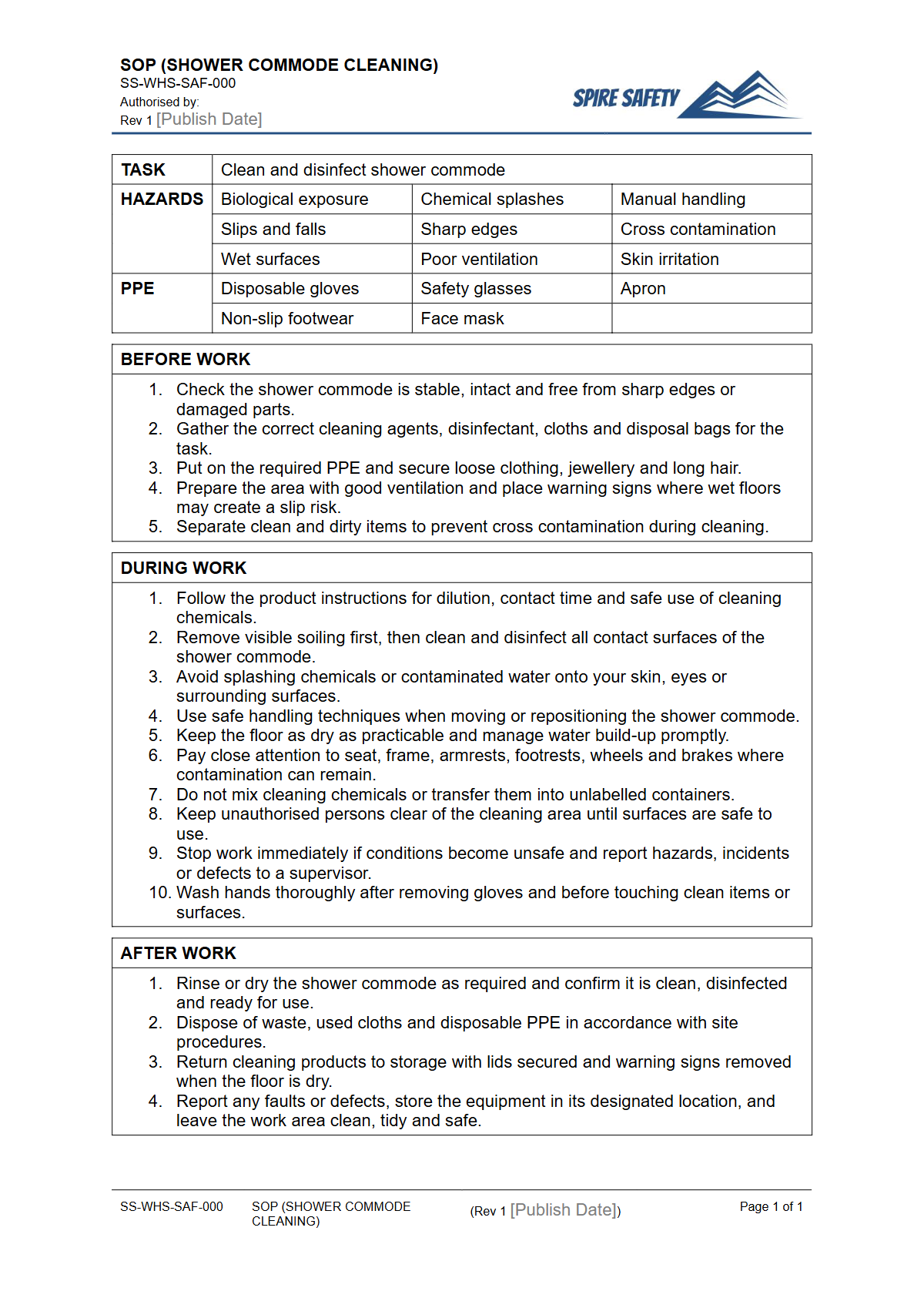
Our Safe Operating Procedure for shower commode cleaning provides a structured template for health and aged care settings.
Free Safe Operating Procedure (Shower Commode Cleaning) Template
DOCX • 126 KB + PDF
Updated Oct 2026
No signup required
Purpose of the Free Safe Operating Procedure (Shower Commode Cleaning) Template
Cleaning shower commodes is a routine but high-risk task in many healthcare, aged care, and disability support settings. This task presents significant hazards, including exposure to infectious agents, hazardous chemicals, and ergonomic strains.
Our Free Safe Operating Procedure (Shower Commode Cleaning) Template provides a structured framework to document and standardise your cleaning process. A clear, documented SOP is essential for managing health and safety risks, ensuring consistent hygiene standards, and providing a reliable training tool for staff.
It formalises the steps required to complete the task safely, protecting both workers and the vulnerable individuals in their care.
Implementing documented procedures like this SOP is a cornerstone of effective safety management. It demonstrates a commitment to meeting WHS obligations by systematically identifying hazards and implementing controls.
Integrating such procedures into broader WHS management systems helps create a robust safety culture where every task is assessed for risk and performed according to best practice.
Key Hazards Addressed by this Safe Operating Procedure
- Biological Hazards: Exposure to blood, body fluids, and other potentially infectious materials that can cause illness.
- Chemical Hazards: Incorrect handling, mixing, or use of disinfectants and cleaning agents, leading to skin irritation, respiratory issues, or chemical burns.
- Ergonomic Hazards: Manual handling risks associated with moving the commode, awkward postures during cleaning, and repetitive movements.
- Slips, Trips, and Falls: Wet floors during the cleaning process pose a significant risk to both the cleaner and others in the vicinity.
Video walkthrough
How to use the Free Safe Operating Procedure (Shower Commode Cleaning) Template
This Safe Operating Procedure template is provided as a downloadable DOCX file for easy editing and a PDF for quick reference. It is designed to be a comprehensive starting point, pre-filled with common steps and safety considerations relevant to cleaning shower commodes.
To make it effective for your organisation, you must adapt it to your specific context. This involves adding details about the exact equipment, cleaning chemicals (including Safety Data Sheet locations), personal protective equipment (PPE), and waste disposal methods used at your facility.
Important: This is a template, not a completed document. We have designed it as a structured starting point, and you must review, edit, and customise it to reflect the specific chemicals, equipment, PPE, and procedures unique to your workplace.
Generic procedures are insufficient; they must be site-specific to be effective and to support your safety obligations. The process of customising an SOP for a specific task is similar across different operational areas, whether for cleaning medical equipment or using commercial appliances as outlined in our Free Safe Operating Procedure (Deep Fryer - Standard Operation) Template.
When to use this Safe Operating Procedure
This SOP should be used as the primary guide whenever a shower commode requires cleaning. This typically occurs after each patient or resident use to prevent cross-contamination.
It should also be followed for scheduled deep cleaning and decontamination procedures. Beyond daily operations, this document serves as a critical tool for several key workplace activities:
- New Staff Induction: Training new carers, support workers, or cleaning staff on the established, safe procedure.
- Refresher Training: Conducting periodic reviews with existing staff to ensure standards are maintained and bad habits have not formed.
- Incident Investigation: Providing a benchmark of the expected procedure when investigating any incidents or near misses related to the task.
- Audits and Inspections: Demonstrating documented processes to internal or external auditors. Regular WHS compliance auditing often involves verifying that such procedures are in place and being followed correctly.
Who should use this Safe Operating Procedure
This SOP is intended for all personnel responsible for cleaning and maintaining patient and resident hygiene equipment. This includes, but is not limited to:
- Personal Care Assistants (PCAs) in aged care facilities.
- Assistants in Nursing (AINs) and nurses in hospitals and clinical settings.
- Disability Support Workers.
- Designated cleaning and environmental services staff.
Furthermore, managers, supervisors, and WHS representatives should use this template as a tool to fulfil their duty of care. They are responsible for ensuring the procedure is properly customised, communicated to all relevant staff, and consistently enforced.
For those looking to build a comprehensive suite of safety documents, our free WHS resources library offers a wide range of templates for various tasks and equipment.
Common mistakes
Common mistakes to avoid
- Using the wrong cleaning chemicals or incorrect dilution ratios, reducing effectiveness or creating hazards.
- Forgetting to inspect the commode for cracks, breaks, or damage before and after cleaning.
- Failing to rinse away disinfectant residue, which can cause skin irritation for the next user.
- Not allowing sufficient contact time for the disinfectant to work effectively against pathogens.
- Wearing contaminated PPE outside of the designated cleaning area, leading to cross-contamination.
Legal references
Legal considerations
The following legal requirements may be relevant to this type of work.
- Work Health and Safety Act (Harmonised) — Provides the primary duties for protecting workers and other people from work health and safety risks.
- Work Health and Safety Regulations (Harmonised) — Sets out requirements supporting the management of workplace hazards and risks.
The following codes may be relevant to this type of work.
- Managing WHS Risks Code of Practice — Provides practical guidance on identifying hazards, assessing risks and applying effective controls.
- Work Health and Safety Consultation, Cooperation and Coordination Code of Practice — Provides practical guidance on consulting workers and coordinating with other duty holders.
- Managing the Work Environment and Facilities Code of Practice — Provides practical guidance on safe work environments, workplace facilities and related controls.
Did you know
Infection Control
Healthcare-Associated Infections (HAIs) are a major patient safety issue. The Australian Commission on Safety and Quality in Health Care notes that contaminated equipment and surfaces are a key transmission pathway for these preventable infections.
FAQ
Frequently asked questions
01What kind of chemicals are used for cleaning a shower commode?
02How often does a shower commode need to be cleaned?
03What Personal Protective Equipment (PPE) is needed for cleaning a shower commode?
04Why is an SOP so important for a simple cleaning task?
Share this resource
Free Safe Operating Procedure (Shower Commode Cleaning) Template
Browse Categories
How To Use It
- 1Download and open in Word or PDF.
- 2Replace the placeholders with your business details.
- 3Get it reviewed by a WHS specialist before rollout.
Need it customised?
Our WHS consultants can adapt this template to your site, run a gap analysis, or audit what you already have in place.
Book a Free Consultation WHS consulting servicesor call 1300 156 382
Related templates
- Free Safe Operating Procedure (Shower Screen Cleaning) Template
- Free Safe Operating Procedure (Shower Trolley Check) Template
- Free Safe Operating Procedure (Shower Trolley Cleaning) Template
- Free Safe Operating Procedure (Shrink Wrapper) Template
- Free Safe Operating Procedure (Shrub Hand Pruning) Template
- Free Safe Operating Procedure (Shrub Planting) Template