
Free Safe Operating Procedure (Shoe Press) Template
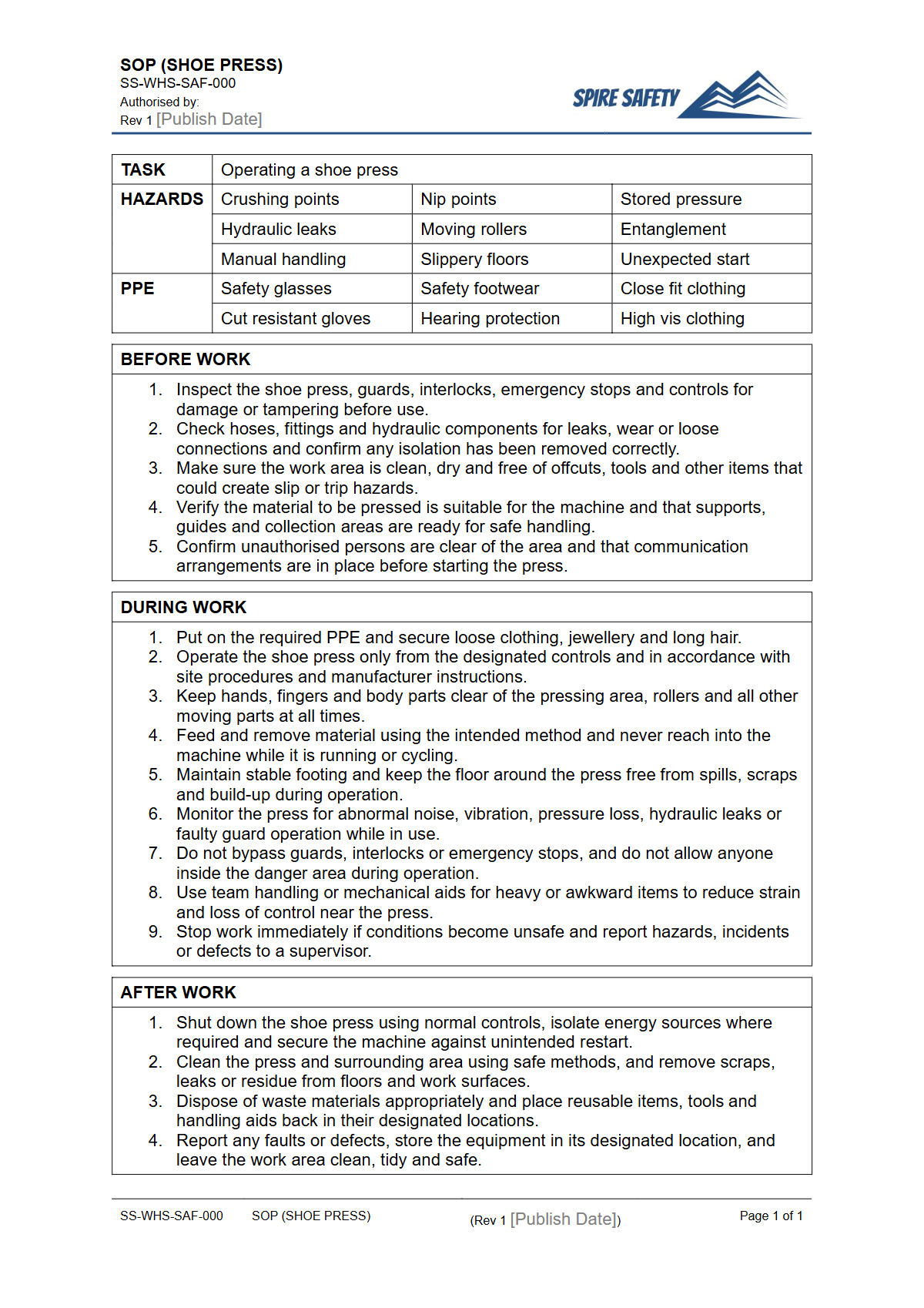
Control the hazards associated with shoe press operation using our structured Safe Operating Procedure template. Download the free DOCX file to get started.
Free Safe Operating Procedure (Shoe Press) Template
DOCX • 126 KB + PDF
Updated Oct 2026
No signup required
Purpose of the Free Safe Operating Procedure (Shoe Press) Template
Operating heavy machinery like a shoe press presents significant workplace hazards, including crushing, entanglement, and high-pressure fluid injection. Our Free Safe Operating Procedure (Shoe Press) Template provides a structured framework for documenting the safe and correct way to use this equipment.
An SOP is a fundamental administrative control that formalises a safe system of work. It outlines step-by-step instructions that help minimise risk, standardise operational tasks, and ensure every worker understands their safety obligations before, during, and after operation.
This document serves as a crucial tool for worker training, competency assessments, and ongoing supervision. By clearly defining the expected procedures and safety precautions, you create a repeatable and auditable process that supports your organisation's duty of care.
For related machinery, you may also find our free Hydraulic Press SOP template useful, as many shoe presses utilise similar systems.
Video walkthrough
How to use the Free Safe Operating Procedure (Shoe Press) Template
This resource is provided as a fully editable DOCX file, allowing for comprehensive customisation. To use it effectively, download the template and methodically work through each section, replacing the placeholder text with information specific to your machinery, environment, and organisational procedures.
It is critical to tailor the content to reflect the unique configuration and risks of the shoe press in your workplace. In many production lines, shoe presses work in conjunction with other equipment; consider documenting associated processes with resources like our free Conveyer System SOP template.
Important: This is a template, not a finished document. We have provided a structured starting point, but you must adapt it to your specific needs.
To do this effectively, consult with the machine operators and supervisors who use the equipment daily, review the manufacturer’s operating manual, and incorporate findings from your own specialist WHS consulting services or internal risk assessments.
When to use a Safe Operating Procedure
A Safe Operating Procedure for a shoe press should be a living document that is integrated into daily operations. It is not a file to be completed once and archived.
The SOP should be actively used in several key situations, including during the induction and training of new employees to ensure they receive consistent and safe instructions. It should also be used as a reference for periodic refresher training for experienced staff to prevent complacency and bad habits.
Supervisors can use the SOP as a checklist during safety observations or performance reviews to verify that tasks are being performed correctly. Furthermore, it is an essential reference document following an incident or near-miss to assist in investigations and identify any procedural gaps.
Regular WHS compliance auditing activities will often involve checking that SOPs are current, accurate, and being followed by workers.
Who should use this SOP
A well-drafted SOP is a valuable tool for multiple roles within an organisation. Primarily, it is for the machine operators who are directly responsible for the safe and efficient use of the shoe press.
It gives them a clear, authorised guide to follow for every task. Supervisors and managers must also be intimately familiar with the SOP to effectively train their teams, monitor work practices, and enforce safety standards.
They are responsible for ensuring the procedures outlined are practical and consistently applied.
Maintenance and engineering personnel should also use the SOP, particularly the sections on isolation, lockout/tagout (LOTO), and safe shutdown, before performing any servicing, repairs, or cleaning. Finally, WHS and HR personnel use SOPs as a cornerstone of their effective WHS management systems, helping to demonstrate that the organisation is taking proactive steps to manage risks and provide a safe workplace. For more templates and safety documents, browse our complete free WHS resources library.
Common mistakes
Common mistakes to avoid
- Failing to conduct thorough pre-start checks of safety guards, emergency stops, and hydraulic systems.
- Bypassing or disabling safety interlocks to speed up production or clear jams, exposing operators to moving parts.
- Neglecting to follow correct lockout/tagout (LOTO) procedures before maintenance, cleaning, or clearing a blockage.
- Using the incorrect PPE or not wearing it consistently, especially safety glasses and steel-capped boots.
Legal references
Legal considerations
The following legal requirements may be relevant to this type of work.
- Work Health and Safety Act (Harmonised) — Provides the primary duties for protecting workers and other people from work health and safety risks.
- Work Health and Safety Regulations (Harmonised) — Sets out requirements supporting the management of workplace hazards and risks.
The following codes may be relevant to this type of work.
- Managing WHS Risks Code of Practice — Provides practical guidance on identifying hazards, assessing risks and applying effective controls.
- Work Health and Safety Consultation, Cooperation and Coordination Code of Practice — Provides practical guidance on consulting workers and coordinating with other duty holders.
- Managing the Work Environment and Facilities Code of Practice — Provides practical guidance on safe work environments, workplace facilities and related controls.
Did you know
Industrial Application
While the name might suggest footwear, an industrial 'shoe press' is a large machine used in paper and pulp manufacturing. It uses a hydraulic system and a long, curved 'shoe' to press water out of the paper sheet, applying immense pressure over a wide area.
Energy of Motion
The primary danger from presses comes from stored energy. Even when powered off, hydraulic or pneumatic systems can retain pressure, and heavy components can move due to gravity, making robust lockout/tagout (LOTO) procedures absolutely critical before any maintenance.
FAQ
Frequently asked questions
01What are the primary hazards associated with operating a shoe press?
02Is an SOP a legal requirement for a shoe press in Australia?
03What key information must be included in a shoe press SOP?
04How often should our shoe press SOP be reviewed and updated?
Share this resource
Free Safe Operating Procedure (Shoe Press) Template
Browse Categories
How To Use It
- 1Download and open in Word or PDF.
- 2Replace the placeholders with your business details.
- 3Get it reviewed by a WHS specialist before rollout.
Need it customised?
Our WHS consultants can adapt this template to your site, run a gap analysis, or audit what you already have in place.
Book a Free Consultation WHS consulting servicesor call 1300 156 382
Related templates
- Free Safe Operating Procedure (Shopping Basket Clean) Template
- Free Safe Operating Procedure (Shopping Trolley Return) Template
- Free Safe Operating Procedure (Shower Area Descaling) Template
- Free Safe Operating Procedure (Shower Commode Cleaning) Template
- Free Safe Operating Procedure (Shower Screen Cleaning) Template
- Free Safe Operating Procedure (Shower Trolley Check) Template