
Free Safe Operating Procedure (Shopping Basket Clean) Template
Download our free Safe Operating Procedure (Shopping Basket Clean) template to ensure consistent hygiene standards.
Free Safe Operating Procedure (Shopping Basket Clean) Template
DOCX • 126 KB + PDF
Updated Oct 2026
No signup required
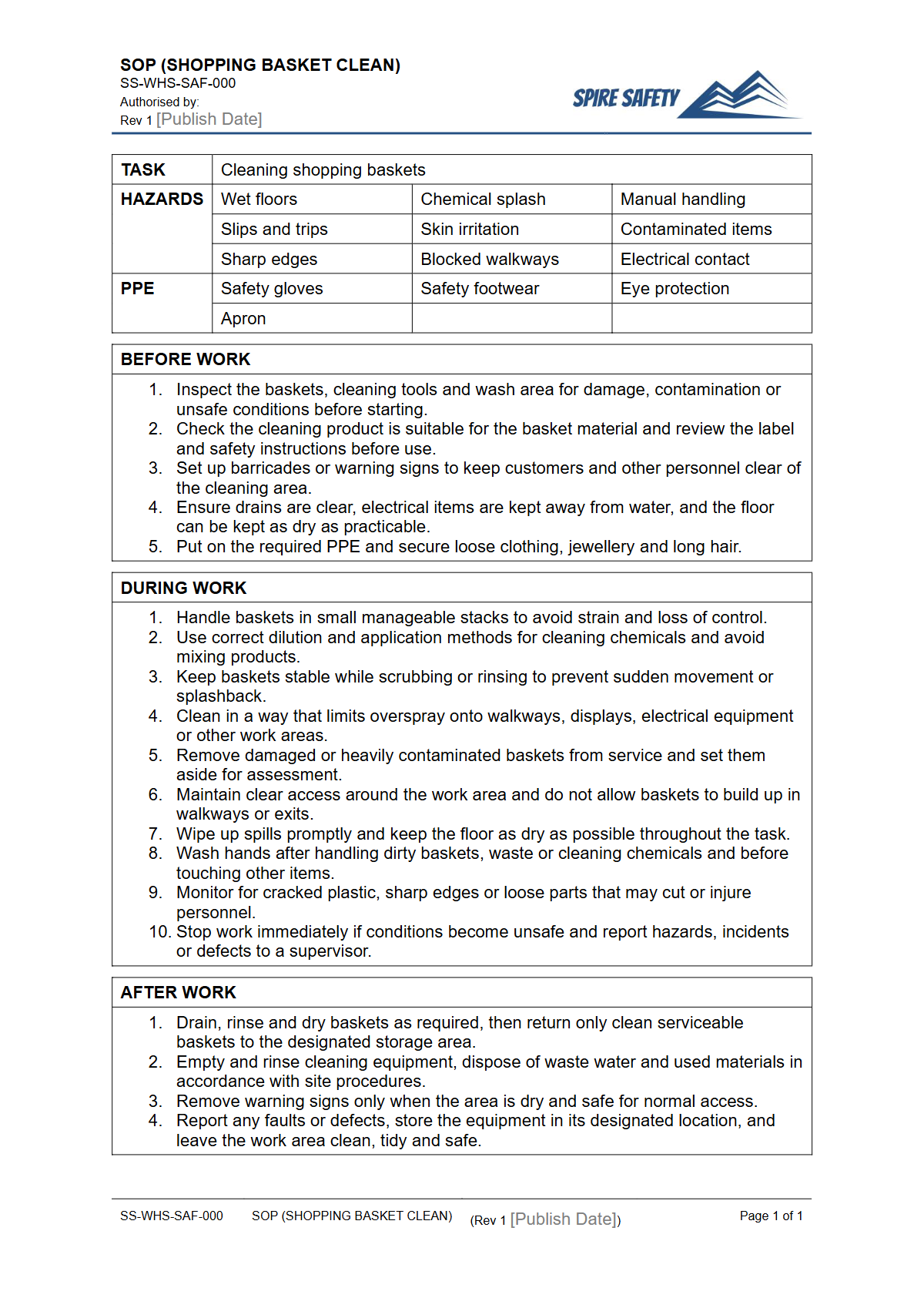
Purpose of the Free Safe Operating Procedure (Shopping Basket Clean) Template
This Free Safe Operating Procedure (Shopping Basket Clean) Template provides a structured framework for businesses to establish and document a consistent cleaning process for shopping baskets and trolleys. Its primary purpose is to ensure the health and safety of both employees and customers by minimising the transmission of germs and viruses.
A documented procedure helps standardise cleaning activities, ensures staff use correct personal protective equipment (PPE) and cleaning agents, and demonstrates a commitment to workplace hygiene and public health. Implementing a clear SOP also assists in training new staff and serves as a reference point for all employees, promoting a safer retail environment.
By outlining a step-by-step process, this SOP helps control hazards associated with manual tasks and chemical handling. A systematic approach to cleaning can significantly improve customer confidence and perception of your business.
While this document is a comprehensive starting point, it should be integrated into your broader WHS management system to ensure holistic safety management across all operations.
Video walkthrough
How to use the Free Safe Operating Procedure (Shopping Basket Clean) Template
Using this template effectively involves more than just downloading the file. It requires customisation to align with the unique context of your workplace.
Start by downloading the DOCX or PDF and reviewing the outlined steps. You should then adapt the content to specify the exact cleaning agents, dilution ratios, types of PPE, and cleaning equipment used in your facility.
It is crucial to consult with your employees during this process; their hands-on experience is invaluable for creating a practical and effective procedure.
Please note: this document is a template designed as a starting point. We are not WHS consultants providing specific advice for your business.
You must customise this Safe Operating Procedure to reflect the specific hazards, equipment, chemicals, and control measures relevant to your individual workplace. Once finalised, the SOP should be used as a primary tool for training staff on the cleaning task.
Ensure all relevant workers read, understand, and sign off on the procedure before undertaking the work unsupervised.
When to use it
A Safe Operating Procedure for cleaning shopping baskets should be implemented as part of a regular cleaning schedule. This may include cleaning baskets at set intervals throughout the day, as part of end-of-day closing duties, or on a less frequent but regular deep-cleaning schedule.
The frequency will depend on factors like customer traffic, the nature of the retail environment, and any public health directives in effect. The SOP should also be referenced immediately in the event of a spillage or contamination incident involving a basket or trolley.
For businesses that also handle food, maintaining clear procedures for all equipment is vital. This approach to hygiene can be applied to other areas, just as you would use a specific SOP for a deep fryer in a food service section to manage different risks.
Who should use it
This Safe Operating Procedure is intended for use by Persons Conducting a Business or Undertaking (PCBUs), such as retail store managers, operations managers, and Work Health and Safety (WHS) officers. They are responsible for adapting the template and implementing it within their safety management framework.
The finalised, site-specific SOP should then be used by all employees and contractors tasked with cleaning shopping baskets and trolleys. It is essential that anyone performing this task is thoroughly trained on the procedure to ensure they understand the steps, hazards, and control measures involved.
In larger retail environments like supermarkets or distribution centres, multiple SOPs are often required to cover various tasks and equipment. For instance, a similar methodical approach is needed for a Safe Operating Procedure for a conveyer system used in back-of-house operations.
Integrating SOPs into Your Safety Framework
A single Safe Operating Procedure is one component of a comprehensive safety system. To be effective, it must be supported by other WHS processes.
This includes conducting a risk assessment for the task, providing adequate training and instruction, and maintaining records of training and cleaning activities. The SOP itself should be regularly reviewed—at least annually or whenever there is a change in equipment, chemicals, or procedures—to ensure it remains current and effective.
Regular WHS compliance audits can help verify that your documented procedures are being followed correctly in practice.
Maintaining a library of task-specific SOPs ensures consistency and safety across all business operations. Whether your maintenance team is using an air compressor SOP for cleaning equipment or front-of-house staff are following this basket cleaning procedure, the principle remains the same: clear, documented instructions reduce risk. You can find more templates to build out your safety documentation in our free WHS resources library.
Common mistakes
Common mistakes to avoid
- Using incorrect chemicals or dilution ratios, which can damage baskets or be ineffective.
- Failing to provide or enforce the use of appropriate PPE, such as gloves and eye protection.
- Inconsistent application of the cleaning procedure due to inadequate staff training or supervision.
- Neglecting to keep records of cleaning schedules, which are important for due diligence and quality control.
Legal references
Legal considerations
The following legal requirements may be relevant to this type of work.
- Work Health and Safety Act (Harmonised) — Provides the primary duties for protecting workers and other people from work health and safety risks.
- Work Health and Safety Regulations (Harmonised) — Sets out requirements supporting the management of workplace hazards and risks.
The following codes may be relevant to this type of work.
- Managing WHS Risks Code of Practice — Provides practical guidance on identifying hazards, assessing risks and applying effective controls.
- Work Health and Safety Consultation, Cooperation and Coordination Code of Practice — Provides practical guidance on consulting workers and coordinating with other duty holders.
- Managing the Work Environment and Facilities Code of Practice — Provides practical guidance on safe work environments, workplace facilities and related controls.
Did you know
Surface Viability
Studies have shown that viruses and bacteria can survive on plastic and metal surfaces, like those on shopping baskets and trolleys, for hours or even days, highlighting the importance of regular and effective cleaning routines.
Customer Perception
Visible cleanliness is a major factor in customer perception and trust. A study by the International Journal of Hospitality Management found that cleanliness was one of the most significant predictors of customer satisfaction and loyalty.
FAQ
Frequently asked questions
01What should be included in an SOP for cleaning shopping baskets?
02How often should shopping baskets be cleaned?
03Are employers in Australia required to have an SOP for cleaning tasks?
04What type of cleaning agents are suitable for shopping baskets?
Share this resource
Free Safe Operating Procedure (Shopping Basket Clean) Template
Browse Categories
How To Use It
- 1Download and open in Word or PDF.
- 2Replace the placeholders with your business details.
- 3Get it reviewed by a WHS specialist before rollout.
Need it customised?
Our WHS consultants can adapt this template to your site, run a gap analysis, or audit what you already have in place.
Book a Free Consultation WHS consulting servicesor call 1300 156 382
Related templates
- Free Safe Operating Procedure (Shopping Trolley Return) Template
- Free Safe Operating Procedure (Shower Area Descaling) Template
- Free Safe Operating Procedure (Shower Commode Cleaning) Template
- Free Safe Operating Procedure (Shower Screen Cleaning) Template
- Free Safe Operating Procedure (Shower Trolley Check) Template
- Free Safe Operating Procedure (Shower Trolley Cleaning) Template