
Free Safe Operating Procedure (Ship Waste Handling) Template
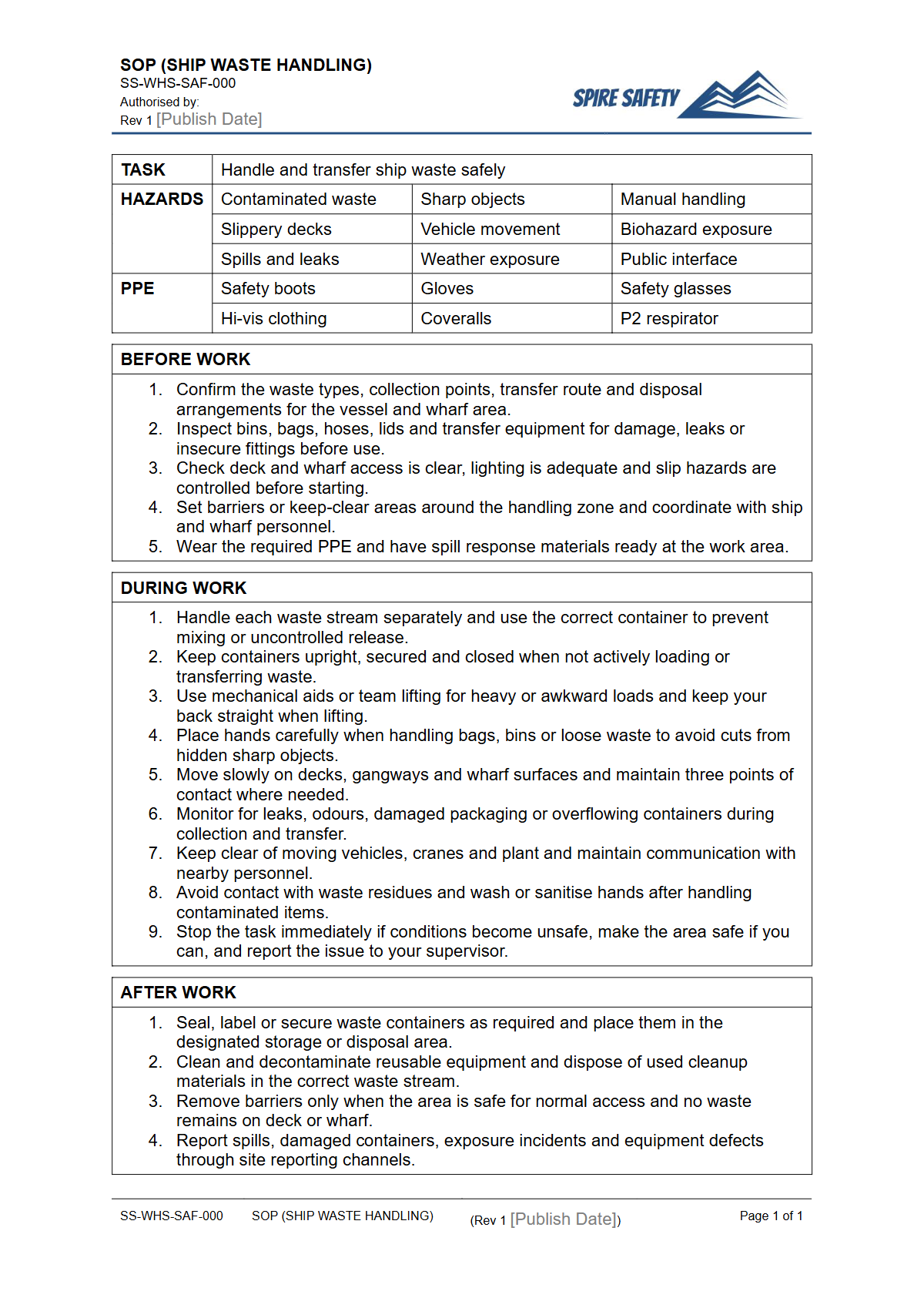
Download our free Safe Operating Procedure (Ship Waste Handling) Template to formalise your waste management processes. Customise this structured DOCX or PDF.
Free Safe Operating Procedure (Ship Waste Handling) Template
DOCX • 126 KB + PDF
Updated Oct 2026
No signup required
Purpose of the Free Safe Operating Procedure (Ship Waste Handling) Template
Managing waste from vessels is a critical task with significant safety and environmental implications. This free Safe Operating Procedure (Ship Waste Handling) Template provides a structured framework for documenting the required steps to safely collect, segregate, store, and dispose of various waste streams.
These can include general garbage, food waste, recyclables, quarantine waste, and hazardous materials like oils and chemicals. Formalising your process helps control risks such as manual handling injuries, exposure to biological hazards, chemical spills, and non-compliance with strict biosecurity regulations.
A well-defined SOP is a fundamental component of a proactive safety culture. It serves as a clear, actionable guide for workers, reducing ambiguity and the likelihood of incidents.
By integrating this procedure into your daily operations, you demonstrate a commitment to protecting your people and the environment. This document should form part of your organisation's broader safety framework, which can be strengthened by implementing comprehensive WHS management systems.
Video walkthrough
How to use the Free Safe Operating Procedure (Ship Waste Handling) Template
To begin, download the Safe Operating Procedure (Ship Waste Handling) Template in your preferred format (DOCX for easy editing or PDF). The document is structured with key sections including pre-operational checks, step-by-step instructions for the task, potential hazards, and required personal protective equipment (PPE).
It is designed to align with Australian WHS principles and provide a robust starting point for your organisation.
It is crucial to remember that this document is a template. We have designed it as a starting point, and you must adapt it to reflect the specific equipment, processes, and risks present in your workplace.
Conduct a thorough risk assessment for your ship waste handling activities and customise the SOP to include your site-specific controls, machinery details (e.g., compactors, cranes), and emergency contact information. For complex port operations where waste is moved mechanically, you may also need procedures for specific plant, such as those covered in our FREE Conveyer System SOP (Safe Operating Procedure) Template.
When to use a Safe Operating Procedure
A Safe Operating Procedure for ship waste handling should be developed, finalised, and communicated before any worker undertakes the task. It is a vital training tool for inducting new personnel and serves as a consistent reference for experienced staff.
The SOP should be readily accessible in the work area where waste handling occurs, whether that's on the wharf, in a storage facility, or on the vessel itself.
This procedure is not a static document. It should be reviewed regularly—at least annually—or whenever there is a change in equipment, processes, or legislation.
It must also be reviewed immediately following any incident or near-miss to identify and implement corrective actions. Periodic reviews, which can be supported by formal WHS compliance auditing, ensure the procedure remains effective and relevant to your operational risks.
Who should use this Safe Operating Procedure
This template is intended for use by any person conducting a business or undertaking (PCBU) involved in maritime operations. This includes port authorities, terminal operators, stevedoring companies, vessel owners and operators, and waste management contractors.
WHS Managers and Environmental Officers will find it particularly useful for drafting and implementing formal safety processes.
The finalised SOP is for the workers who perform the task directly. This includes ship's crew, wharfies, and specialised waste disposal teams who need clear instructions to perform their duties safely. For tasks that involve moving large waste containers or bins around a port facility, workers may also need training on relevant machinery, which would be covered by a separate SOP like our FREE Telehandler SOP Template.
Regular maintenance of waste handling equipment is also essential for safety. Some maintenance tasks may require their own procedures, such as for equipment powered by compressed air, which can be detailed using a resource like our Free Air Compressor SOP (Safe Operating Procedure) Template. For complex scenarios or if you lack in-house expertise, seeking external advice from qualified professionals is recommended.
Our team provides dedicated WHS consulting to help businesses navigate their safety obligations.
This document is one of many resources designed to support Australian businesses in managing their safety obligations. You can explore our complete free WHS resources library for more templates, checklists, and guides.
Common mistakes
Common mistakes to avoid
- Failing to correctly segregate different waste streams, leading to cross-contamination and biosecurity breaches.
- Using inadequate or damaged Personal Protective Equipment (PPE) when handling potentially hazardous or infectious materials.
- Poor record-keeping for waste transfer and disposal, which is often a legal requirement.
- Neglecting to check specific port authority or state-based regulations, which can be stricter than national standards.
Legal references
Legal considerations
The following legal requirements may be relevant to this type of work.
- Work Health and Safety Act (Harmonised) — Provides the primary duties for protecting workers and other people from work health and safety risks.
- Work Health and Safety Regulations (Harmonised) — Sets out requirements supporting the management of workplace hazards and risks.
The following codes may be relevant to this type of work.
- Managing WHS Risks Code of Practice — Provides practical guidance on identifying hazards, assessing risks and applying effective controls.
- Work Health and Safety Consultation, Cooperation and Coordination Code of Practice — Provides practical guidance on consulting workers and coordinating with other duty holders.
- Managing the Work Environment and Facilities Code of Practice — Provides practical guidance on safe work environments, workplace facilities and related controls.
Did you know
MARPOL Annex V
The International Convention for the Prevention of Pollution from Ships (MARPOL) Annex V makes it illegal to discharge most types of garbage from ships at sea. This has made compliant shore-based waste reception facilities a critical part of global maritime infrastructure.
Biosecurity Risks
Food waste and other organic materials from international vessels are treated as high-risk quarantine waste in Australia. This is to prevent the introduction of foreign pests and diseases that could devastate local agriculture and ecosystems.
FAQ
Frequently asked questions
01What is a Safe Operating Procedure for ship waste handling?
02Who is responsible for managing ship waste in Australia?
03What types of waste are covered in this SOP template?
04Why is it important to customise this SOP template?
Share this resource
Free Safe Operating Procedure (Ship Waste Handling) Template
Browse Categories
How To Use It
- 1Download and open in Word or PDF.
- 2Replace the placeholders with your business details.
- 3Get it reviewed by a WHS specialist before rollout.
Need it customised?
Our WHS consultants can adapt this template to your site, run a gap analysis, or audit what you already have in place.
Book a Free Consultation WHS consulting servicesor call 1300 156 382
Related templates
- Free Safe Operating Procedure (Shock Absorber Change) Template
- Free Safe Operating Procedure (Shoe Press) Template
- Free Safe Operating Procedure (Shopping Basket Clean) Template
- Free Safe Operating Procedure (Shopping Trolley Return) Template
- Free Safe Operating Procedure (Shower Area Descaling) Template
- Free Safe Operating Procedure (Shower Commode Cleaning) Template