
Free Safe Operating Procedure (Shock Absorber Change) Template
Download our free Safe Operating Procedure for changing shock absorbers to formalise your workshop safety processes. This structured template is a great start.
Free Safe Operating Procedure (Shock Absorber Change) Template
DOCX • 126 KB + PDF
Updated Oct 2026
No signup required
Purpose of the Free Safe Operating Procedure (Shock Absorber Change) Template
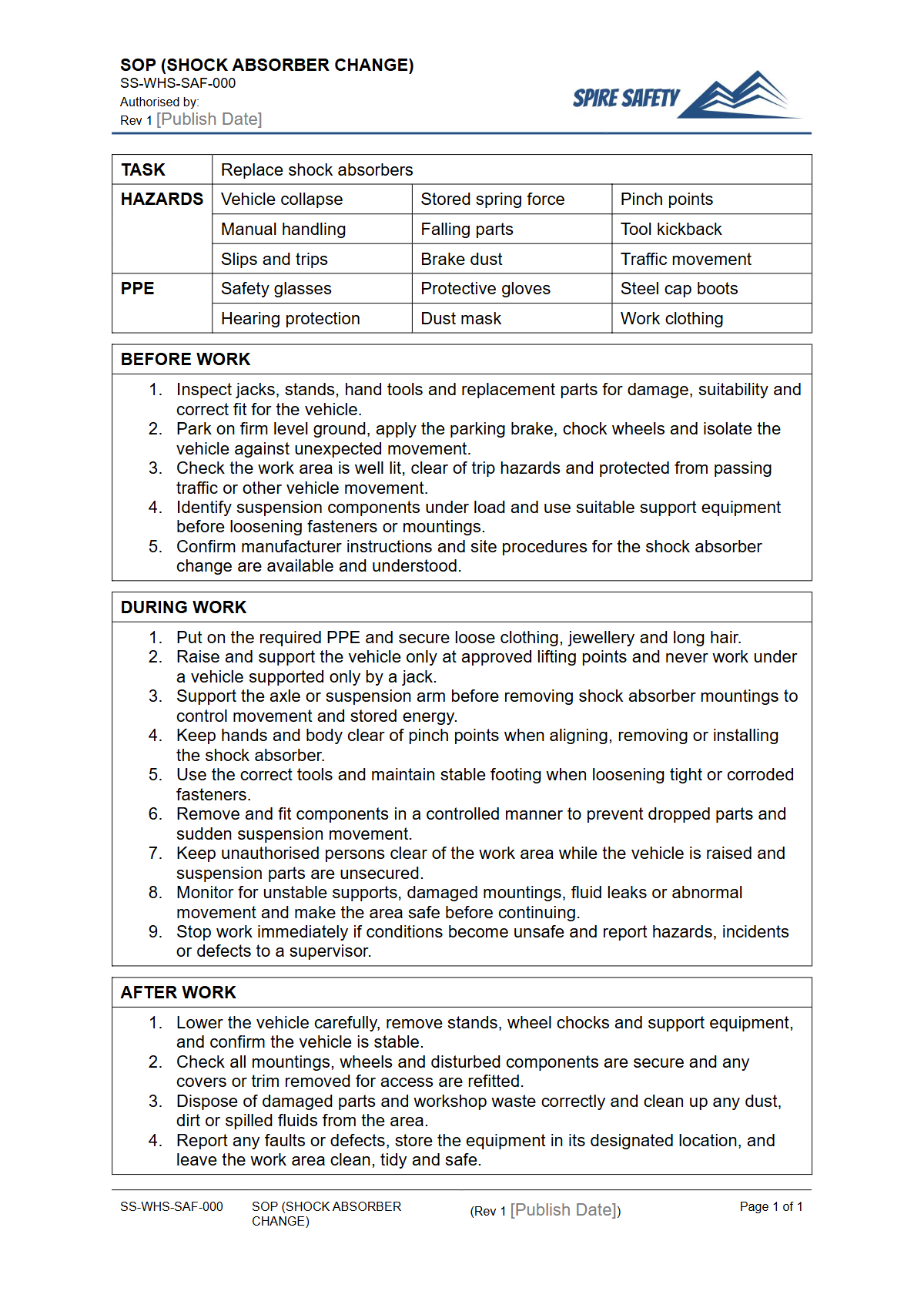
Changing a vehicle's shock absorbers is a common task in automotive workshops, but it involves significant hazards that must be controlled. This Free Safe Operating Procedure (Shock Absorber Change) Template provides a structured framework for documenting the step-by-step process, helping your business meet its work health and safety obligations.
A well-drafted Safe Operating Procedure (SOP) is a critical tool for ensuring tasks are performed consistently and safely by all workers.
This template guides you in outlining key safety elements, including pre-operational checks, required personal protective equipment (PPE), and the specific sequence of actions to remove and install shock absorbers safely. By formalising your process, you create a valuable resource for training new mechanics and a clear standard for competent workers, reducing the risk of injuries related to vehicle stability, stored energy, and manual handling. Documenting procedures for all workshop equipment is a key part of a safe system of work, which can also include procedures outlined in our free Air Compressor SOP.
Key Hazards in Shock Absorber Replacement
An effective SOP must address the specific risks of the task. When customising this template, pay close attention to controlling hazards such as:
- Vehicle Instability: The primary risk is the vehicle falling if not properly supported. The SOP must mandate the use of correctly rated vehicle hoists or axle stands on a firm, level surface. Relying on a jack alone is a critical and often fatal mistake.
- Stored Energy: MacPherson strut assemblies contain a coil spring compressed under extreme tension. If this energy is released uncontrollably during disassembly, components can be ejected with lethal force. The procedure must specify the use of appropriate, well-maintained spring compressors.
- Crush and Pinch Points: Working in and around wheel wells and suspension components creates numerous pinch and crush points for hands and limbs.
- Manual Handling: Lifting wheels, tyres, and heavy suspension components can lead to musculoskeletal injuries if not performed with correct technique or mechanical aids.
- Hazardous Substances: Exposure to hydraulic fluid, brake dust, and cleaning solvents can pose health risks.
Video walkthrough
How to use the Free Safe Operating Procedure (Shock Absorber Change) Template
This resource is provided in both DOCX and PDF formats. The DOCX file is fully editable, allowing you to tailor the content directly to your operational needs.
We recommend engaging with your mechanics and workshop supervisors during the customisation process to ensure the SOP reflects practical, on-the-ground realities.
IMPORTANT: This document is a template and not a complete SOP. To be effective and support your safety obligations, you must customise it for your specific workplace.
We have included prompts and standard sections, but you are responsible for adding details about the specific vehicles you service, the tools and equipment you use, your workshop environment, and the competency requirements for your personnel.
A single SOP is just one component of a holistic safety strategy. For your procedures to be truly effective, they need to be integrated into broader WHS management systems that cover training, supervision, incident reporting, and regular reviews.
When to use this Safe Operating Procedure
This SOP should be used as a primary safety and training document for all shock absorber replacement tasks. It is particularly valuable in the following scenarios:
- Worker Training: Use it to induct and train new mechanics or apprentices, ensuring they understand the approved, safe method from day one.
- Pre-Task Planning: Workers should review the SOP before starting the job, especially if it is performed infrequently.
- Refresher Training: It serves as an excellent basis for periodic refresher training sessions to prevent procedural drift and complacency.
- Incident Investigations: Following an incident or near-miss, the SOP can be reviewed to identify if the procedure was followed and whether it needs improvement.
Documenting procedures for all types of plant is essential for managing risk. While the principles are similar, the specifics for complex machinery like those covered in our Telehandler SOP Template will vary significantly, highlighting the need for task-specific documentation.
Who should use this document
This SOP template is designed for use by various personnel within a vehicle maintenance or repair business:
- Persons Conducting a Business or Undertaking (PCBUs): Business owners and managers can use it to fulfil their primary duty of care to provide and maintain safe systems of work.
- Workshop Supervisors: Foremen and supervisors can use it to enforce safety standards, conduct training, and monitor compliance on the workshop floor.
- WHS/HSE Officers: Safety professionals can integrate this template into the organisation's overall safety management system. Regular reviews of SOPs and work practices are a core component of routine WHS compliance auditing.
- Workers: Competent mechanics and technicians who perform the task should use the finalised SOP as their guide to performing the work safely and correctly.
The principles of identifying hazards, assessing risks, and outlining control measures are universal across different types of plant maintenance. Similar structured thinking is required when developing procedures for heavy equipment, such as those found in our free Grader SOP.
This template is one of many available in our comprehensive free WHS resources library, which offers a wide range of documents to help you build out your safety systems.
Common mistakes
Common mistakes to avoid
- Failing to properly support the vehicle on correctly rated axle stands, relying only on a jack.
- Using incorrect or damaged tools, especially for compressing coil springs.
- Not wearing appropriate personal protective equipment (PPE), particularly impact-rated safety glasses.
- Neglecting to consult the vehicle manufacturer's specific service manual for torque specifications and unique procedures.
Legal references
Legal considerations
The following legal requirements may be relevant to this type of work.
- Work Health and Safety Act (Harmonised) — Provides the primary duties for protecting workers and other people from work health and safety risks.
- Work Health and Safety Regulations (Harmonised) — Sets out requirements supporting the management of workplace hazards and risks.
The following codes may be relevant to this type of work.
- Managing WHS Risks Code of Practice — Provides practical guidance on identifying hazards, assessing risks and applying effective controls.
- Work Health and Safety Consultation, Cooperation and Coordination Code of Practice — Provides practical guidance on consulting workers and coordinating with other duty holders.
- Managing the Work Environment and Facilities Code of Practice — Provides practical guidance on safe work environments, workplace facilities and related controls.
Did you know
Stored Energy Hazard
A compressed coil spring in a vehicle's strut assembly stores an immense amount of potential energy. Uncontrolled release during removal can be catastrophic, launching components with enough force to cause fatal injury.
Hydraulic Injection Injury
While rare, puncturing a pressurised gas shock absorber can lead to a high-pressure injection of hydraulic fluid into the skin. This is a serious medical emergency that can cause severe tissue damage and requires immediate specialist treatment.
FAQ
Frequently asked questions
01What is the difference between an SOP and a SWMS for changing a shock absorber?
02How often should an SOP for shock absorber replacement be reviewed?
03Is this template suitable for heavy vehicles like trucks or buses?
04Do I need a qualification to change a shock absorber in a workplace?
Share this resource
Free Safe Operating Procedure (Shock Absorber Change) Template
Browse Categories
How To Use It
- 1Download and open in Word or PDF.
- 2Replace the placeholders with your business details.
- 3Get it reviewed by a WHS specialist before rollout.
Need it customised?
Our WHS consultants can adapt this template to your site, run a gap analysis, or audit what you already have in place.
Book a Free Consultation WHS consulting servicesor call 1300 156 382
Related templates
- Free Safe Operating Procedure (Shoe Press) Template
- Free Safe Operating Procedure (Shopping Basket Clean) Template
- Free Safe Operating Procedure (Shopping Trolley Return) Template
- Free Safe Operating Procedure (Shower Area Descaling) Template
- Free Safe Operating Procedure (Shower Commode Cleaning) Template
- Free Safe Operating Procedure (Shower Screen Cleaning) Template