
Free Safe Operating Procedure (Sheet Pile Driver) Template
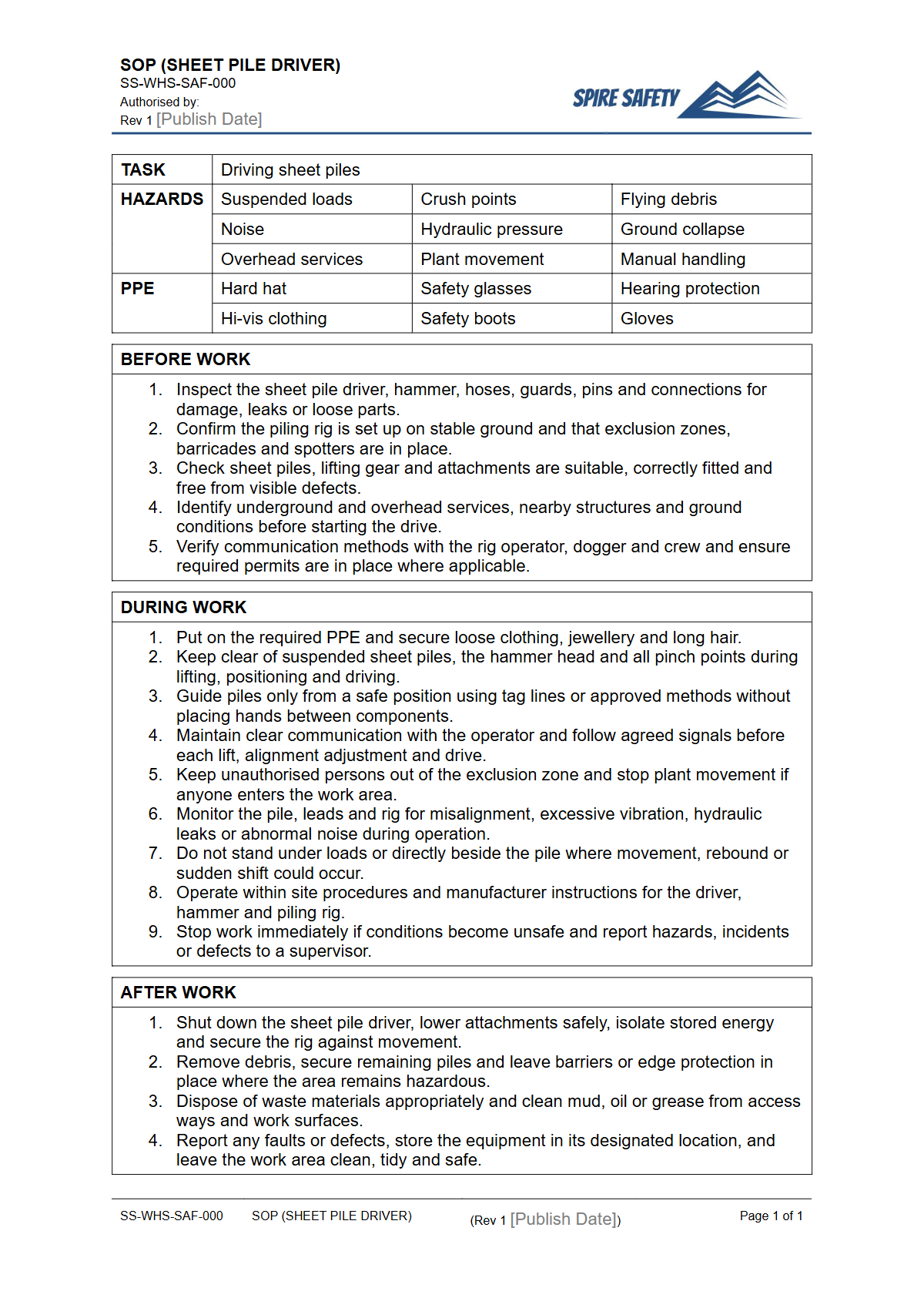
Download our free Safe Operating Procedure (Sheet Pile Driver) Template. This customisable DOCX and PDF helps define safe work methods for sheet piling.
Free Safe Operating Procedure (Sheet Pile Driver) Template
DOCX • 126 KB + PDF
Updated Oct 2026
No signup required
Purpose of the Free Safe Operating Procedure (Sheet Pile Driver) Template
Operating a sheet pile driver involves significant risks, including ground instability, noise exposure, vibration, and the potential for striking underground services. This free Safe Operating Procedure (Sheet Pile Driver) Template provides a structured starting point for developing a comprehensive, step-by-step guide to performing this task safely.
By documenting the required pre-operational checks, procedural steps, and emergency responses, you can formalise safety expectations and reduce the risk of incidents on your worksite. Using a standardised SOP helps ensure that all operators follow the same approved, safe methods for every task.
An SOP is a critical component for managing workplace hazards. It forms part of a broader safety framework that demonstrates due diligence and helps build a strong safety culture.
A well-developed SOP is a foundational document within a company's WHS management system, providing clear instructions to workers and evidence of risk management to regulators.
Video walkthrough
How to use the Free Safe Operating Procedure (Sheet Pile Driver) Template
This document is provided in both DOCX and PDF formats for your convenience. The DOCX file is fully editable, allowing you to tailor the content to the specific requirements of your project and organisation.
You should add your company branding and review every section to ensure it aligns with your operational reality. It is crucial to conduct a site-specific risk assessment and use its findings to inform the controls and steps documented in your final SOP.
Important: This is a template only. It must be customised to reflect your specific equipment, ground conditions, personnel, and internal procedures.
We are not responsible for any incidents arising from the use of an unmodified template. Your final document should be a unique tool developed for your workplace.
While this procedure covers the sheet pile driver, many construction sites utilise other specialised machinery for groundworks. For related tasks, you may find our FREE Trencher SOP Template a useful addition to your safety documentation library.
What to Include in Your Customisation
When adapting the template, ensure you include details specific to your operation, such as:
- The specific make and model of the sheet pile driver and any attachments.
- A detailed pre-start inspection checklist relevant to the equipment.
- Clearly defined exclusion zones and the methods for enforcing them.
- Communication protocols, including hand signals between the operator and spotter/dogger.
- Procedures for managing risks like noise, silica dust, and vibration.
- Emergency response steps, including actions to take if underground services are struck.
When to use a Safe Operating Procedure
A finalised SOP for a sheet pile driver should be used as a core operational document throughout the project lifecycle. It serves as an essential resource during worker training and induction, ensuring everyone understands the established safe work method before commencing work.
The SOP should also be referenced during pre-start meetings and toolbox talks to reinforce key safety points. Following an incident or near miss, the SOP becomes a critical document for review to identify any gaps or areas for improvement in the procedure.
Regular reviews ensure that safety documents remain current and effective. A periodic WHS compliance audit can provide external verification that your SOPs are being implemented correctly and continue to meet regulatory expectations.
Who should use it
The development and approval of this Safe Operating Procedure template are typically overseen by individuals with safety responsibilities. This includes WHS Advisors, Site Managers, Project Managers, and the Person Conducting a Business or Undertaking (PCBU).
They are responsible for ensuring the final document is accurate, comprehensive, and effectively manages risk. The end-users of the completed SOP are the workers directly involved in the task, including the plant operator, spotters, doggers, and supervisors who must follow the procedure to ensure their safety and the safety of others.
Many job sites feature a variety of heavy equipment, each requiring its own safety documentation. If your project also involves material handling with mobile plant, our FREE Telehandler SOP Template can help you establish safe practices for that task.
Furthermore, operators must have the necessary training and competency for all equipment they use. For other common earthmoving plant, having a clear procedure is just as important.
Our FREE Grader SOP Template can provide a starting point for managing grader operations.
This document is one of many tools designed to assist Australian businesses. For more templates and checklists covering a wide range of tasks and equipment, browse our complete free WHS resources library.
Common mistakes
Common mistakes to avoid
- Failing to customise the template for the specific make and model of the pile driver being used.
- Neglecting to conduct and incorporate findings from a site-specific risk assessment before finalising the procedure.
- Using the SOP as a substitute for proper operator training, licensing, and competency verification.
- Not clearly defining and enforcing exclusion zones or communication protocols between the operator and ground crew.
Legal references
Legal considerations
The following legal requirements may be relevant to this type of work.
- Work Health and Safety Act (Harmonised) — Provides the primary duties for protecting workers and other people from work health and safety risks.
- Work Health and Safety Regulations (Harmonised) — Sets out requirements supporting the management of workplace hazards and risks.
The following codes may be relevant to this type of work.
- Managing WHS Risks Code of Practice — Provides practical guidance on identifying hazards, assessing risks and applying effective controls.
- Work Health and Safety Consultation, Cooperation and Coordination Code of Practice — Provides practical guidance on consulting workers and coordinating with other duty holders.
- Managing the Work Environment and Facilities Code of Practice — Provides practical guidance on safe work environments, workplace facilities and related controls.
Did you know
Vibration Hazards
Operating vibratory pile drivers can expose workers to Hand-Arm Vibration (HAV) and Whole-Body Vibration (WBV). Long-term exposure can lead to serious and permanent health conditions, known as 'vibration white finger'.
Underground Services
Striking underground utilities like gas or electricity is a severe risk in piling. A 'Dial Before You Dig' report is a mandatory first step but does not replace the need for physical detection methods like non-destructive trenching.
FAQ
Frequently asked questions
01What is the difference between a SWMS and an SOP for a sheet pile driver?
02Does this sheet pile driver SOP template cover all legal requirements?
03Who is responsible for creating and implementing the SOP on site?
04How often should a Safe Operating Procedure for a sheet pile driver be reviewed?
Share this resource
Free Safe Operating Procedure (Sheet Pile Driver) Template
Browse Categories
How To Use It
- 1Download and open in Word or PDF.
- 2Replace the placeholders with your business details.
- 3Get it reviewed by a WHS specialist before rollout.
Need it customised?
Our WHS consultants can adapt this template to your site, run a gap analysis, or audit what you already have in place.
Book a Free Consultation WHS consulting servicesor call 1300 156 382
Related templates
- Free Safe Operating Procedure (Sheet Sander) Template
- Free Safe Operating Procedure (Shelf Label Gun) Template
- Free Safe Operating Procedure (Ship Cabin Cleaning) Template
- Free Safe Operating Procedure (Ship Galley Cleaning) Template
- Free Safe Operating Procedure (Ship Waste Handling) Template
- Free Safe Operating Procedure (Shock Absorber Change) Template