
Free Safe Operating Procedure (Sheet Sander) Template
Manage risks from sheet sander use with our free Safe Operating Procedure template. This customisable guide helps you create a step-by-step safety document.
Free Safe Operating Procedure (Sheet Sander) Template
DOCX • 126 KB + PDF
Updated Oct 2026
No signup required
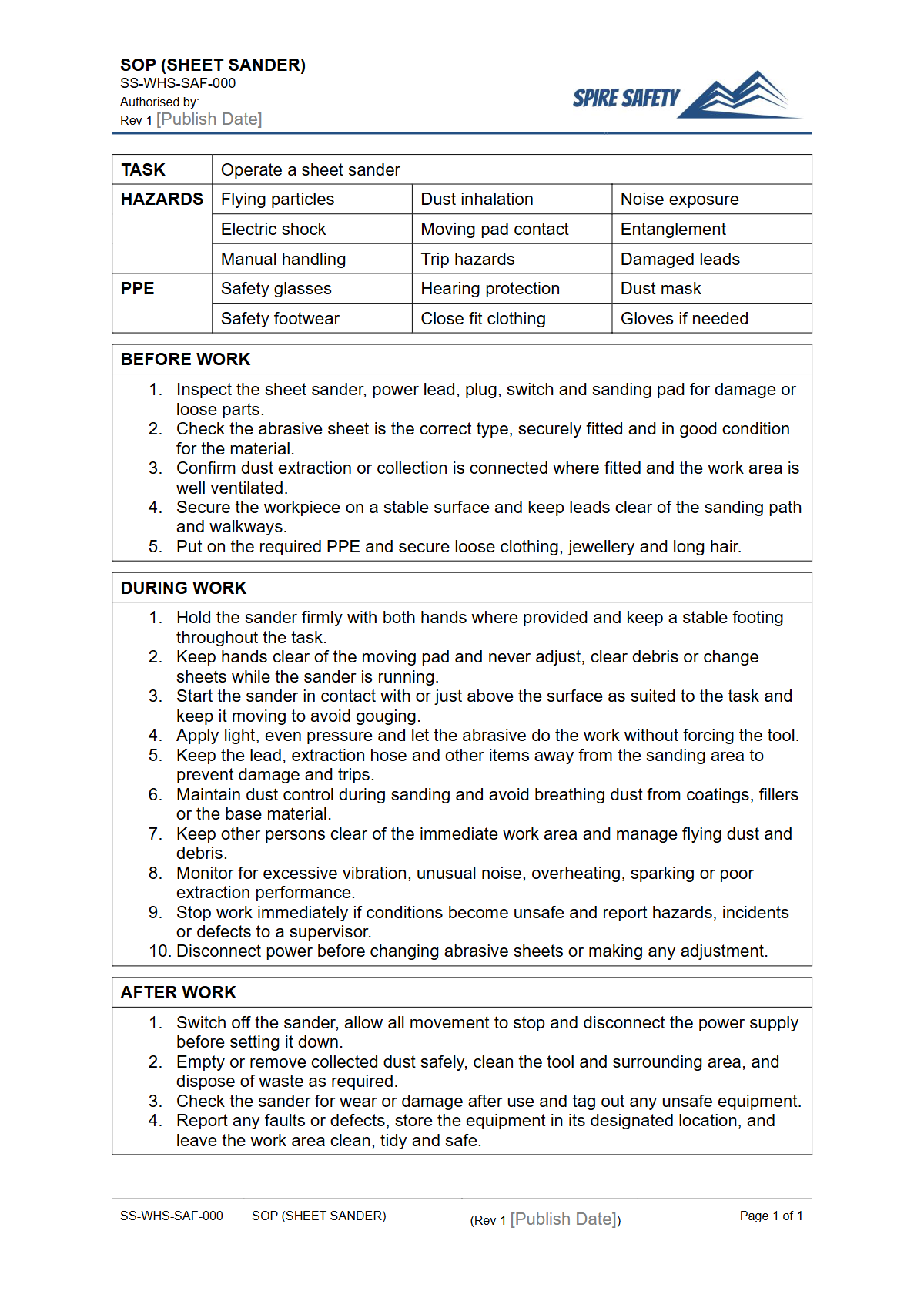
Purpose of the Free Safe Operating Procedure (Sheet Sander) Template
A sheet sander, or orbital sander, is a common tool in workshops across Australia, but it presents several workplace health and safety risks, including hazardous dust, noise, vibration, and electrical hazards. This Free Safe Operating Procedure (Sheet Sander) Template provides a structured framework for documenting the safest way to use this equipment in your specific environment.
By outlining pre-start checks, operational steps, and required Personal Protective Equipment (PPE), this SOP helps your organisation meet its duty of care and create a safer system of work for employees.
Using a documented procedure standardises operator behaviour, reduces the likelihood of incidents, and provides a clear basis for training and supervision. It forms an essential part of your risk management process for workshop equipment, similar to procedures for other common tools.
For instance, documenting processes for cutting tasks is just as critical, which is why we also offer a free Circular Saw SOP template to help manage related hazards.
Video walkthrough
How to use the Free Safe Operating Procedure (Sheet Sander) Template
This resource is available as a fully editable DOCX file for easy customisation, as well as a print-ready PDF. The document is structured logically to guide you through defining key safety elements, including required PPE, pre-operational checks, step-by-step operating instructions, and post-operational tasks like cleaning and storage.
Important: This template is a starting point, not a finished document. You must adapt it to your workplace.
We have provided a comprehensive foundation, but to be effective, you need to review and edit the content to reflect the specific sheet sander models you use, the materials being sanded, your workshop environment, and the specific risk controls your business has implemented. Integrating this SOP is a key activity within your broader comprehensive WHS management systems.
Once customised, the SOP should be used to verify that operators are following the prescribed safety measures. This verification is a critical feedback loop, and findings can be used as inputs for management reviews or to inform regular WHS compliance auditing activities to ensure procedures are being implemented effectively on the ground.
Many workshop hazards are interconnected. For example, dust generated by sanding often needs to be cleaned using compressed air.
It is vital to have safe procedures for all related equipment. If your workshop uses air tools, consider developing a procedure using our free Air Compressor SOP to manage those associated risks.
When to use a Sheet Sander SOP
A Safe Operating Procedure for a sheet sander should be a living document, used and referenced in multiple scenarios. It is not a 'set and forget' piece of paperwork. Key times to use and review the SOP include:
- Worker Induction: When a new employee starts, the SOP should be a core part of their job-specific safety training.
- Task-Specific Training: Before a worker is authorised to use a sheet sander for the first time, they must be trained on the contents of the SOP.
- Refresher Training: The SOP should be used for periodic refresher training to prevent complacency and reinforce safe work habits.
- After an Incident: If a near miss or injury involving a sheet sander occurs, the SOP must be reviewed and updated to prevent a recurrence.
- Introducing New Equipment: If a new model of sander is purchased, the SOP should be reviewed to account for any differences in operation or safety features.
Who should use this Safe Operating Procedure
Responsibility for workplace safety is shared, and various roles within an organisation will interact with this SOP:
- Persons Conducting a Business or Undertaking (PCBUs): Have the ultimate responsibility to provide safe systems of work. This SOP is a tool to help meet that obligation.
- Managers and Supervisors: Use the SOP as a tool for training workers, conducting competency assessments, and supervising work to ensure it is performed safely.
- Workers: Must read, understand, and follow the instructions outlined in the SOP to protect their own health and safety and that of their colleagues.
- WHS/HSE Officers: Are responsible for developing, implementing, and reviewing safety procedures as part of the overall WHS management system.
Developing robust, site-specific procedures can be complex. If you require assistance in tailoring this template or developing other WHS documentation for your business, Spire Safety offers expert WHS consulting to help you navigate your obligations.
By properly implementing this SOP, you take a proactive step towards controlling workshop hazards. Feel free to explore our complete free WHS resources library for more templates and guides to support your safety management efforts.
Common mistakes
Common mistakes to avoid
- Using the downloaded template without customising it for the specific sander models and tasks in the workplace.
- Failing to connect the SOP to practical training and a formal verification of competency for operators.
- Neglecting to check material safety data sheets (SDS) before sanding materials that may contain hazardous substances like lead, isocyanates, or silica.
- Ignoring pre-start safety checks, especially inspecting the power cord for damage and ensuring the sanding sheet is securely fitted.
Legal references
Legal considerations
The following legal requirements may be relevant to this type of work.
- Work Health and Safety Act (Harmonised) — Provides the primary duties for protecting workers and other people from work health and safety risks.
- Work Health and Safety Regulations (Harmonised) — Sets out requirements supporting the management of workplace hazards and risks.
The following codes may be relevant to this type of work.
- Managing WHS Risks Code of Practice — Provides practical guidance on identifying hazards, assessing risks and applying effective controls.
- Work Health and Safety Consultation, Cooperation and Coordination Code of Practice — Provides practical guidance on consulting workers and coordinating with other duty holders.
- Managing the Work Environment and Facilities Code of Practice — Provides practical guidance on safe work environments, workplace facilities and related controls.
Did you know
Vibration Risk
Prolonged or regular use of vibrating tools like sheet sanders can lead to Hand-Arm Vibration Syndrome (HAVS), a permanent and debilitating condition affecting nerves, blood vessels, and joints.
Hazardous Dust
Dust from sanding wood, particularly from Medium-Density Fibreboard (MDF) or certain hardwoods, is classified as a carcinogen. Effective on-tool dust extraction is a critical safety control measure, not just an optional extra for cleanliness.
FAQ
Frequently asked questions
01What are the main hazards of using a sheet sander?
02Is a Safe Operating Procedure a legal requirement in Australia?
03How often should a Sheet Sander SOP be reviewed?
04What PPE is generally needed for using a sheet sander?
Share this resource
Free Safe Operating Procedure (Sheet Sander) Template
Browse Categories
How To Use It
- 1Download and open in Word or PDF.
- 2Replace the placeholders with your business details.
- 3Get it reviewed by a WHS specialist before rollout.
Need it customised?
Our WHS consultants can adapt this template to your site, run a gap analysis, or audit what you already have in place.
Book a Free Consultation WHS consulting servicesor call 1300 156 382
Related templates
- Free Safe Operating Procedure (Shelf Label Gun) Template
- Free Safe Operating Procedure (Ship Cabin Cleaning) Template
- Free Safe Operating Procedure (Ship Galley Cleaning) Template
- Free Safe Operating Procedure (Ship Waste Handling) Template
- Free Safe Operating Procedure (Shock Absorber Change) Template
- Free Safe Operating Procedure (Shoe Press) Template