
Free Safe Operating Procedure (Sheet Metal Brake) Template
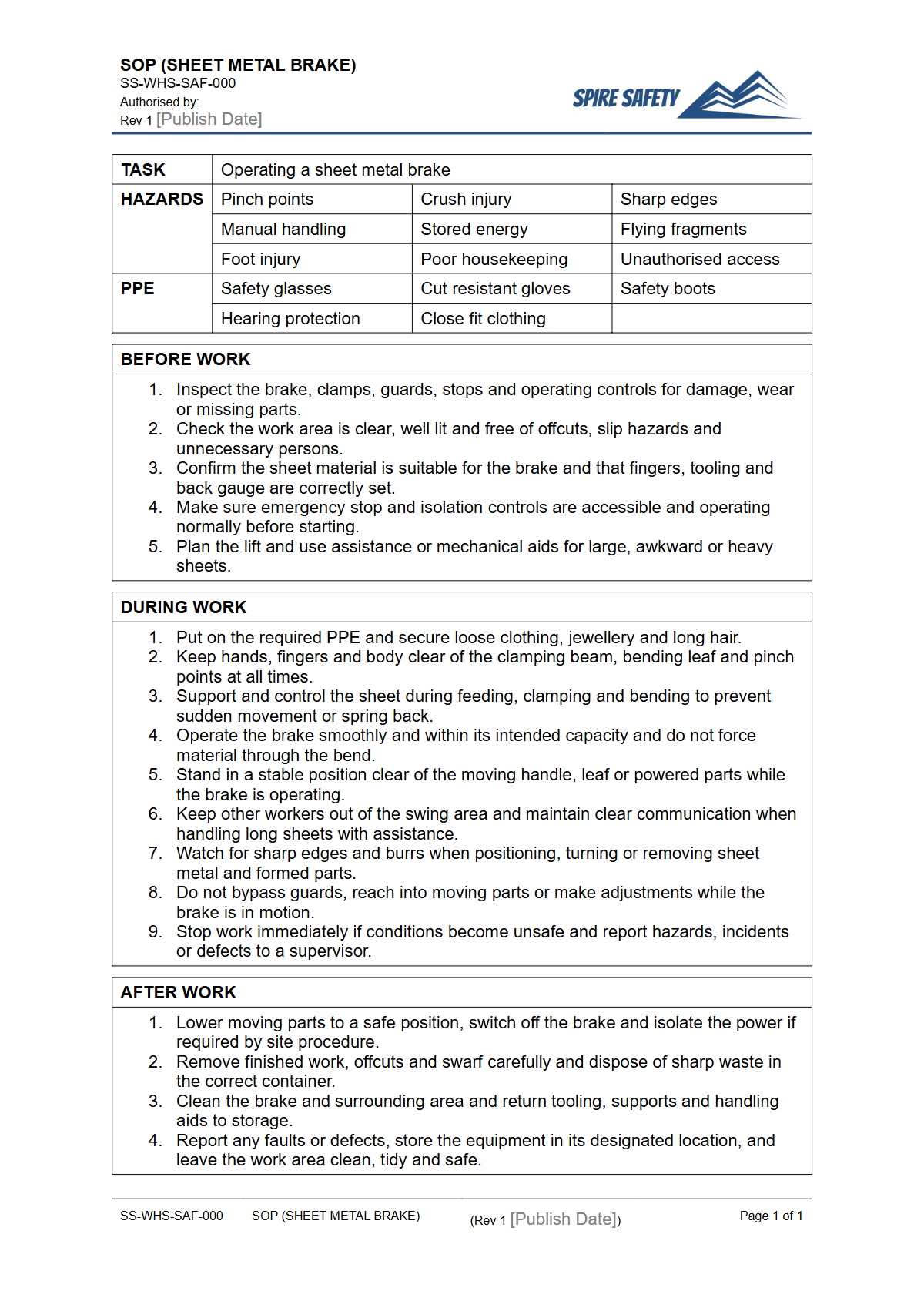
Operating a sheet metal brake requires clear, consistent instructions. Download our free Safe Operating Procedure template to formalise your safety processes.
Free Safe Operating Procedure (Sheet Metal Brake) Template
DOCX • 126 KB + PDF
Updated Oct 2026
No signup required
Purpose of the Free Safe Operating Procedure (Sheet Metal Brake) Template
A sheet metal brake, or press brake, is powerful machinery essential in many fabrication and manufacturing settings. Its operation involves significant risks, including crushing, pinching, and amputation hazards.
This Free Safe Operating Procedure (Sheet Metal Brake) Template provides a structured starting point for your organisation to document a safe system of work. Using a standardised procedure helps ensure all operators follow the same safety-critical steps, minimising guesswork and reducing the likelihood of incidents.
Formalising your process with a written SOP is a key administrative control measure. It serves as a vital tool for training new employees, conducting refresher courses, and demonstrating due diligence in managing workplace risks.
This template is based on the model WHS framework and established industry practices, helping you outline pre-operational checks, step-by-step operating instructions, and emergency procedures specific to your equipment.
Video walkthrough
How to use the Free Safe Operating Procedure (Sheet Metal Brake) Template
This resource is available as a DOCX file for easy editing and a PDF for straightforward printing and distribution. To use the template effectively, download the DOCX version and begin customising it to reflect the specific make, model, and configuration of the sheet metal brake used in your workplace.
A generic procedure is not sufficient; you must incorporate your site-specific controls, tooling, and materials.
Important: This is a template, not a finished document. We strongly advise that you consult with experienced operators, supervisors, and health and safety representatives during the customisation process.
Their direct input is crucial to ensure the final SOP is practical, accurate, and reflects the real-world tasks and hazards at your workplace. Just as with other machinery, such as that covered in our free Air Compressor SOP template, specificity is key to effectiveness.
When to use a Safe Operating Procedure
A Safe Operating Procedure for a sheet metal brake should be a core part of your safety management system. It must be used as the primary training document for any worker before they are authorised to operate the machine.
It also serves as a benchmark for competency assessments and ongoing supervision.
The SOP should be formally reviewed and referenced during refresher training sessions to prevent procedural drift. Furthermore, it is critical to review and update the SOP following any incident or near-miss involving the brake press, or whenever there are changes to the equipment, tooling, materials, or the work process itself.
Documenting procedures for all key plant, including those detailed in resources like our FREE Conveyer System SOP, builds a robust and consistent safety culture.
Who should use this Safe Operating Procedure
This SOP should be used by several key personnel within an organisation. WHS managers and supervisors are responsible for developing, implementing, and reviewing the procedure to ensure it meets regulatory expectations and effectively controls risks.
They use it to train workers and to audit workplace behaviour against the documented standard.
Operators are the primary end-users of the SOP. They must be thoroughly trained on its contents and are expected to follow the procedure during every task.
A copy of the finalised SOP should always be kept in a clean, accessible location near the sheet metal brake for easy reference. Developing and implementing SOPs forms a fundamental part of comprehensive WHS management systems, demonstrating a proactive approach to safety that is scalable across all business operations.
Integrating clear procedures for hazardous tools is essential. While a sheet metal brake has unique risks, the principles of pre-start checks and controlled operation apply to other equipment, like that described in our FREE Circular Saw SOP Template. Regular reviews of all such documents ensure they remain current and effective.
Conducting periodic checks helps verify that the documented procedures are being followed correctly on the floor.
A robust safety system relies on continuous improvement and verification. Formal WHS compliance auditing can help identify gaps between your documented procedures and actual work practices, providing valuable insights to strengthen your safety controls. After refining your procedures, be sure to browse our complete free WHS resources library for other templates that can support your safety objectives.
Common mistakes
Common mistakes to avoid
- Using a generic template without customising it for the specific machine, tooling, and tasks.
- Failing to adequately train operators on the finalised SOP or verify their competency.
- Neglecting to review and update the SOP after a near-miss, incident, or change in process.
- Storing the SOP in an office instead of making it readily accessible to operators at the machine.
Legal references
Legal considerations
The following legal requirements may be relevant to this type of work.
- Work Health and Safety Act (Harmonised) — Provides the primary duties for protecting workers and other people from work health and safety risks.
- Work Health and Safety Regulations (Harmonised) — Sets out requirements supporting the management of workplace hazards and risks.
The following codes may be relevant to this type of work.
- Managing WHS Risks Code of Practice — Provides practical guidance on identifying hazards, assessing risks and applying effective controls.
- Work Health and Safety Consultation, Cooperation and Coordination Code of Practice — Provides practical guidance on consulting workers and coordinating with other duty holders.
- Managing the Work Environment and Facilities Code of Practice — Provides practical guidance on safe work environments, workplace facilities and related controls.
Did you know
Hydraulic vs. Mechanical
Sheet metal brakes can be mechanical, pneumatic, hydraulic, or electric. Hydraulic presses offer greater control, as the ram can be stopped at any point in its stroke, which is a significant safety feature compared to older mechanical flywheel presses that must complete a full cycle.
Tonnage Matters
The force a press brake exerts is measured in tonnage. Attempting to bend a piece of metal that is too thick or hard for the machine's rated tonnage can cause catastrophic failure of the tooling or machine frame, presenting a serious risk to the operator.
FAQ
Frequently asked questions
01What should be included in a sheet metal brake SOP?
02How often should a Safe Operating Procedure be reviewed?
03Is a Safe Operating Procedure (SOP) the same as a Safe Work Method Statement (SWMS)?
04Who is responsible for training workers on the sheet metal brake SOP?
Share this resource
Free Safe Operating Procedure (Sheet Metal Brake) Template
Browse Categories
How To Use It
- 1Download and open in Word or PDF.
- 2Replace the placeholders with your business details.
- 3Get it reviewed by a WHS specialist before rollout.
Need it customised?
Our WHS consultants can adapt this template to your site, run a gap analysis, or audit what you already have in place.
Book a Free Consultation WHS consulting servicesor call 1300 156 382
Related templates
- Free Safe Operating Procedure (Sheet Metal Roller) Template
- Free Safe Operating Procedure (Sheet Pile Driver) Template
- Free Safe Operating Procedure (Sheet Sander) Template
- Free Safe Operating Procedure (Shelf Label Gun) Template
- Free Safe Operating Procedure (Ship Cabin Cleaning) Template
- Free Safe Operating Procedure (Ship Galley Cleaning) Template