
Free Safe Operating Procedure (Shale Shaker) Template
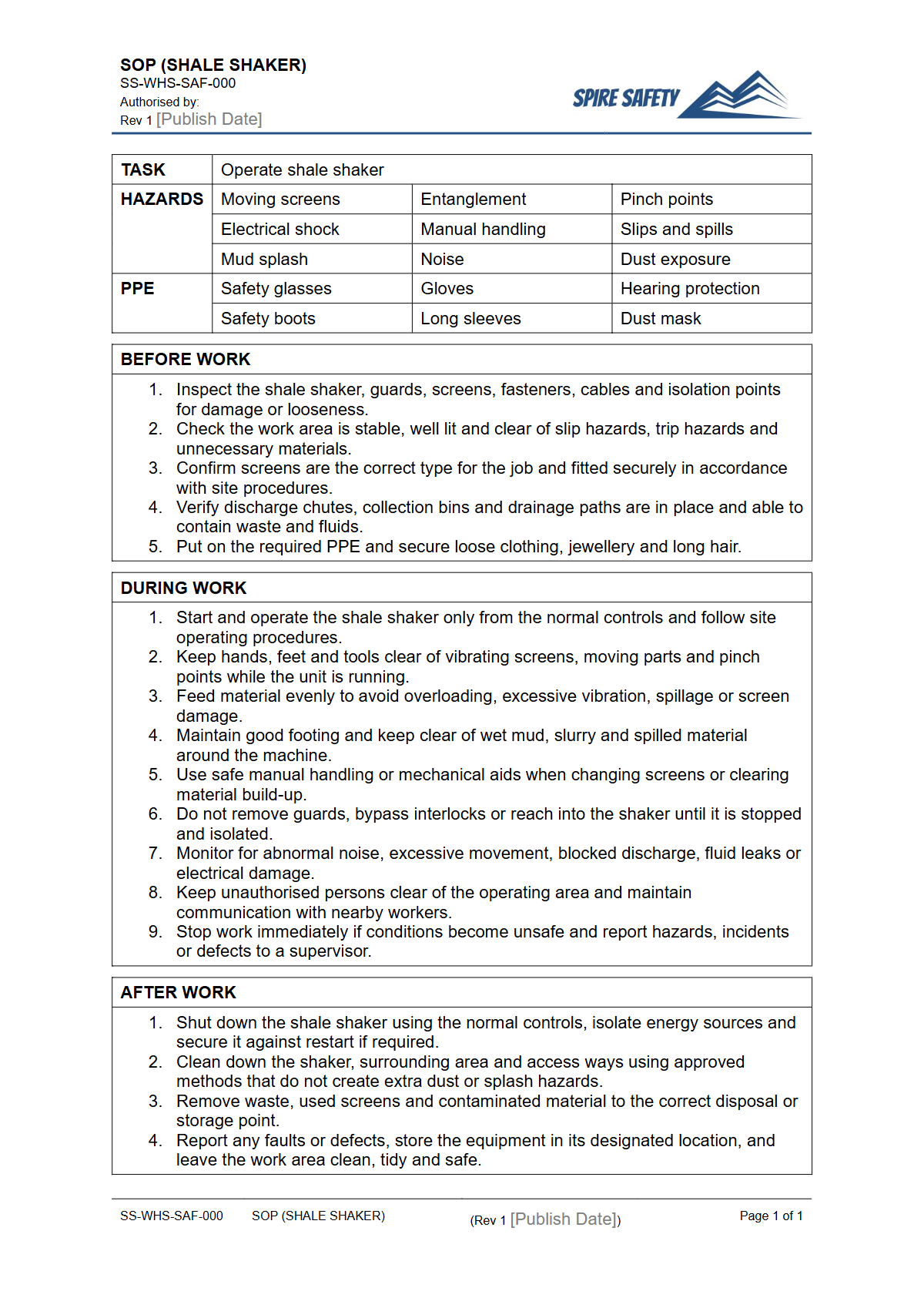
Download our free Safe Operating Procedure (Shale Shaker) Template. This structured document helps you outline key safety steps for your workplace.
Free Safe Operating Procedure (Shale Shaker) Template
DOCX • 126 KB + PDF
Updated Oct 2026
No signup required
Purpose of the Free Safe Operating Procedure (Shale Shaker) Template
Operating a shale shaker involves significant risks, including exposure to vibration, high-pressure fluids, hazardous materials, and moving parts. This Free Safe Operating Procedure (Shale Shaker) Template provides a structured framework for documenting the specific safety requirements for operating this equipment in your workplace.
It guides you in outlining pre-start checks, step-by-step operating instructions, and shutdown procedures to minimise risks to workers. A well-developed SOP is a critical component of a compliant and effective safety system.
Using this template helps a Person Conducting a Business or Undertaking (PCBU) meet their primary duty of care to ensure a safe working environment. It prompts the identification of hazards like pinch points, chemical exposure from drilling fluids, noise, and manual handling risks associated with screen changes.
Documenting these controls is an essential part of robust WHS management systems, ensuring that safety measures are consistently applied and understood by all personnel involved.
Video walkthrough
How to use the Free Safe Operating Procedure (Shale Shaker) Template
To effectively use this Safe Operating Procedure template, you must adapt it to the specific context of your worksite. The provided DOCX and PDF files are starting points designed to be customised.
Download the file and work with a competent person to fill in the details relevant to your specific shale shaker model, the materials being processed (e.g., drilling muds, slurries), and the unique environmental conditions of your site. This customisation is critical for creating a useful and effective safety document.
Remember, this is a template, not a finished document. We cannot know the specific model of shale shaker you use, the materials you process, or the unique conditions of your site.
You must consult with operators and maintenance personnel during the drafting process. Their practical experience is invaluable for identifying all relevant hazards and effective controls.
Once drafted, the SOP should be integrated with other site procedures, such as the FREE Conveyer System SOP (Safe Operating Procedure) Template, if the shaker feeds into one.
When to use a Safe Operating Procedure
A Safe Operating Procedure for a shale shaker should be a living document, referenced frequently in day-to-day operations. It is essential for inducting and training new operators, ensuring they understand the approved method for using the equipment safely.
It should also be used as a checklist for pre-operational inspections to verify that all safety guards, emergency stops, and components are in working order. During operation, it serves as a guide for correct procedure and for troubleshooting common issues.
Furthermore, the SOP is a critical reference during scheduled maintenance, particularly for high-risk tasks like changing shaker screens or cleaning the unit. It also forms a key piece of evidence during safety audits or incident investigations, demonstrating that a safe system of work has been defined and communicated.
SOPs for ancillary equipment, like an Free Air Compressor SOP (Safe Operating Procedure) Template, should also be readily available to ensure all plant on site is operated according to established safe work methods.
Who should use this Safe Operating Procedure
This Safe Operating Procedure should be used by a range of personnel within an organisation. Primarily, operators of the shale shaker must be trained in the SOP's contents and follow it diligently.
Supervisors and line managers are responsible for enforcing its use, ensuring operators are competent, and conducting regular checks. Maintenance crews must also refer to the SOP, especially sections related to isolation, lockout/tagout, and safe servicing practices.
Safety managers and WHS officers will use the SOP as a tool for risk management, training development, and as a benchmark during safety inspections. It is the PCBU’s responsibility to ensure such procedures are developed, implemented, and reviewed in consultation with workers.
Having specific SOPs for each piece of major equipment, such as a FREE Scraper SOP (Safe Operating Procedure) Template for earthmoving plant, helps standardise safety across your operations. Regular WHS compliance auditing can verify that these procedures are being followed correctly.
This template is one of many tools available to help you build a safer workplace. Explore our complete free WHS resources library for more templates, checklists, and guides to support your safety management efforts.
Common mistakes
Common mistakes to avoid
- Using the template without customising it for the specific shaker model and worksite conditions.
- Failing to involve the equipment operators and maintenance staff in the drafting and review process.
- Neglecting to include procedures for non-routine tasks like screen changes, cleaning, or fault-finding.
- Treating the SOP as a one-time document and not reviewing or updating it after incidents or changes to work practices.
Legal references
Legal considerations
The following legal requirements may be relevant to this type of work.
- Work Health and Safety Act (Harmonised) — Provides the primary duties for protecting workers and other people from work health and safety risks.
- Work Health and Safety Regulations (Harmonised) — Sets out requirements supporting the management of workplace hazards and risks.
The following codes may be relevant to this type of work.
- Managing WHS Risks Code of Practice — Provides practical guidance on identifying hazards, assessing risks and applying effective controls.
- Work Health and Safety Consultation, Cooperation and Coordination Code of Practice — Provides practical guidance on consulting workers and coordinating with other duty holders.
- Managing the Work Environment and Facilities Code of Practice — Provides practical guidance on safe work environments, workplace facilities and related controls.
Did you know
Solids Control
Shale shakers are the primary solids control tool on a drilling rig, designed to remove large solid particles (cuttings) from the drilling fluid, or 'mud'.
Noise Hazard
Operating shale shakers can generate noise levels exceeding 85 dBA, the exposure standard for noise in Australia. This makes appropriate hearing protection a mandatory piece of PPE for nearby workers.
FAQ
Frequently asked questions
01What is the primary purpose of a Safe Operating Procedure for a shale shaker?
02How often should a shale shaker SOP be reviewed?
03Is this template suitable for all types of shale shakers?
04Who is responsible for developing and implementing the shale shaker SOP?
Share this resource
Free Safe Operating Procedure (Shale Shaker) Template
Browse Categories
How To Use It
- 1Download and open in Word or PDF.
- 2Replace the placeholders with your business details.
- 3Get it reviewed by a WHS specialist before rollout.
Need it customised?
Our WHS consultants can adapt this template to your site, run a gap analysis, or audit what you already have in place.
Book a Free Consultation WHS consulting servicesor call 1300 156 382
Related templates
- Free Safe Operating Procedure (Sharps Disposal) Template
- Free Safe Operating Procedure (Shearing Machine) Template
- Free Safe Operating Procedure (Sheep Crutching Stand) Template
- Free Safe Operating Procedure (Sheep Drafting) Template
- Free Safe Operating Procedure (Sheep Feeding) Template
- Free Safe Operating Procedure (Sheep Footbath) Template