
Free Safe Operating Procedure (Sharps Disposal) Template
Download our Free Safe Operating Procedure (Sharps Disposal) Template to manage needlestick injury risks. Get your customisable DOCX and PDF resource now.
Free Safe Operating Procedure (Sharps Disposal) Template
DOCX • 126 KB + PDF
Updated Oct 2026
No signup required
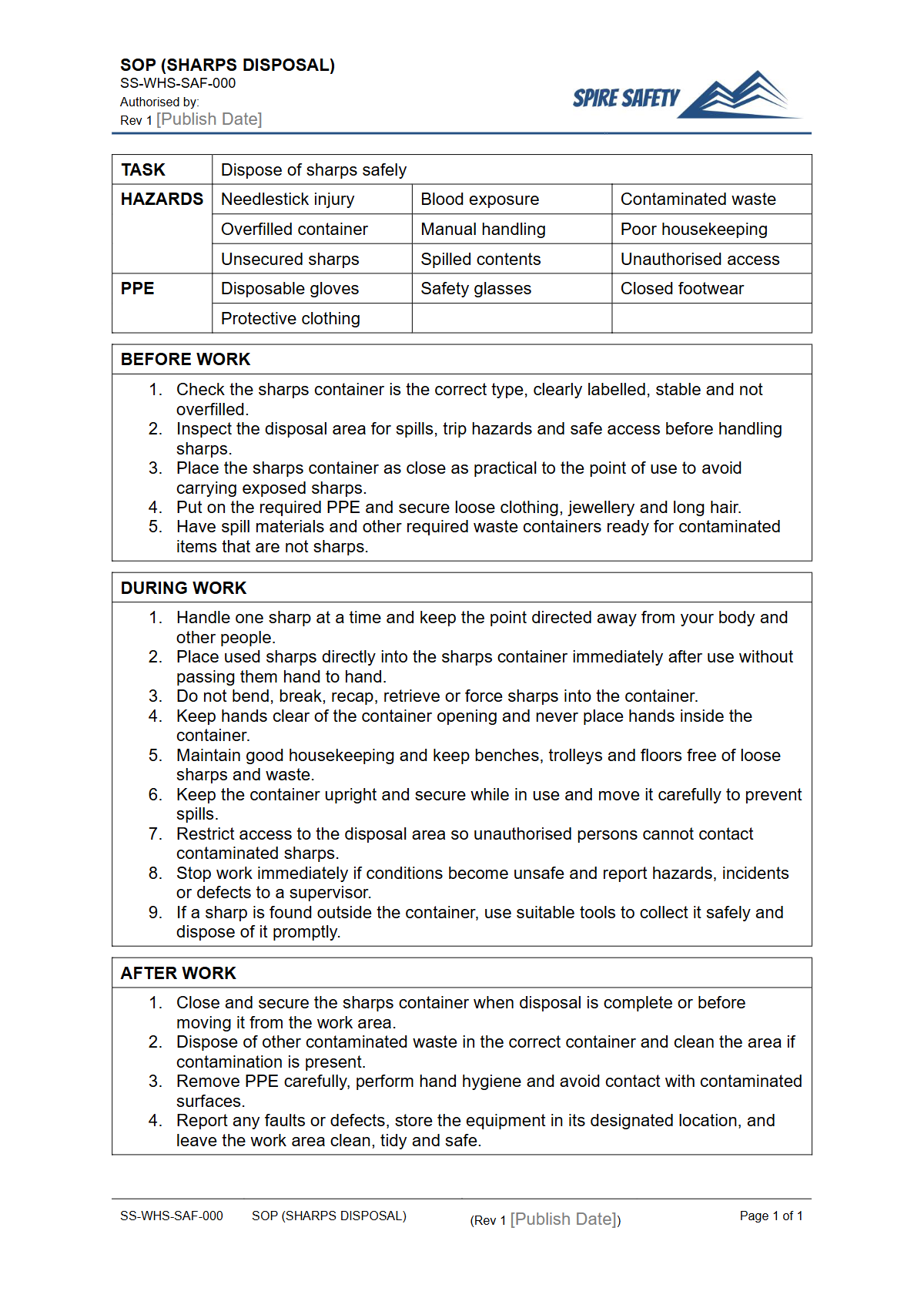
Purpose of the Free Safe Operating Procedure (Sharps Disposal) Template
Effectively managing sharps is a critical component of workplace safety, particularly in industries like healthcare, pathology, veterinary services, and personal care. This Free Safe Operating Procedure (Sharps Disposal) Template provides a structured framework for documenting the correct, safe method for handling and disposing of needles, scalpels, blades, and other sharp items.
The primary goal is to prevent sharps injuries, which can lead to serious infections from blood-borne pathogens like Hepatitis B, Hepatitis C, and HIV. Implementing a formal SOP demonstrates a commitment to worker safety and helps meet your duty of care obligations under Australian WHS laws.
A well-defined procedure is a cornerstone of any effective safety framework. It ensures consistency in how tasks are performed, reduces ambiguity, and provides a clear reference for training and supervision.
By formalising your process for sharps disposal, you create a safer environment for everyone. This SOP can be integrated into your broader WHS management systems to strengthen your organisation's overall approach to hazard control.
Video walkthrough
How to use the Free Safe Operating Procedure (Sharps Disposal) Template
This template is provided in both DOCX and PDF formats for your convenience. To get started, download the document and begin populating it with information specific to your operational environment.
The procedure should detail the types of sharps used, the specific personal protective equipment (PPE) required, the location and type of approved sharps containers, and the steps for final disposal and collection by a licensed waste contractor.
You should conduct a risk assessment to identify all potential hazards associated with sharps handling in your workplace before finalising the procedure. This ensures the controls you document are relevant and effective.
Involve workers who handle sharps in the customisation process; their direct experience is invaluable for creating a practical and effective SOP.
Important: It’s important to remember that this is a template. We strongly advise that you customise it with your specific workplace details, equipment brands, site-specific hazards, and control measures to ensure it is effective for your operational context.
A generic procedure is not sufficient to ensure safety or compliance.
When to use a Safe Operating Procedure
A Safe Operating Procedure for sharps disposal should be used in any workplace where sharps are generated. This is not limited to clinical settings. It includes, but is not limited to:
- Medical, dental, and cosmetic clinics
- Pathology and research laboratories
- Veterinary practices
- Tattooing and body piercing studios
- First aid rooms in any industry (e.g., construction, manufacturing, offices)
- Diabetic care facilities and pharmacies
- Waste management and cleaning services
The SOP should be readily accessible to all workers who may be exposed to sharps hazards. It should be used as a primary reference during worker induction, task-specific training, and refresher courses.
It also serves as a critical document during incident investigations or WHS compliance auditing, providing evidence of the systems you have in place to manage known risks.
Who should use this Safe Operating Procedure
This procedure is intended for use by multiple parties within an organisation. Persons Conducting a Business or Undertaking (PCBUs) and managers are responsible for ensuring the SOP is developed, implemented, and reviewed regularly.
Supervisors must ensure that workers are trained on the procedure and adhere to it during their daily tasks. Most importantly, workers who directly handle or may come into contact with sharps must understand and follow the procedure to protect themselves and others.
Competency is key. No worker should handle sharps without being trained on the risks and the specific control measures outlined in this SOP.
If your team requires assistance in developing robust safety documentation or training programs, consider engaging professional WHS consulting services for expert guidance.
Integrating the SOP into your Safety System
An SOP is an administrative control, which sits toward the bottom of the hierarchy of controls. It is most effective when supported by higher-level controls, such as using sharps with engineered safety features (engineering controls) and providing appropriate PPE.
For businesses aiming for best practice or certification, documenting procedures like this is fundamental. Formalised processes are a key requirement for management systems aligned with international standards, and seeking support for ISO 45001 certification can help embed this level of rigour across your organisation.
Once completed, this SOP becomes a valuable part of your safety toolkit. We encourage you to explore our full free WHS resources library for other templates and guides to help you build a comprehensive safety management system.
Common mistakes
Common mistakes to avoid
- Overfilling sharps containers beyond the indicated 'fill line', increasing injury risk.
- Attempting to recap used needles by hand, a leading cause of needlestick injuries.
- Using improper containers like plastic drink bottles or cardboard boxes, which are not puncture-proof.
- Failing to provide adequate training to all workers who may be exposed to sharps.
Legal references
Legal considerations
The following legal requirements may be relevant to this type of work.
- Work Health and Safety Act (Harmonised) — Provides the primary duties for protecting workers and other people from work health and safety risks.
- Work Health and Safety Regulations (Harmonised) — Sets out requirements supporting the management of workplace hazards and risks.
The following codes may be relevant to this type of work.
- Managing WHS Risks Code of Practice — Provides practical guidance on identifying hazards, assessing risks and applying effective controls.
- Work Health and Safety Consultation, Cooperation and Coordination Code of Practice — Provides practical guidance on consulting workers and coordinating with other duty holders.
- Managing the Work Environment and Facilities Code of Practice — Provides practical guidance on safe work environments, workplace facilities and related controls.
Did you know
Needlestick Injury Rates
Studies have shown that up to 50% of needlestick injuries go unreported. Encouraging a strong reporting culture is vital for accurate risk assessment and prevention.
Container Standards
Sharps containers in Australia must comply with AS 4031:1992. This standard specifies that they must be yellow, puncture-resistant, and clearly labelled with the biohazard symbol.
FAQ
Frequently asked questions
01What is legally considered a 'sharp' in a WHS context?
02How often should a sharps disposal procedure be reviewed?
03Who is responsible for providing and maintaining sharps containers?
04Can I dispose of sharps in the general waste bin?
Share this resource
Free Safe Operating Procedure (Sharps Disposal) Template
Browse Categories
How To Use It
- 1Download and open in Word or PDF.
- 2Replace the placeholders with your business details.
- 3Get it reviewed by a WHS specialist before rollout.
Need it customised?
Our WHS consultants can adapt this template to your site, run a gap analysis, or audit what you already have in place.
Book a Free Consultation WHS consulting servicesor call 1300 156 382
Related templates
- Free Safe Operating Procedure (Shearing Machine) Template
- Free Safe Operating Procedure (Sheep Crutching Stand) Template
- Free Safe Operating Procedure (Sheep Drafting) Template
- Free Safe Operating Procedure (Sheep Feeding) Template
- Free Safe Operating Procedure (Sheep Footbath) Template
- Free Safe Operating Procedure (Sheep Loading) Template