
Free Safe Operating Procedure (Shackle Use) Template
Manage the risks of shackle use with a clear, documented procedure. Our free template guides you through safe handling, inspection, and storage.
Free Safe Operating Procedure (Shackle Use) Template
DOCX • 126 KB + PDF
Updated Oct 2026
No signup required
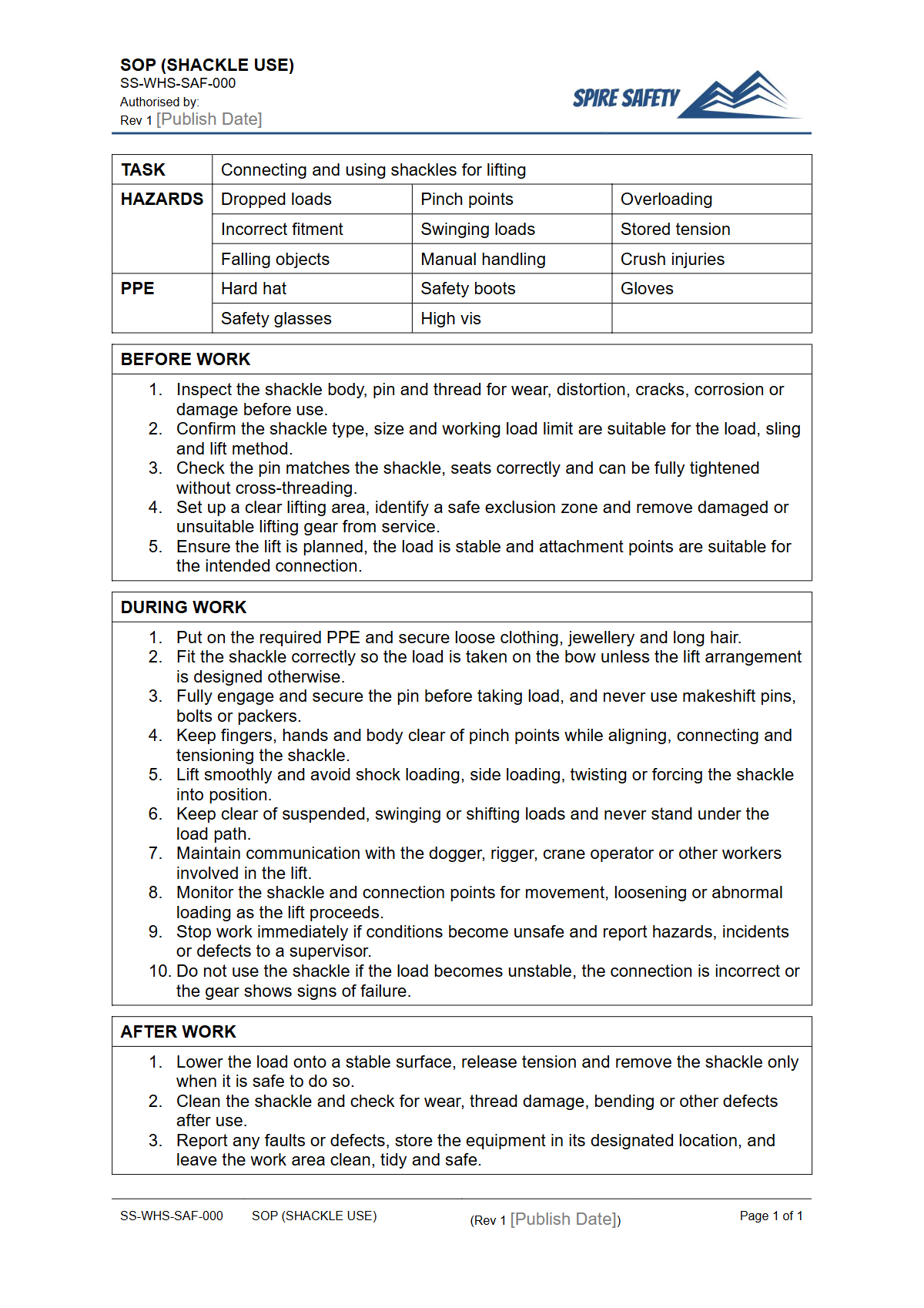
Purpose of the Free Safe Operating Procedure (Shackle Use) Template
Shackles are fundamental components in a vast range of lifting and rigging operations across construction, manufacturing, and transport. Despite their simple appearance, their incorrect selection or use can lead to catastrophic failures, resulting in serious injury or death.
This Free Safe Operating Procedure (Shackle Use) Template provides a structured framework for your organisation to document and standardise the safe use of shackles. Following a documented procedure helps ensure that all workers understand the requirements for pre-use inspection, correct application, load limits, and post-use care, minimising the risk of equipment failure and workplace incidents.
A well-defined SOP is a key control measure for managing the hazards associated with lifting operations. It provides clear, step-by-step instructions that support worker training and competency, forming an essential part of the risk management process for tasks that involve lifting equipment.
This is particularly crucial for ensuring the safe operation of equipment like telehandlers, which frequently use shackles as part of their lifting attachments.
Video walkthrough
How to use the Free Safe Operating Procedure (Shackle Use) Template
This template is designed as a starting point, aligned with Australian WHS principles. To use it effectively, download the DOCX file and adapt it to the specific types of shackles, equipment, and lifting scenarios present in your workplace.
You should integrate your site-specific requirements, including roles, responsibilities, and emergency procedures. Ensure the final document is reviewed and approved by a competent person before it is communicated to all relevant workers during inductions, pre-start meetings, and toolbox talks.
Note: This document is a template and must be customised to suit the specific needs and risks of your workplace. We recommend a competent person reviews and validates the final Safe Operating Procedure before implementation.
An SOP is most effective when it is part of one of your comprehensive WHS management systems, which integrate policies, procedures, and practices to manage health and safety risks systematically.
When to use a Safe Operating Procedure for Shackle Use
A Safe Operating Procedure for shackle use should be referenced before and during any task involving lifting or rigging. It guides workers through the entire process, from initial selection to final storage. Key stages where the SOP is critical include:
- Pre-use Inspection: Before every use, workers must inspect shackles for signs of wear, deformation, corrosion, or damage to threads and pins. The SOP provides a checklist for this critical step.
- Selection: The SOP guides the user in selecting the correct type (e.g., bow or dee) and capacity (Working Load Limit - WLL) for the specific lift.
- Rigging and Configuration: It outlines correct methods for attaching shackles to loads and lifting equipment, including considerations for angular loading and avoiding side loads on dee shackles.
- Post-use Checks and Storage: After the task is complete, the procedure should detail how to clean, inspect, and properly store shackles to prevent damage and ensure they are ready for the next use.
Formalising these steps in an SOP ensures consistency and reinforces safe behaviours. This documented process is a key piece of evidence during regular WHS compliance auditing, demonstrating that your organisation has a system for managing lifting risks.
Who should use this document
This Safe Operating Procedure is intended for all personnel involved in lifting operations. This includes, but is not limited to:
- Riggers and Doggers
- Crane and other plant operators
- Tradespersons who perform rigging as part of their duties
- Supervisors and team leaders responsible for overseeing lifting tasks
- Maintenance staff who inspect and maintain lifting gear
- Warehouse and logistics personnel
Every worker who handles, uses, or inspects shackles should be trained on the contents of the finalised SOP to ensure they are competent to perform their tasks safely. Documenting procedures for all types of workplace equipment is a foundational safety practice, which is why we also provide resources like our Air Compressor SOP for other common plant items.
If you require assistance in developing or customising procedures to meet the unique challenges of your workplace, consider engaging with a professional service. You can get tailored support through expert WHS consulting to ensure your safety documentation is robust and practical.
You can also explore our complete free WHS resources library for more templates and guides.
Common mistakes
Common mistakes to avoid
- Using a dee (chain) shackle for angular loads, which can cause it to deform or fail.
- Exceeding the Working Load Limit (WLL) stamped on the shackle body.
- Failing to properly inspect the shackle for wear, stretching, or thread damage before use.
- Replacing the original manufacturer's pin with a random bolt, which is not rated for lifting.
Legal references
Legal considerations
The following legal requirements may be relevant to this type of work.
- Work Health and Safety Act (Harmonised) — Provides the primary duties for protecting workers and other people from work health and safety risks.
- Work Health and Safety Regulations (Harmonised) — Sets out requirements supporting the management of workplace hazards and risks.
The following codes may be relevant to this type of work.
- Managing WHS Risks Code of Practice — Provides practical guidance on identifying hazards, assessing risks and applying effective controls.
- Work Health and Safety Consultation, Cooperation and Coordination Code of Practice — Provides practical guidance on consulting workers and coordinating with other duty holders.
- Managing the Work Environment and Facilities Code of Practice — Provides practical guidance on safe work environments, workplace facilities and related controls.
Did you know
Tightening Rule of Thumb
For screw pin shackles, the pin should be tightened until it is fully seated, then backed off by a quarter turn. This prevents the pin from seizing under load, making it easier to remove after the lift.
Shackle Retirement
According to Australian Standard AS 2741, a shackle should be immediately removed from service if the body or pin shows wear exceeding 10% of its original dimension, or if it has any bends, twists, or cracks.
FAQ
Frequently asked questions
01What is the difference between a bow shackle and a dee shackle?
02How often should shackles be inspected?
03What does WLL mean on a shackle?
04Can you put a shackle's pin in a hook?
Share this resource
Free Safe Operating Procedure (Shackle Use) Template
Browse Categories
How To Use It
- 1Download and open in Word or PDF.
- 2Replace the placeholders with your business details.
- 3Get it reviewed by a WHS specialist before rollout.
Need it customised?
Our WHS consultants can adapt this template to your site, run a gap analysis, or audit what you already have in place.
Book a Free Consultation WHS consulting servicesor call 1300 156 382
Related templates
- Free Safe Operating Procedure (Shade Cloth Installation) Template
- Free Safe Operating Procedure (Shale Shaker) Template
- Free Safe Operating Procedure (Sharps Disposal) Template
- Free Safe Operating Procedure (Shearing Machine) Template
- Free Safe Operating Procedure (Sheep Crutching Stand) Template
- Free Safe Operating Procedure (Sheep Drafting) Template