
Free Safe Operating Procedure (Sewer Spill Response) Template
Effectively manage sewer spill incidents with our free Safe Operating Procedure template. Download this customisable guide to develop clear response protocols.
Free Safe Operating Procedure (Sewer Spill Response) Template
DOCX • 126 KB + PDF
Updated Oct 2026
No signup required
Purpose of the Free Safe Operating Procedure (Sewer Spill Response) Template
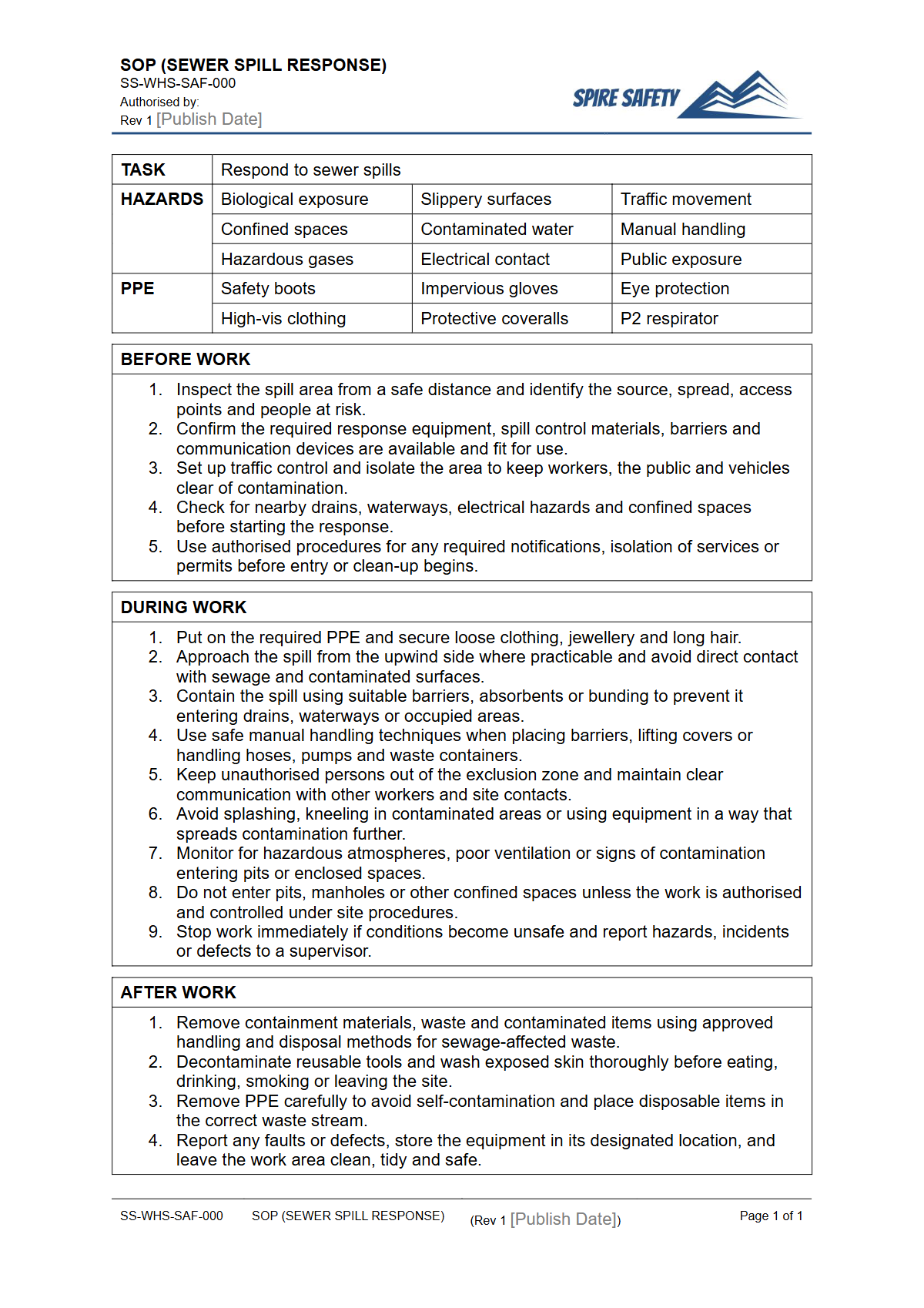
Responding to a sewer spill requires a swift, coordinated, and safe approach to protect workers, the public, and the environment. This free Safe Operating Procedure (Sewer Spill Response) Template provides a structured framework for documenting the essential steps to contain, clean up, and decontaminate an area affected by a sewage release.
Using a clear SOP ensures that all personnel understand their roles, the hazards involved, and the control measures required to manage the incident effectively. A documented procedure is a critical component of a robust safety framework, which can be integrated into your organisation's broader WHS management systems.
This template is designed to help you outline key processes, including initial incident assessment, hazard identification, required Personal Protective Equipment (PPE), spill containment techniques, decontamination procedures, and waste disposal protocols. It serves as a vital tool for training and a practical guide during an actual emergency, promoting consistent and safe work practices aligned with Australian WHS principles.
Video walkthrough
How to use the Free Safe Operating Procedure (Sewer Spill Response) Template
To get the most value from this Safe Operating Procedure template, you must adapt it to the specific context of your workplace. Download the DOCX file and systematically work through each section, replacing the placeholder text with details relevant to your site, equipment, and personnel.
Consider the potential scale of spills, the types of surfaces involved, and the specific emergency contact details for your area. Your SOP should also account for procedures related to adjacent high-risk work, such as using our FREE Trencher SOP Template if excavation is a potential cause of pipe damage.
Important: This document is a template only. We have provided a solid foundation based on established safety principles, but you must customise it to reflect the unique risks and operational realities of your workplace.
This includes consulting with your workers and incorporating site-specific information about spill kits, decontamination agents, and local authority reporting requirements to ensure it is a practical and effective tool for your team.
When to use it
This Safe Operating Procedure should be activated immediately upon the discovery of an uncontrolled release of sewage, regardless of size. This includes spills from blocked pipes, pump station failures, damaged sewer mains, or overflows within a facility.
The SOP is intended for use by the initial responders and the cleanup crew, guiding them from the moment a spill is identified through to the final sign-off that the area is safe. It is a critical document for both planned maintenance where a spill risk is high and for unexpected emergency situations.
Who should use it
This SOP is intended for any person who may be involved in responding to a sewer spill. This includes maintenance personnel, plumbers, site supervisors, facility managers, and dedicated emergency response teams.
It is also a valuable resource for Persons Conducting a Business or Undertaking (PCBUs) to ensure they have provided clear instructions for managing a significant health and environmental hazard. The effectiveness of this procedure should be periodically checked, which can be achieved through practical drills and formal WHS compliance auditing to verify that the steps are understood and correctly implemented by all relevant staff.
For wastewater treatment plants or large industrial sites, other machinery may be involved in daily operations or cleanup. It is wise to have specific SOPs for each piece of equipment, such as our FREE Conveyer System SOP (Safe Operating Procedure) Template, to ensure comprehensive safety coverage.
Similarly, compressed air might be used for tools during repair and cleanup, making a Free Air Compressor SOP (Safe Operating Procedure) Template a relevant supporting document. You can browse our complete free WHS resources library for other templates that may support your operations.
Common mistakes
Common mistakes to avoid
- Underestimating the spill volume and the potential for it to spread.
- Using incorrect or insufficient Personal Protective Equipment (PPE), risking exposure.
- Failing to properly isolate the spill area and establish a decontamination zone.
- Not reporting the incident to relevant environmental or health authorities when legally required.
Legal references
Legal considerations
The following legal requirements may be relevant to this type of work.
- Work Health and Safety Act (Harmonised) — Provides the primary duties for protecting workers and other people from work health and safety risks.
- Work Health and Safety Regulations (Harmonised) — Sets out requirements supporting the management of workplace hazards and risks.
The following codes may be relevant to this type of work.
- Managing WHS Risks Code of Practice — Provides practical guidance on identifying hazards, assessing risks and applying effective controls.
- Work Health and Safety Consultation, Cooperation and Coordination Code of Practice — Provides practical guidance on consulting workers and coordinating with other duty holders.
- Managing the Work Environment and Facilities Code of Practice — Provides practical guidance on safe work environments, workplace facilities and related controls.
Did you know
Health Hazards
Raw sewage can contain numerous pathogens, including bacteria (like E. coli and Salmonella), viruses (like Hepatitis A and Norovirus), and parasites that can cause serious gastrointestinal and other illnesses.
Environmental Impact
When untreated sewage enters waterways, the nutrients can cause algal blooms that deplete oxygen, creating 'dead zones' harmful to fish and other aquatic life. It can also contaminate drinking water sources and soil.
FAQ
Frequently asked questions
01What is the difference between a minor and major sewer spill?
02What essential PPE is required for a sewer spill cleanup?
03How do I dispose of contaminated materials after a sewer spill?
04Does this sewer spill SOP need to be reviewed regularly?
Share this resource
Free Safe Operating Procedure (Sewer Spill Response) Template
Browse Categories
How To Use It
- 1Download and open in Word or PDF.
- 2Replace the placeholders with your business details.
- 3Get it reviewed by a WHS specialist before rollout.
Need it customised?
Our WHS consultants can adapt this template to your site, run a gap analysis, or audit what you already have in place.
Book a Free Consultation WHS consulting servicesor call 1300 156 382
Related templates
- Free Safe Operating Procedure (Sewer Vent Inspection) Template
- Free Safe Operating Procedure (Shackle Use) Template
- Free Safe Operating Procedure (Shade Cloth Installation) Template
- Free Safe Operating Procedure (Shale Shaker) Template
- Free Safe Operating Procedure (Sharps Disposal) Template
- Free Safe Operating Procedure (Shearing Machine) Template