
Free Safe Operating Procedure (Service Lift Cleaning) Template
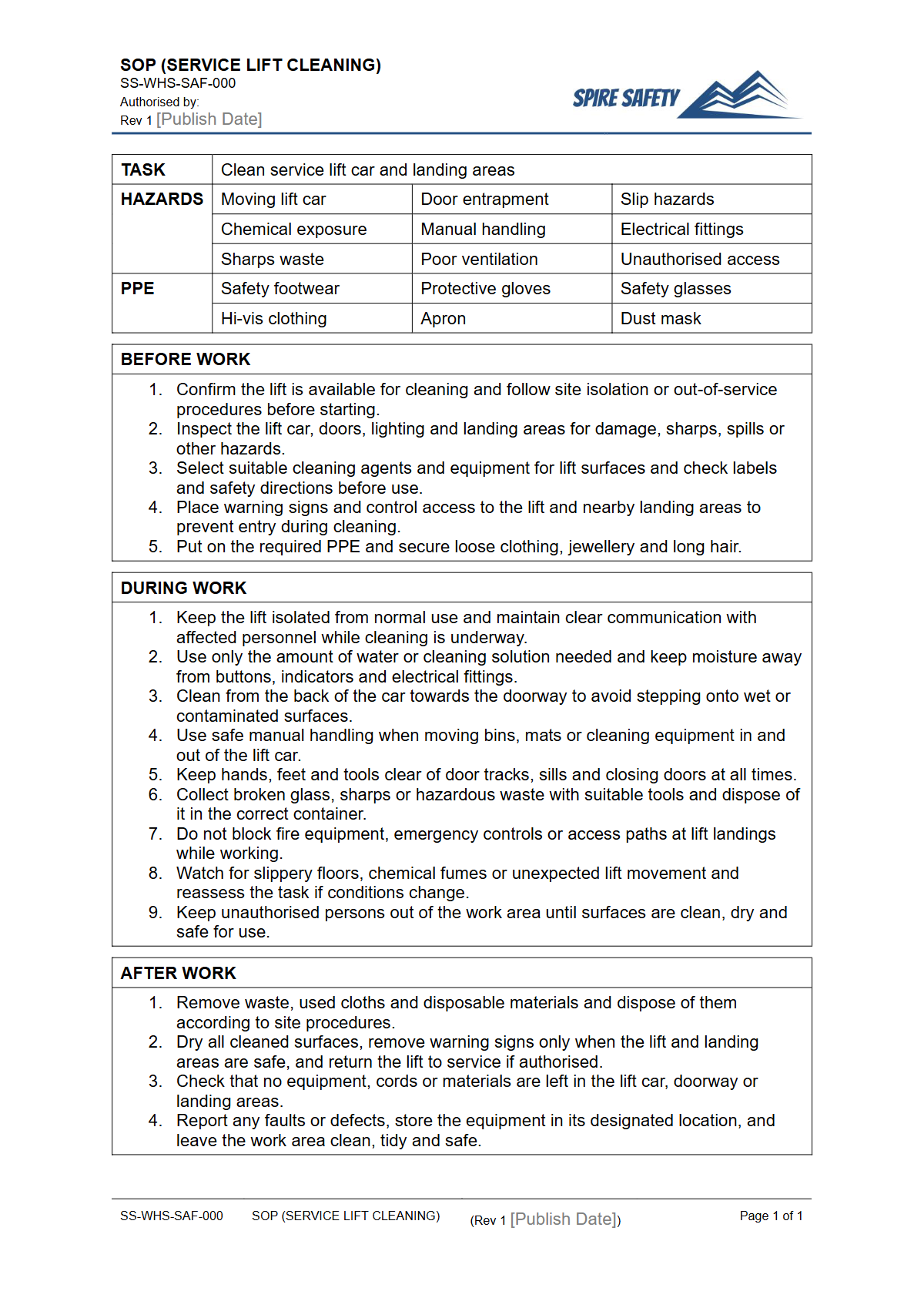
Formalise your cleaning processes for service lifts with our structured template. Download our free Safe Operating Procedure for Service Lift Cleaning today.
Free Safe Operating Procedure (Service Lift Cleaning) Template
DOCX • 126 KB + PDF
Updated Oct 2026
No signup required
Purpose of the Free Safe Operating Procedure (Service Lift Cleaning) Template
The primary purpose of this Safe Operating Procedure is to provide a clear and documented method for cleaning service lifts, mitigating risks to workers. It helps a Person Conducting a Business or Undertaking (PCBU) fulfil their duty of care by systematically identifying hazards such as electrical shock, chemical exposure, slips, trips, and ergonomic strains.
A documented procedure standardises the task, ensuring consistency regardless of who performs it. It also serves as a critical training tool for new employees and for refresher courses, forming a key component of your broader WHS management systems.
Video walkthrough
How to use the Free Safe Operating Procedure (Service Lift Cleaning) Template
Our template is designed for ease of use. Simply download the DOCX file and adapt it to your specific operational context.
This involves detailing the exact type of service lift, the approved cleaning chemicals used on-site, the required Personal Protective Equipment (PPE), and emergency procedures.
Important: This document is a template, not a finished procedure. To be effective, you must customise it to reflect the specific equipment, chemicals, and hazards present in your workplace.
We strongly recommend you consult with the workers who perform the cleaning tasks, as their direct experience is invaluable for creating a practical and effective SOP.
Once customised, the procedure should be reviewed, approved by management, and communicated to all relevant personnel. Keeping it accessible near the work area is best practice.
If you need other procedural documents, you can browse our complete free WHS resources library for more templates.
When to use a Service Lift Cleaning SOP
This SOP should be used as the primary reference document whenever a service lift is scheduled for cleaning. It is essential for inducting and training new cleaning staff or any worker assigned to the task.
It should also be a central part of regular refresher training to prevent procedural drift and reinforce safe work habits. Following an incident or near miss related to lift cleaning, the SOP must be reviewed and updated to incorporate any lessons learned and prevent recurrence.
This structured approach is vital for all types of workplace equipment, as detailed in resources like our Free Safe Operating Procedure (Deep Fryer - Standard Operation) template for kitchen environments.
Who should use this Safe Operating Procedure
This SOP is intended for a range of personnel within an organisation. Workplace Managers and Supervisors should use it to establish and enforce a safe standard of work.
WHS and Facilities Managers can integrate it into the site's overall safety and maintenance framework. Most importantly, Workers and Cleaning Operatives must use it as their guide to perform the task safely and correctly every time.
It provides them with clear, authorised instructions, empowering them to work safely and raise concerns if the prescribed steps cannot be followed. Regular checks can confirm it is being used correctly as part of a formal WHS compliance auditing program.
Key Elements of a Service Lift Cleaning SOP
A comprehensive SOP for cleaning service lifts, as structured in our template, should cover several critical areas. These include pre-operational checks, such as ensuring the lift is empty and correctly positioned.
A crucial step is the isolation of energy sources through a formal lockout/tagout procedure to prevent unexpected movement or electrical activation. The procedure should also specify the correct handling, dilution, and application of approved cleaning chemicals, as well as the mandatory PPE like gloves and safety glasses.
Finally, it outlines steps for waste disposal and post-cleaning checks to ensure the lift is safe to return to service. This level of detail is necessary for any task-based procedure, from cleaning to operating machinery covered by our Free Air Compressor SOP (Safe Operating Procedure) Template.
Integrating SOPs into Your Safety Culture
Safe Operating Procedures are more than just documents; they are a cornerstone of a proactive safety culture. When workers are involved in their creation and review, it fosters a sense of ownership and demonstrates a genuine commitment to their wellbeing.
Procedures for high-risk tasks, such as those involving powerful tools, require the same attention to detail. For example, our FREE Circular Saw SOP (Safe Operating Procedure) Template outlines specific controls for a completely different set of hazards, yet the principles of risk identification, control, and documentation remain the same.
Consistently applying this methodology across all workplace tasks builds a robust and resilient safety system.
Common mistakes
Common mistakes to avoid
- Failing to de-energise and lock out the lift before starting work.
- Using incorrect or incompatible cleaning chemicals that can damage surfaces or create hazardous fumes.
- Neglecting to use the specified Personal Protective Equipment (PPE), such as gloves and eye protection.
- Not allowing adequate ventilation, leading to the buildup of chemical vapours in a confined space.
Legal references
Legal considerations
The following legal requirements may be relevant to this type of work.
- Work Health and Safety Act (Harmonised) — Provides the primary duties for protecting workers and other people from work health and safety risks.
- Work Health and Safety Regulations (Harmonised) — Sets out requirements supporting the management of workplace hazards and risks.
The following codes may be relevant to this type of work.
- Managing WHS Risks Code of Practice — Provides practical guidance on identifying hazards, assessing risks and applying effective controls.
- Work Health and Safety Consultation, Cooperation and Coordination Code of Practice — Provides practical guidance on consulting workers and coordinating with other duty holders.
- Managing the Work Environment and Facilities Code of Practice — Provides practical guidance on safe work environments, workplace facilities and related controls.
Did you know
Slips, Trips, and Falls
Slips, trips, and falls are a leading cause of workplace injuries in Australia. Using wet floor signage and ensuring surfaces are completely dry before returning a lift to service are critical control measures.
Electrical Isolation is Key
Cleaning with liquids around electrical components presents a significant risk. A formal lockout/tagout procedure to de-energise the lift is the most effective way to prevent electric shock during cleaning operations.
FAQ
Frequently asked questions
01What is a Safe Operating Procedure (SOP) for service lift cleaning?
02Are workers required to be trained on this SOP?
03How often should a service lift cleaning SOP be reviewed?
04Can I use any generic cleaning chemicals for a service lift?
Share this resource
Free Safe Operating Procedure (Service Lift Cleaning) Template
Browse Categories
How To Use It
- 1Download and open in Word or PDF.
- 2Replace the placeholders with your business details.
- 3Get it reviewed by a WHS specialist before rollout.
Need it customised?
Our WHS consultants can adapt this template to your site, run a gap analysis, or audit what you already have in place.
Book a Free Consultation WHS consulting servicesor call 1300 156 382
Related templates
- Free Safe Operating Procedure (Service Lift) Template
- Free Safe Operating Procedure (Settlement Gauge) Template
- Free Safe Operating Procedure (Sewer Access Check) Template
- Free Safe Operating Procedure (Sewer Jetting) Template
- Free Safe Operating Procedure (Sewer Overflow Cleanup) Template
- Free Safe Operating Procedure (Sewer Spill Response) Template