
Free Safe Operating Procedure (Service Lift) Template
Download our free Safe Operating Procedure (Service Lift) Template to document safe work methods for your team. This structured DOCX helps you meet WHS duties.
Free Safe Operating Procedure (Service Lift) Template
DOCX • 126 KB + PDF
Updated Oct 2026
No signup required
Purpose of the Free Safe Operating Procedure (Service Lift) Template
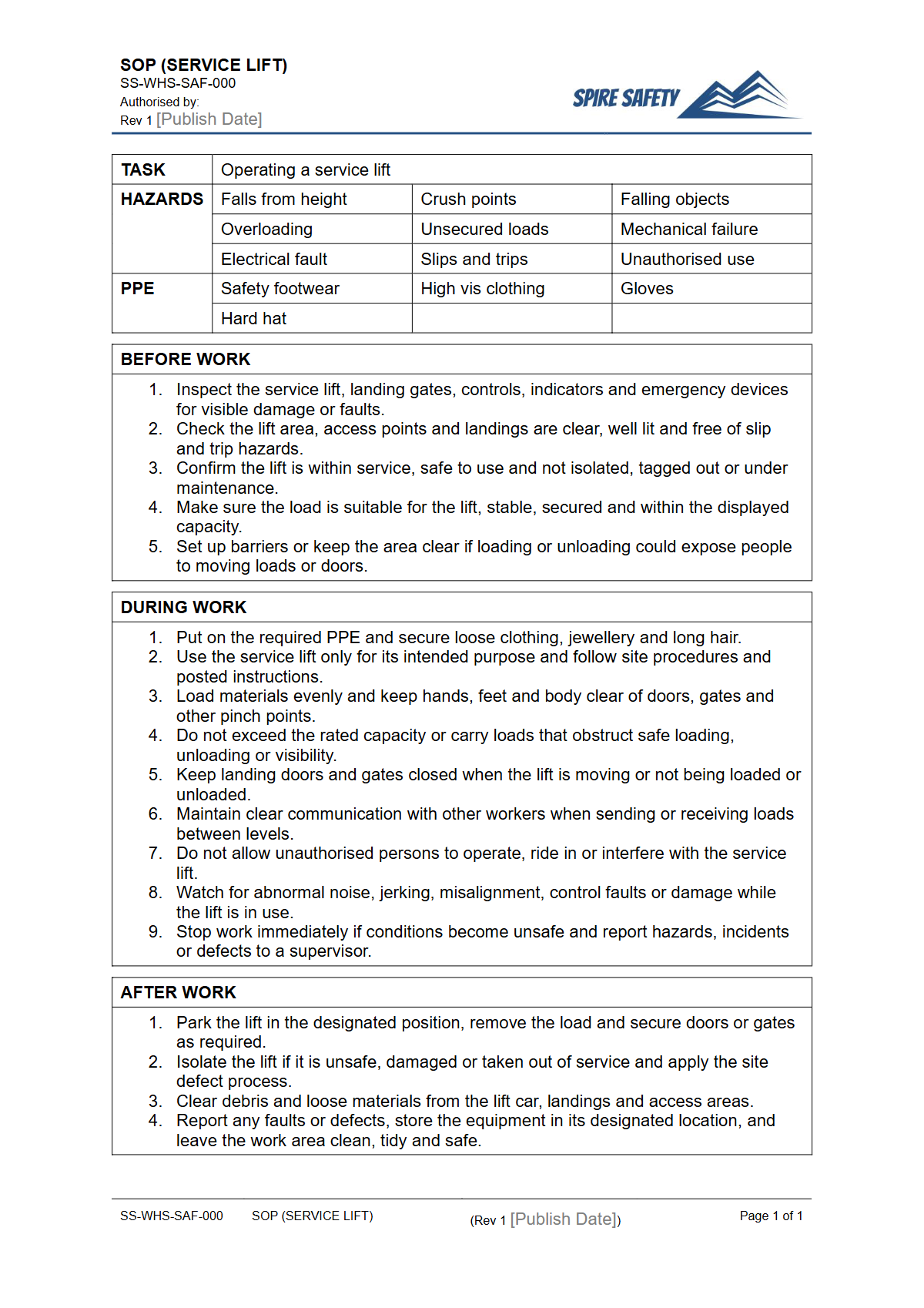
Effectively managing workplace risks involves creating clear, documented processes for high-risk tasks. This free Safe Operating Procedure (Service Lift) Template provides a structured starting point for your business to outline the safe use of service lifts, also known as dumbwaiters.
Using a standardised SOP ensures all workers follow the same safe steps, reducing the risk of injury or equipment damage. This document helps formalise pre-operational checks, correct loading and unloading techniques, and shutdown procedures, forming a critical part of your safety management system.
A well-drafted SOP is an essential control measure for any piece of workplace plant. It serves as a key training tool for new employees and a reference for experienced operators.
Just as you would for other mechanical equipment, documenting the process is vital. For example, the principles are similar to those found in our FREE Conveyer System SOP, where standardising worker actions is paramount to safety.
Video walkthrough
How to use the Free Safe Operating Procedure (Service Lift) Template
This template is available for download in both DOCX and PDF formats. The DOCX version is fully editable, allowing you to tailor it to your specific operational needs.
To create an effective and relevant procedure, it is essential that you modify the document to reflect the unique aspects of your workplace.
Important: This is a template, not a finished document. We have provided a comprehensive framework, but you must customise it to suit your specific make and model of service lift, the tasks it is used for, and the hazards identified in your own risk assessment.
We strongly recommend you consult with the workers who operate the equipment to ensure the final SOP is practical and accurate.
Integrating SOPs into your broader safety framework is key to building a strong safety culture. These documents are a fundamental part of developing comprehensive WHS management systems that protect workers and ensure operational consistency.
Key Elements of a Service Lift Safe Operating Procedure
A robust SOP for a service lift should be broken down into clear, logical sections that guide the operator through the entire task cycle. Our template includes fields for all essential information, prompting you to consider each stage of the process.
Pre-Operational Checks
Before any use, the operator should conduct a series of visual and functional checks. This includes inspecting the lift doors and interlocks, checking that control buttons are functional and clearly labelled, ensuring the interior is clean and free of obstructions, and verifying that safety signs, including the maximum load capacity, are visible and legible.
Operating Sequence
This section details the step-by-step process for using the lift. It outlines the correct way to load items, ensuring they are stable and do not exceed the weight limit.
It also covers the sequence for sending and calling the lift between floors and the safe procedure for unloading items at their destination. For complex sites, seeking guidance from professional WHS consulting services can help refine these workflows.
Post-Operational & Emergency Procedures
The SOP should conclude with instructions for after use, such as cleaning the lift car and ensuring it is left in a safe state (e.g., doors closed). Crucially, it must also include clear instructions for what to do in case of a malfunction, such as the lift getting stuck or a power failure.
This includes who to contact for maintenance and how to secure the area.
When to use this Safe Operating Procedure
A Safe Operating Procedure for a service lift is a versatile document used in various daily and periodic activities. It is essential during the induction and training of new staff to ensure they learn the correct, safe method from the start.
It also serves as a valuable refresher tool for existing team members. Furthermore, the SOP should be referenced during incident investigations to determine if procedural breaches occurred and is a key piece of evidence during regular WHS compliance auditing.
Who should use this SOP Template
This template is designed for use by anyone with responsibility for workplace health and safety. This includes WHS Managers, Safety Advisors, and Line Managers or Supervisors in industries where service lifts are common, such as hospitality, healthcare, retail, and manufacturing. Small business owners will also find it an invaluable tool for formalising safety processes without having to start from scratch. A consistent approach to safety documentation is crucial across all equipment, whether it's a service lift or you are using our free Safe Operating Procedure for deep fryers in a commercial kitchen. If you need other templates, you can browse our full library of free WHS resources to find documents relevant to your operations.
Common mistakes
Common mistakes to avoid
- Forgetting to include model-specific details in the procedure.
- Failing to specify the maximum load capacity and rules against overloading.
- Not consulting with the actual operators of the lift during the drafting process.
- Neglecting to train workers on the new SOP or keep records of the training.
Legal references
Legal considerations
The following legal requirements may be relevant to this type of work.
- Work Health and Safety Act (Harmonised) — Provides the primary duties for protecting workers and other people from work health and safety risks.
- Work Health and Safety Regulations (Harmonised) — Sets out requirements supporting the management of workplace hazards and risks.
The following codes may be relevant to this type of work.
- Managing WHS Risks Code of Practice — Provides practical guidance on identifying hazards, assessing risks and applying effective controls.
- Work Health and Safety Consultation, Cooperation and Coordination Code of Practice — Provides practical guidance on consulting workers and coordinating with other duty holders.
- Managing the Work Environment and Facilities Code of Practice — Provides practical guidance on safe work environments, workplace facilities and related controls.
Did you know
Plant Registration
Depending on their design and capacity, some types of lifts require registration with the relevant state or territory WHS regulator. Always check local requirements for your specific equipment.
FAQ
Frequently asked questions
01Is a Safe Operating Procedure the same as a risk assessment?
02Who should be consulted when writing a service lift SOP?
03How often should we review our Safe Operating Procedures?
04What is a service lift?
Share this resource
Free Safe Operating Procedure (Service Lift) Template
Browse Categories
How To Use It
- 1Download and open in Word or PDF.
- 2Replace the placeholders with your business details.
- 3Get it reviewed by a WHS specialist before rollout.
Need it customised?
Our WHS consultants can adapt this template to your site, run a gap analysis, or audit what you already have in place.
Book a Free Consultation WHS consulting servicesor call 1300 156 382
Related templates
- Free Safe Operating Procedure (Settlement Gauge) Template
- Free Safe Operating Procedure (Sewer Access Check) Template
- Free Safe Operating Procedure (Sewer Jetting) Template
- Free Safe Operating Procedure (Sewer Overflow Cleanup) Template
- Free Safe Operating Procedure (Sewer Spill Response) Template
- Free Safe Operating Procedure (Sewer Vent Inspection) Template