
Free Safe Operating Procedure (Sewer Access Check) Template
Download our free Safe Operating Procedure (Sewer Access Check) Template to manage high-risk entry into sewers and drains.
Free Safe Operating Procedure (Sewer Access Check) Template
DOCX • 126 KB + PDF
Updated Oct 2026
No signup required
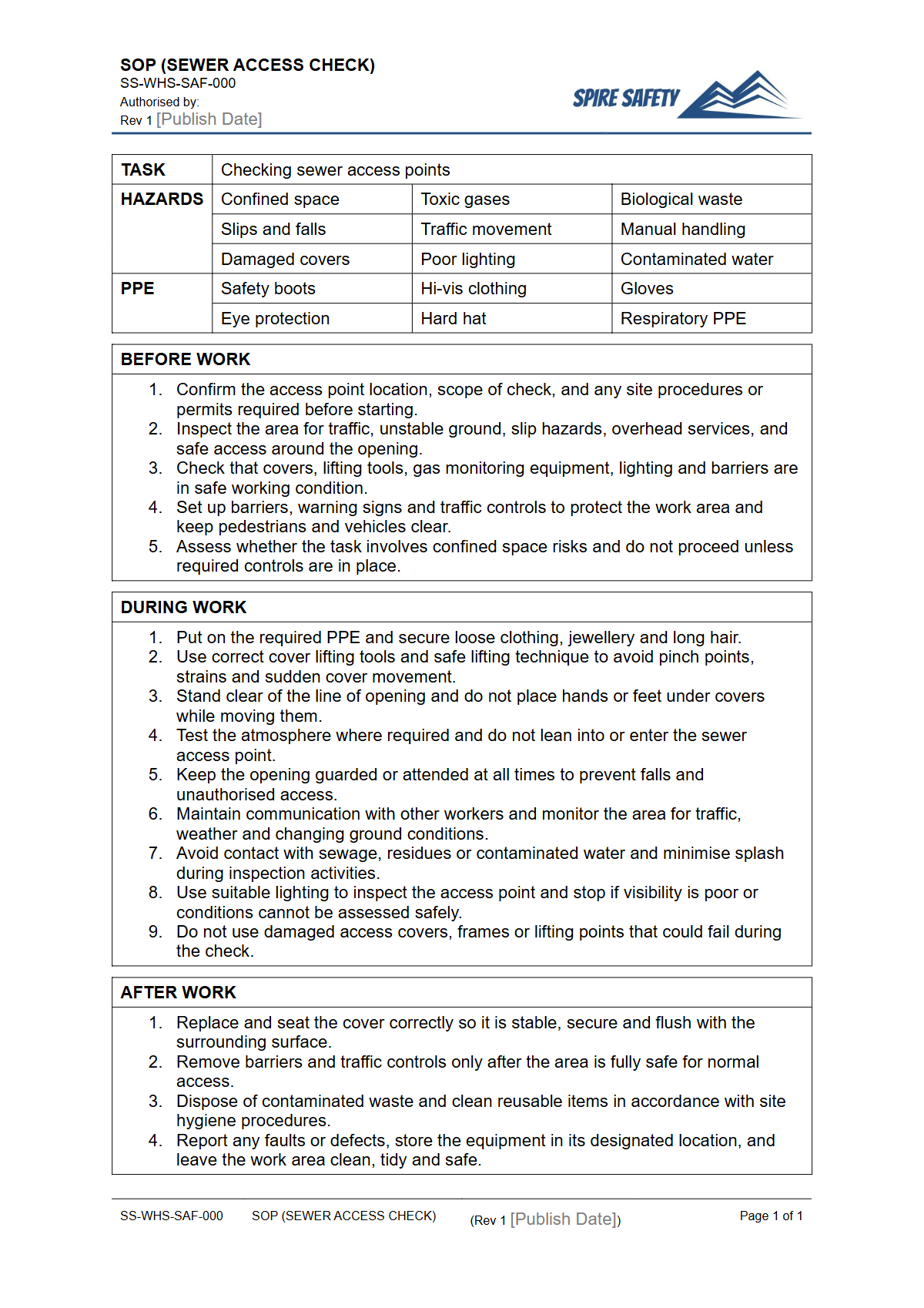
Purpose of the Free Safe Operating Procedure (Sewer Access Check) Template
Working in and around sewers presents extreme risks, including atmospheric contamination, engulfment, and biological hazards. This free Safe Operating Procedure (Sewer Access Check) Template provides a structured framework for documenting the step-by-step process required for safe entry and work.
It is designed to help your organisation standardise procedures, ensure workers are aware of the hazards and controls, and demonstrate a commitment to systematic safety management. An effective SOP is a critical component of broader WHS management systems, formalising the expected safe work behaviour for high-risk tasks.
Video walkthrough
How to use the Free Safe Operating Procedure (Sewer Access Check) Template
This template is provided in both DOCX for easy customisation and PDF for straightforward distribution. It is essential to adapt this document to the specific conditions, equipment, and personnel at your worksite.
Generic procedures are insufficient for managing site-specific risks.
IMPORTANT: This document is a template and must be customised to your specific workplace, equipment, and processes. We are not liable for any incidents arising from the use of this template.
You must conduct your own risk assessment and consult with workers to ensure the procedure is comprehensive and effective for your context.
Review every section, replacing placeholder text with detailed information relevant to your operations. This includes specifying the types of gas monitoring equipment used, emergency contact details, and site-specific isolation points.
Once customised, it should be used for training, pre-start meetings, and as a reference for supervisors and workers. For other procedural documents, you can browse our complete free WHS resources library.
When to use a Sewer Access Procedure
A Safe Operating Procedure for sewer access should be implemented as part of the planning phase for any work involving entry into a sewer, drain, manhole, wet well, or associated confined space. It forms a key part of the risk management process, alongside a job safety analysis (JSA) and a confined space entry permit.
This SOP should be reviewed during toolbox talks before work begins to ensure every team member understands their roles, the hazards, and the required control measures. It is especially critical when the work involves related high-risk activities, such as excavation, which may require a separate free Trencher SOP template.
Who should use this Safe Operating Procedure
This SOP is intended for use by a range of personnel within an organisation. Persons Conducting a Business or Undertaking (PCBUs) can use it to establish and formalise safe work systems.
WHS managers and supervisors are responsible for implementing, training, and enforcing the procedure on-site. Workers and contractors who perform sewer access tasks must be trained in the SOP and follow it diligently to protect their health and safety.
The document also serves as a critical reference during safety reviews and WHS compliance auditing to verify that prescribed safety protocols are being followed.
Key Elements of a Sewer Access SOP
A comprehensive sewer access SOP should detail the entire process from planning to completion. Key sections to include and customise are:
- Pre-Entry Checks: This is the most critical phase. It must include steps for isolating the space from potential liquid, gas, or electrical sources. It must also mandate atmospheric testing by a competent person for oxygen levels, flammable gases, and toxic contaminants like hydrogen sulfide and carbon monoxide. Checks on all equipment, including harnesses, tripods, and ventilation systems, are also essential. If you use mechanical ventilation, its setup and operation may be covered in a specific Air Compressor SOP.
- Entry and Work Procedures: This section outlines the sequence of actions for entry, the tasks to be performed, and the safety protocols to be maintained while inside. It should define the roles and responsibilities of the entry team, including the standby person who must remain outside and maintain constant communication. Continuous atmospheric monitoring requirements should be clearly stated.
- Emergency and Rescue: A detailed, site-specific emergency rescue plan is non-negotiable. This section must outline procedures for non-entry rescue, methods for contacting emergency services, and the location and use of rescue equipment. Planning should also consider how to move heavy equipment in an emergency, for which procedures like a Telehandler SOP may be relevant for external lifting support.
Common mistakes
Common mistakes to avoid
- Failing to conduct atmospheric testing before entry and continuously during the work.
- Using an untrained or inattentive standby person who is assigned other duties.
- Inadequate isolation of the space, leading to unexpected inflow of liquids or gases.
- Having a generic rescue plan that is not specific to the location or scenario.
Legal references
Legal considerations
The following legal requirements may be relevant to this type of work.
- Work Health and Safety Act (Harmonised) — Provides the primary duties for protecting workers and other people from work health and safety risks.
- Work Health and Safety Regulations (Harmonised) — Sets out requirements supporting the management of workplace hazards and risks.
The following codes may be relevant to this type of work.
- Managing WHS Risks Code of Practice — Provides practical guidance on identifying hazards, assessing risks and applying effective controls.
- Work Health and Safety Consultation, Cooperation and Coordination Code of Practice — Provides practical guidance on consulting workers and coordinating with other duty holders.
- Managing the Work Environment and Facilities Code of Practice — Provides practical guidance on safe work environments, workplace facilities and related controls.
Did you know
The Danger of Olfactory Fatigue
Hydrogen sulfide (H₂S), a common gas in sewers, causes olfactory fatigue. At high concentrations, it deadens the sense of smell, leading workers to falsely believe the gas has dissipated when it has actually reached life-threatening levels.
FAQ
Frequently asked questions
01Is a Safe Operating Procedure the same as a SWMS for sewer access?
02What are the main hazards of sewer access?
03Does this SOP template cover all confined space entry requirements?
04How often should a sewer access SOP be reviewed?
Share this resource
Free Safe Operating Procedure (Sewer Access Check) Template
Browse Categories
How To Use It
- 1Download and open in Word or PDF.
- 2Replace the placeholders with your business details.
- 3Get it reviewed by a WHS specialist before rollout.
Need it customised?
Our WHS consultants can adapt this template to your site, run a gap analysis, or audit what you already have in place.
Book a Free Consultation WHS consulting servicesor call 1300 156 382
Related templates
- Free Safe Operating Procedure (Sewer Jetting) Template
- Free Safe Operating Procedure (Sewer Overflow Cleanup) Template
- Free Safe Operating Procedure (Sewer Spill Response) Template
- Free Safe Operating Procedure (Sewer Vent Inspection) Template
- Free Safe Operating Procedure (Shackle Use) Template
- Free Safe Operating Procedure (Shade Cloth Installation) Template