
Free Safe Operating Procedure (Septic Tank Inspection) Template
Download our free Safe Operating Procedure (Septic Tank Inspection) Template to formalise safety protocols. A great starting point for Australian workplaces.
Free Safe Operating Procedure (Septic Tank Inspection) Template
DOCX • 126 KB + PDF
Updated Oct 2026
No signup required
Purpose of the Free Safe Operating Procedure (Septic Tank Inspection) Template
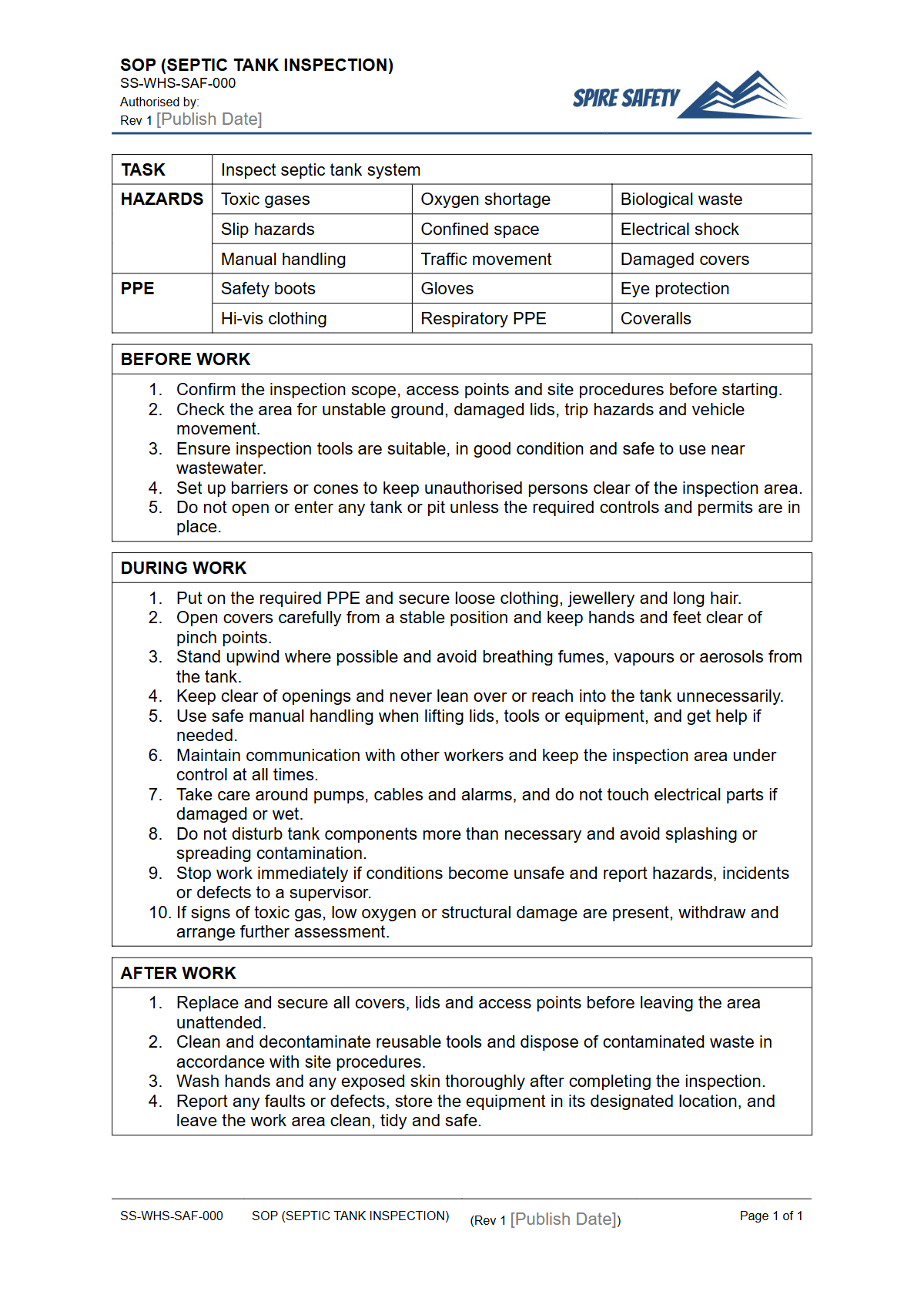
Working with or near septic tanks presents significant health and safety risks, including confined space entry, exposure to hazardous atmospheres, and biological contaminants. This Free Safe Operating Procedure (Septic Tank Inspection) Template provides a structured framework for documenting the step-by-step process required to perform inspections safely.
It prompts you to identify potential hazards, assess risks, and implement effective control measures to protect your workers.
Using this SOP helps ensure that all personnel are aware of the required precautions, such as atmospheric testing, isolation procedures, personal protective equipment (PPE) requirements, and emergency response plans. Formalising your process is a critical step in meeting your duty of care as a PCBU (Person Conducting a Business or Undertaking) under Australian WHS legislation.
Video walkthrough
How to use the Free Safe Operating Procedure (Septic Tank Inspection) Template
This template is provided in both DOCX and PDF formats for your convenience. To use it, simply download the file and adapt its contents to the specific context of your workplace, equipment, and personnel.
You must detail your site-specific emergency procedures, communication protocols, and the types of septic systems your team services.
Important: This is a template only. We are not WHS consultants, and this document must be customised by a competent person to suit your specific circumstances.
A generic procedure is not sufficient for ensuring safety; it must reflect the real-world conditions and risks of your operations. Integrating this SOP into your broader safety framework is key to its effectiveness, forming part of your comprehensive WHS management systems.
Key Hazards in Septic Tank Inspection
A thorough risk assessment is essential before any work begins. This SOP template guides you in documenting controls for several critical hazards.
Confined Space Entry
Septic tanks are classic examples of a confined space. They can contain hazardous atmospheres with low oxygen levels or toxic gases like hydrogen sulfide, methane, and carbon monoxide.
There is also a risk of engulfment or drowning. This SOP outlines the need for a confined space entry permit system, a trained standby person, continuous atmospheric monitoring, and a detailed rescue plan.
Biological and Chemical Risks
Septic systems contain raw sewage, which is a significant biological hazard harbouring bacteria, viruses, and parasites that can cause serious illness. The SOP prompts the user to specify PPE, such as gloves, eye protection, and respiratory protection, as well as strict hygiene practices to prevent exposure.
It also covers hazards associated with any chemicals used for cleaning or treatment.
Excavation and Structural Hazards
Accessing underground tanks may require excavation, introducing risks like trench collapse. The surrounding soil must be assessed for stability, and appropriate shoring or benching used.
Your procedures should include protocols for the safe use of trenching machinery if applicable. The structural integrity of the tank itself—including the lid and walls—must also be verified to prevent collapse.
When to use this Safe Operating Procedure
An SOP for septic tank inspection should be used as a primary reference document before, during, and after the task. It is essential for training new workers, providing refresher training for existing staff, and conducting pre-start toolbox talks.
The procedure should also be readily available on-site for all workers and supervisors to consult. It serves as a benchmark for safety observations and incident investigations.
Who should use this Safe Operating Procedure
This document is intended for use by anyone involved in the management or execution of septic tank inspections. This includes PCBUs, operations managers, WHS advisors, site supervisors, and the workers carrying out the inspection.
All personnel must be trained on the contents of the finalised SOP and deemed competent to perform the task safely. Regular reviews and checks, often as part of a formal WHS compliance auditing program, ensure the procedure remains current and is being followed correctly.
The equipment used during an inspection, such as ventilation fans or pumps, must also have its own safe operating procedures. If using powered equipment, ensure operators are familiar with documents like a specific air compressor SOP to manage associated risks.
Similarly, for lifting heavy tank lids or moving equipment on site, a relevant SOP for telehandler use might be required. You can find more templates like these in our free WHS resources library to build out your safety documentation.
Common mistakes
Common mistakes to avoid
- Entering a tank based on smell alone, without using a calibrated gas detector for atmospheric testing.
- Working without a dedicated, trained standby person who has a rescue plan.
- Using standard electrical equipment (e.g., lights, fans) that is not intrinsically safe, creating an ignition source for flammable gases like methane.
- Failing to properly secure the work area, allowing for falls into the tank or unauthorised entry.
Legal references
Legal considerations
The following legal requirements may be relevant to this type of work.
- Work Health and Safety Act (Harmonised) — Provides the primary duties for protecting workers and other people from work health and safety risks.
- Work Health and Safety Regulations (Harmonised) — Sets out requirements supporting the management of workplace hazards and risks.
The following codes may be relevant to this type of work.
- Managing WHS Risks Code of Practice — Provides practical guidance on identifying hazards, assessing risks and applying effective controls.
- Work Health and Safety Consultation, Cooperation and Coordination Code of Practice — Provides practical guidance on consulting workers and coordinating with other duty holders.
- Managing the Work Environment and Facilities Code of Practice — Provides practical guidance on safe work environments, workplace facilities and related controls.
Did you know
Silent Danger
Hydrogen sulfide (H₂S), the gas that smells like rotten eggs, causes olfactory fatigue. At high concentrations, it quickly deadens your sense of smell, creating a false sense of safety right before it becomes lethal.
Confined Space Risk
In Australia, a significant number of confined space fatalities involve would-be rescuers who enter the space without proper training or equipment, becoming victims themselves.
FAQ
Frequently asked questions
01Is a Safe Operating Procedure legally required for septic tank inspection?
02What are the biggest risks when inspecting a septic tank?
03Can one person inspect a septic tank alone?
04How often should an SOP for septic tank inspection be reviewed?
Share this resource
Free Safe Operating Procedure (Septic Tank Inspection) Template
Browse Categories
How To Use It
- 1Download and open in Word or PDF.
- 2Replace the placeholders with your business details.
- 3Get it reviewed by a WHS specialist before rollout.
Need it customised?
Our WHS consultants can adapt this template to your site, run a gap analysis, or audit what you already have in place.
Book a Free Consultation WHS consulting servicesor call 1300 156 382
Related templates
- Free Safe Operating Procedure (Service Bay Cleaning) Template
- Free Safe Operating Procedure (Service Corridor Clean) Template
- Free Safe Operating Procedure (Service Door Cleaning) Template
- Free Safe Operating Procedure (Service Lift Cleaning) Template
- Free Safe Operating Procedure (Service Lift) Template
- Free Safe Operating Procedure (Settlement Gauge) Template