
Free Safe Operating Procedure (Service Corridor Clean) Template
Establish clear, safe work steps for maintaining service corridors in your facility. Download our Free Safe Operating Procedure (Service Corridor Clean) Template.
Free Safe Operating Procedure (Service Corridor Clean) Template
DOCX • 126 KB + PDF
Updated Oct 2026
No signup required
Purpose of the Free Safe Operating Procedure (Service Corridor Clean) Template
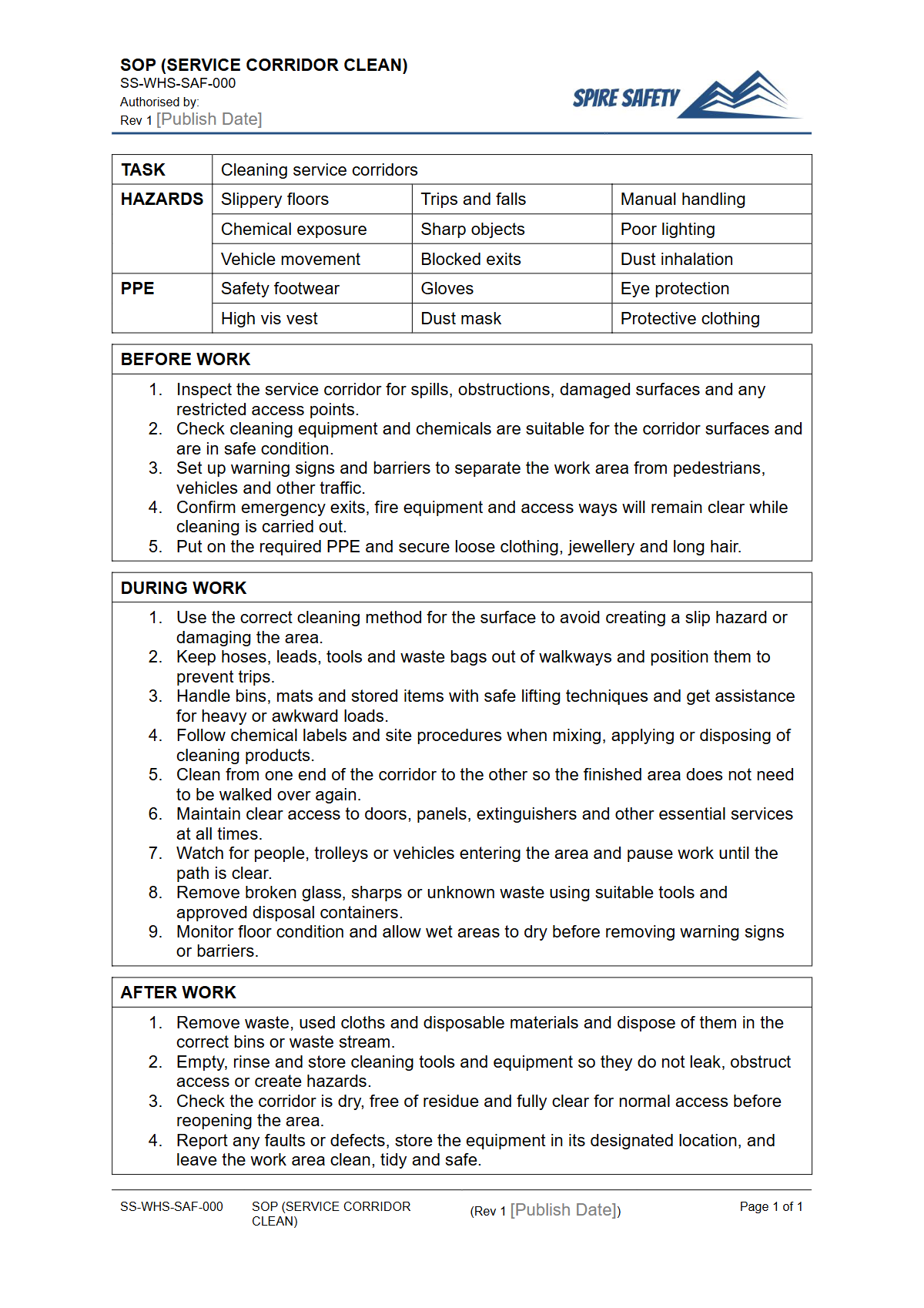
Maintaining clear and clean service corridors is essential for operational efficiency and workplace safety. This Free Safe Operating Procedure (Service Corridor Clean) Template provides a structured starting point for documenting the required steps to perform this task safely.
By standardising your cleaning process, you can systematically manage common risks such as slips, trips, falls, hazardous chemical exposure, and manual handling injuries.
A well-defined Safe Operating Procedure (SOP) is a fundamental tool for any person conducting a business or undertaking (PCBU) to fulfil their primary duty of care. It demonstrates a commitment to a proactive safety culture and forms a critical component of broader WHS management systems, ensuring that tasks are performed consistently and safely every time.
Video walkthrough
How to use the Free Safe Operating Procedure (Service Corridor Clean) Template
This document is provided in both DOCX and PDF formats for your convenience. The DOCX file is fully editable, allowing you to tailor it to the specific conditions of your workplace.
To use it effectively, download the template and conduct a thorough risk assessment of the service corridor cleaning task in consultation with the workers who perform it.
You must adapt the content to reflect your site's unique environment, including the specific cleaning agents used, the types of flooring, the equipment available, and the layout of the corridors. Ensure the SOP accounts for all fixed plant or equipment within the area, which may require their own procedures, such as those detailed in our FREE Conveyer System SOP.
Please note: This is a template that must be customised for your specific workplace. We recommend a person with competence in the task consults with workers and other stakeholders to adapt this document to your unique environment, equipment, chemicals, and control measures.
Key Hazards in Service Corridor Cleaning
Service corridors often present a unique combination of hazards that must be effectively controlled. Your customised SOP should address:
- Slips, Trips & Falls: Caused by wet floors during cleaning, spills, stored items, uneven surfaces, or poor lighting.
- Hazardous Chemicals: Risks from incorrect dilution, inadequate ventilation, skin or eye contact, and improper storage of cleaning agents. Reference to Safety Data Sheets (SDS) is crucial.
- Manual Tasks: Injuries from lifting heavy buckets, operating floor polishers, or using awkward postures to clean confined spaces.
- Shared Spaces: The potential for interaction with other workers, vehicles like forklifts, or live services (electrical, plumbing) that may be exposed in the corridor.
Regular WHS compliance auditing helps confirm that the control measures you implement for these hazards are consistently applied and remain effective over time.
When to use this Safe Operating Procedure
An SOP is a live document that should be used as part of your daily safety management. It should be referenced during worker inductions and for specific task training to ensure everyone understands the established safe work method.
It also serves as a critical reference tool for supervisors overseeing work and as a benchmark during safety inspections.
This procedure should also be reviewed and updated following any incident or near miss, or when there are changes to the task, such as the introduction of new cleaning equipment or chemicals. While this SOP is for general corridor cleaning, other specific tasks may require their own documentation, such as our Free Safe Operating Procedure (Deep Fryer) template for commercial kitchens.
Who should use this template
This template is designed for use by anyone responsible for workplace health and safety. This includes WHS managers, facilities managers, team leaders, and supervisors in industries such as warehousing, manufacturing, healthcare, and property management.
It provides a framework for PCBUs to document and implement a safe system of work, helping to meet WHS obligations.
For organisations with complex sites or high-risk environments, developing robust safety procedures can be challenging. Engaging external expertise through WHS consulting can provide valuable support in conducting risk assessments and ensuring your safety documentation is practical and fit-for-purpose.
Common mistakes
Common mistakes to avoid
- Using a generic template without customising it for specific site hazards.
- Failing to reference the specific Safety Data Sheets (SDS) for cleaning chemicals used.
- Neglecting to train workers on the finalised procedure before they start work.
- Forgetting to schedule and document regular reviews of the SOP.
Legal references
Legal considerations
The following legal requirements may be relevant to this type of work.
- Work Health and Safety Act (Harmonised) — Provides the primary duties for protecting workers and other people from work health and safety risks.
- Work Health and Safety Regulations (Harmonised) — Sets out requirements supporting the management of workplace hazards and risks.
The following codes may be relevant to this type of work.
- Managing WHS Risks Code of Practice — Provides practical guidance on identifying hazards, assessing risks and applying effective controls.
- Work Health and Safety Consultation, Cooperation and Coordination Code of Practice — Provides practical guidance on consulting workers and coordinating with other duty holders.
- Managing the Work Environment and Facilities Code of Practice — Provides practical guidance on safe work environments, workplace facilities and related controls.
Did you know
Slips, Trips, and Falls
Slips, trips, and falls are a leading cause of workplace injuries in Australia. A 'wet floor' sign is a basic control, but a comprehensive SOP ensures processes like 'mopping-in-sections' are used to maintain a safe path of travel at all times.
The Consultation Duty
Under model WHS laws, employers have a specific duty to consult with workers on matters related to their health and safety. Involving your cleaning crew in drafting and reviewing this SOP is not just good practice—it's a legal requirement.
FAQ
Frequently asked questions
01What is a Safe Operating Procedure for cleaning a service corridor?
02Why are service corridors considered high-risk areas for cleaning?
03Who is responsible for creating a Safe Operating Procedure?
04How often should a Service Corridor Cleaning SOP be reviewed?
Share this resource
Free Safe Operating Procedure (Service Corridor Clean) Template
Browse Categories
How To Use It
- 1Download and open in Word or PDF.
- 2Replace the placeholders with your business details.
- 3Get it reviewed by a WHS specialist before rollout.
Need it customised?
Our WHS consultants can adapt this template to your site, run a gap analysis, or audit what you already have in place.
Book a Free Consultation WHS consulting servicesor call 1300 156 382
Related templates
- Free Safe Operating Procedure (Service Door Cleaning) Template
- Free Safe Operating Procedure (Service Lift Cleaning) Template
- Free Safe Operating Procedure (Service Lift) Template
- Free Safe Operating Procedure (Settlement Gauge) Template
- Free Safe Operating Procedure (Sewer Access Check) Template
- Free Safe Operating Procedure (Sewer Jetting) Template