
Free Safe Operating Procedure (Service Bay Cleaning) Template
Our free Safe Operating Procedure for service bay cleaning provides a structured framework for managing hazards. Download the customisable template today.
Free Safe Operating Procedure (Service Bay Cleaning) Template
DOCX • 126 KB + PDF
Updated Oct 2026
No signup required
Purpose of the Free Safe Operating Procedure (Service Bay Cleaning) Template
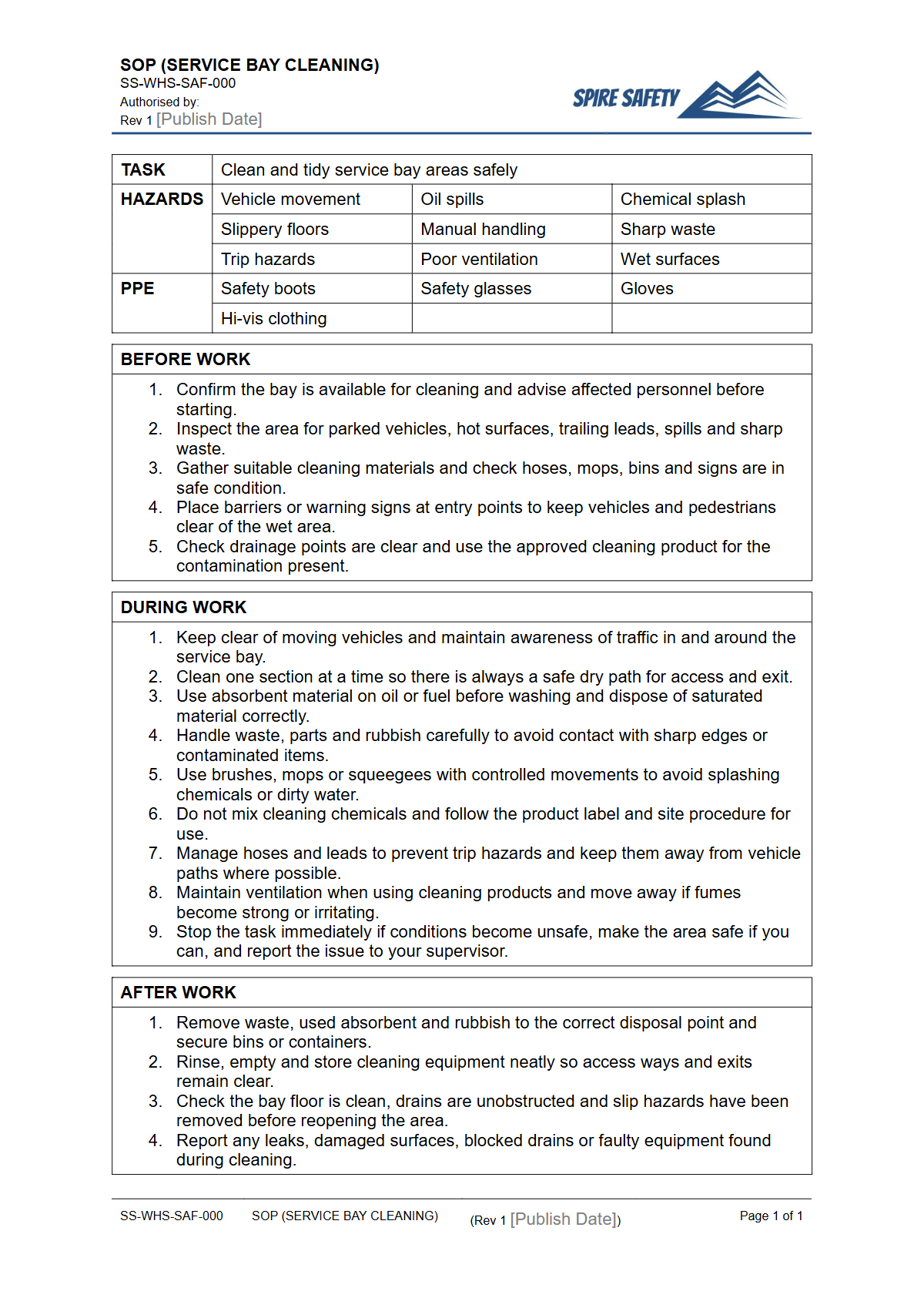
Maintaining a clean and organised vehicle service bay is fundamental to workplace health and safety. This Free Safe Operating Procedure (Service Bay Cleaning) Template provides a structured, step-by-step guide to help your business manage the risks associated with this common but hazardous task.
A clean workspace minimises the chance of slips, trips, and falls from oil, grease, or water spills, which are a leading cause of injury in mechanical workshops.
This Safe Operating Procedure addresses key hazards including exposure to hazardous cleaning chemicals, musculoskeletal injuries from manual handling and awkward postures, and potential interaction with workshop equipment during the cleaning process. By implementing a formal procedure, you establish a clear, repeatable, and safe method of work that all personnel can follow.
This helps ensure that cleaning tasks are performed consistently and safely, protecting your workers and helping your organisation meet its duty of care.
A thorough SOP also covers pre-operational checks, the correct use of Personal Protective Equipment (PPE), and waste disposal protocols. It serves as a vital tool for worker training and inductions.
While cleaning, personnel may also need to work around other machinery. For related equipment, a specific Free Air Compressor SOP (Safe Operating Procedure) Template may also be required.
Video walkthrough
How to use the Free Safe Operating Procedure (Service Bay Cleaning) Template
This template is provided in both DOCX and PDF formats to suit your needs. We recommend downloading the DOCX version to allow for easy customisation.
The procedure should be adapted to reflect the specific layout of your service bay, the types of cleaning chemicals you use, the equipment available, and your unique site risks. Effective consultation is key; involve the workers who actually perform the cleaning tasks in the review and customisation process to ensure the procedure is practical and addresses real-world challenges.
Once customised, this Safe Operating Procedure becomes a critical document within your safety framework. It should be integrated into your broader WHS management systems to ensure it is managed, reviewed, and updated correctly.
The finalised SOP should be made readily available to all relevant workers at the point of use—not just filed away in an office.
Important: This document is a template and does not constitute legal advice. We are not familiar with your specific worksite, equipment, or processes.
You MUST customise this Safe Operating Procedure in consultation with your team to ensure it is relevant and effective for your business's unique operational context.
When to use a Safe Operating Procedure for Service Bay Cleaning
A Safe Operating Procedure for service bay cleaning should be used every time the task is performed. It's not just a document for new employees; it's a live tool for experienced staff as well. It should be referenced:
- Before work starts: To gather the correct PPE, cleaning agents, and equipment, and to check for any immediate hazards in the area.
- During the task: To follow the sequence of steps, ensuring that controls like ventilation, spill management, and correct manual handling techniques are applied.
- After the task is complete: To ensure equipment is cleaned and stored correctly, waste is disposed of according to environmental and safety regulations, and the area is made safe for normal operations.
The SOP is also a cornerstone of worker training, competency assessments, and incident investigations. Regular reviews of your procedures are also essential and often form part of a scheduled WHS compliance auditing program to ensure ongoing effectiveness.
Who should use this Safe Operating Procedure
This SOP is intended for multiple roles within a vehicle service or workshop environment:
- Workers and Technicians: The primary users who must follow the procedure to perform cleaning tasks safely. They should be trained on the SOP's contents and know where to access it.
- Supervisors and Team Leaders: Responsible for ensuring workers are trained on the SOP, understand its requirements, and follow it consistently. They use it as a tool for monitoring work and providing instruction.
- WHS Managers and Business Owners (PCBUs): Accountable for ensuring that a safe system of work is in place, documented, and effective. They oversee the implementation, review, and improvement of all SOPs.
The complexity of your workshop will influence the number and type of procedures required. For example, if your service bay includes automated parts delivery, you may also need a FREE Conveyer System SOP (Safe Operating Procedure) Template to manage associated risks. If you need assistance developing or reviewing your procedures to meet your specific obligations, engaging professional WHS consulting services can provide valuable expert guidance. Explore our complete free WHS resources library for more templates to support your organisation's safety goals.
Common mistakes
Common mistakes to avoid
- Using the template 'as-is' without customising it for site-specific chemicals, equipment, and hazards.
- Failing to provide the specific Personal Protective Equipment (PPE) listed in the SOP.
- Not training workers on the procedure before they are required to perform the cleaning task.
- Storing the SOP in an office instead of making it easily accessible to workers in the service bay area.
Legal references
Legal considerations
The following legal requirements may be relevant to this type of work.
- Work Health and Safety Act (Harmonised) — Provides the primary duties for protecting workers and other people from work health and safety risks.
- Work Health and Safety Regulations (Harmonised) — Sets out requirements supporting the management of workplace hazards and risks.
The following codes may be relevant to this type of work.
- Managing WHS Risks Code of Practice — Provides practical guidance on identifying hazards, assessing risks and applying effective controls.
- Work Health and Safety Consultation, Cooperation and Coordination Code of Practice — Provides practical guidance on consulting workers and coordinating with other duty holders.
- Managing the Work Environment and Facilities Code of Practice — Provides practical guidance on safe work environments, workplace facilities and related controls.
Did you know
Slips, Trips, and Falls
Slips, trips, and falls are a leading cause of serious workplace injuries in Australia, with greasy, oily, and wet surfaces in workshops being a major contributor.
Chemical Safety
The model WHS Regulations include specific duties for Persons Conducting a Business or Undertaking (PCBUs) to manage risks associated with hazardous chemicals, including providing information, training, and supervision.
FAQ
Frequently asked questions
01What are the main hazards to consider when cleaning a service bay?
02How often should a Safe Operating Procedure for service bay cleaning be reviewed?
03Can this SOP template be used for any type of vehicle workshop?
04Why is a written SOP better than verbal instructions for cleaning tasks?
Share this resource
Free Safe Operating Procedure (Service Bay Cleaning) Template
Browse Categories
How To Use It
- 1Download and open in Word or PDF.
- 2Replace the placeholders with your business details.
- 3Get it reviewed by a WHS specialist before rollout.
Need it customised?
Our WHS consultants can adapt this template to your site, run a gap analysis, or audit what you already have in place.
Book a Free Consultation WHS consulting servicesor call 1300 156 382
Related templates
- Free Safe Operating Procedure (Service Corridor Clean) Template
- Free Safe Operating Procedure (Service Door Cleaning) Template
- Free Safe Operating Procedure (Service Lift Cleaning) Template
- Free Safe Operating Procedure (Service Lift) Template
- Free Safe Operating Procedure (Settlement Gauge) Template
- Free Safe Operating Procedure (Sewer Access Check) Template