
Free Safe Operating Procedure (Seedling Handling) Template
Download our Free Safe Operating Procedure (Seedling Handling) Template to formalise safe work methods for horticultural and agricultural tasks.
Free Safe Operating Procedure (Seedling Handling) Template
DOCX • 126 KB + PDF
Updated Oct 2026
No signup required
Purpose of the Free Safe Operating Procedure (Seedling Handling) Template
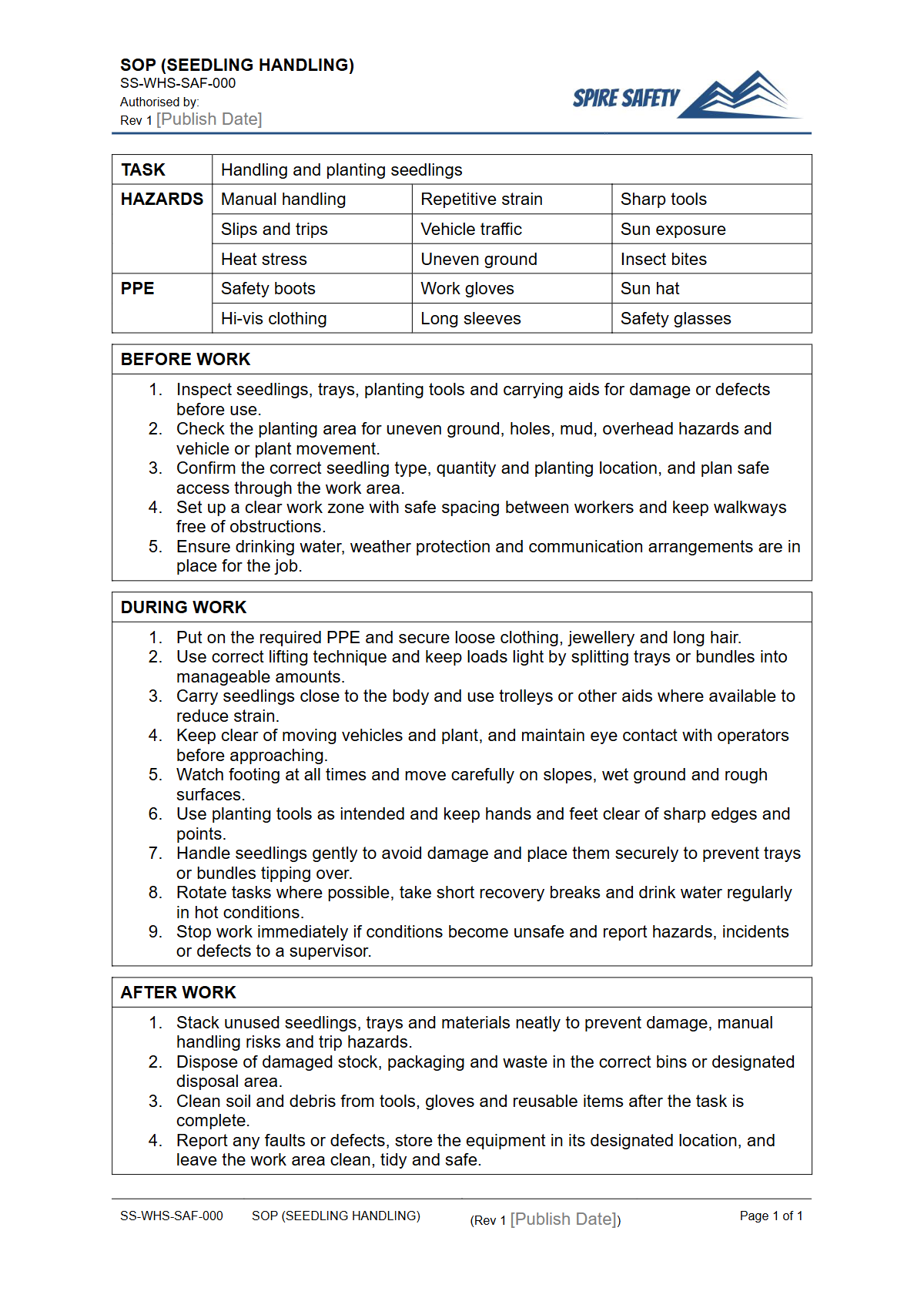
This Free Safe Operating Procedure (Seedling Handling) Template provides a structured framework for documenting the steps required to handle seedlings safely in a nursery, farm, or landscaping environment. The primary goal of any Safe Operating Procedure (SOP) is to control risks and standardise work methods to prevent injury.
Handling seedlings, while seemingly simple, involves significant hazards, including ergonomic risks from repetitive bending and lifting, manual handling injuries from carrying heavy trays, and potential exposure to residual chemicals like pesticides or fungicides.
By implementing a clear SOP, your organisation can minimise the likelihood of musculoskeletal disorders (MSDs), which are a leading cause of workplace injury. A documented procedure ensures all workers, regardless of experience level, understand the approved methods, required Personal Protective Equipment (PPE), and emergency protocols. This process forms a critical component of your overall safety framework, demonstrating a commitment to proactive risk management and supporting your WHS management systems.
Video walkthrough
How to use the Free Safe Operating Procedure (Seedling Handling) Template
Our template is available for instant download in both DOCX and PDF formats. The DOCX version is fully editable, allowing you to tailor it to your specific operational needs.
To use this Safe Operating Procedure, download the file and systematically work through each section, replacing the placeholder text with information relevant to your workplace. This includes specifying the exact types of seedling trays used, the layout of the work area, the chemicals present, and the specific models of any equipment involved.
Important: This document is a template and must be customised to your workplace. We are not WHS consultants, and the information provided is for general guidance only.
You must conduct your own risk assessment in consultation with your workers to ensure all identified hazards are controlled. A generic procedure is not sufficient; it must reflect the reality of your tasks and environment.
For related agricultural tasks, you might also find our FREE Planter SOP Template a useful reference for documenting machinery-based procedures.
When to use a Safe Operating Procedure
An SOP for seedling handling should be used as a core part of your safety and training processes. It is essential for inducting new employees, providing them with a clear, step-by-step guide from their first day.
It also serves as an excellent tool for pre-start meetings or toolbox talks, allowing supervisors to review safe practices before work begins. Furthermore, the SOP should be a key reference document during refresher training to prevent procedural drift and the formation of unsafe habits.
Following any incident or near miss involving seedling handling, the SOP should be reviewed and updated to incorporate any lessons learned. Similar task-specific documents, like a FREE Grain Drill SOP Template, are used in the same way for equipment-based activities.
Who should use it
This SOP is intended for a range of personnel within any organisation involved in horticulture, agriculture, forestry, or landscaping. Key users include:
- Workers: The primary audience. They must be trained on the SOP and follow its instructions to perform their tasks safely.
- Supervisors and Team Leaders: Responsible for ensuring workers understand and adhere to the SOP, providing coaching, and monitoring for compliance.
- WHS Managers and Advisors: Use the SOP as a tool for risk management, training development, and incident investigation. They are often responsible for drafting, reviewing, and approving the document.
- Business Owners (PCBUs): Accountable for providing safe systems of work. A well-implemented SOP helps fulfil this duty of care. Regular reviews of such procedures are often a key part of formal WHS compliance auditing.
Key elements of a seedling handling SOP
A robust SOP for this task should cover several critical areas to be effective. Our template prompts you to detail these sections to create a comprehensive guide.
Key elements include a clear definition of the required PPE, such as nitrile gloves to protect against chemicals, safety glasses if there is a splash risk, and sturdy, enclosed footwear. The procedure should also outline pre-operational checks, like inspecting the work area for trip hazards and ensuring seedling trays are intact.
The core of the document is the step-by-step operating sequence, which breaks down the task into manageable actions. This includes instructions on proper lifting techniques (bending at the knees), how to safely move trays using trolleys or other aids, and procedures for working at benches to reduce back strain.
Incorporating procedures for tasks that use related equipment, such as when using mechanised systems, is also vital. For example, if seedlings are moved via a belt, referencing a FREE Conveyer System SOP may be necessary.
Finally, the SOP must include emergency procedures, detailing what to do in case of a chemical spill, injury, or other adverse event. To see more examples, you can browse our entire free WHS resources library.
Common mistakes
Common mistakes to avoid
- Assuming seedling handling is a 'low-risk' task that doesn't require a formal procedure.
- Failing to train workers in specific manual handling techniques for lifting and moving trays.
- Not specifying the exact type of PPE needed (e.g., chemical-resistant vs. general-purpose gloves).
- Using a generic template without customising it for specific seedling types, tray weights, or the workplace layout.
Legal references
Legal considerations
The following legal requirements may be relevant to this type of work.
- Work Health and Safety Act (Harmonised) — Provides the primary duties for protecting workers and other people from work health and safety risks.
- Work Health and Safety Regulations (Harmonised) — Sets out requirements supporting the management of workplace hazards and risks.
The following codes may be relevant to this type of work.
- Managing WHS Risks Code of Practice — Provides practical guidance on identifying hazards, assessing risks and applying effective controls.
- Work Health and Safety Consultation, Cooperation and Coordination Code of Practice — Provides practical guidance on consulting workers and coordinating with other duty holders.
- Managing the Work Environment and Facilities Code of Practice — Provides practical guidance on safe work environments, workplace facilities and related controls.
Did you know
The Cost of Strains
Musculoskeletal disorders, particularly those arising from hazardous manual tasks, are the most common mechanism of serious workers' compensation claims in Australia, highlighting the importance of proper ergonomic procedures.
Repetitive Risk
Tasks are considered highly repetitive if the core movement cycle is repeated more than twice a minute. Many nursery tasks, like transferring seedlings from trays, easily exceed this threshold, increasing ergonomic risk.
FAQ
Frequently asked questions
01What are the main hazards when handling seedlings?
02How often should a Safe Operating Procedure for seedling handling be reviewed?
03Do I need an SOP if I only have a few staff handling seedlings?
04Can this template be used for handling mature plants too?
Share this resource
Free Safe Operating Procedure (Seedling Handling) Template
Browse Categories
How To Use It
- 1Download and open in Word or PDF.
- 2Replace the placeholders with your business details.
- 3Get it reviewed by a WHS specialist before rollout.
Need it customised?
Our WHS consultants can adapt this template to your site, run a gap analysis, or audit what you already have in place.
Book a Free Consultation WHS consulting servicesor call 1300 156 382
Related templates
- Free Safe Operating Procedure (Seedling Transplanting) Template
- Free Safe Operating Procedure (Self Retracting Lifeline) Template
- Free Safe Operating Procedure (Septic Tank Inspection) Template
- Free Safe Operating Procedure (Service Bay Cleaning) Template
- Free Safe Operating Procedure (Service Corridor Clean) Template
- Free Safe Operating Procedure (Service Door Cleaning) Template