
Free Safe Operating Procedure (Seed Hand Treatment) Template
Effectively manage chemical handling risks with our free Safe Operating Procedure (Seed Hand Treatment) Template. Download the DOCX and PDF to start today.
Free Safe Operating Procedure (Seed Hand Treatment) Template
DOCX • 126 KB + PDF
Updated Oct 2026
No signup required
Purpose of the Free Safe Operating Procedure (Seed Hand Treatment) Template
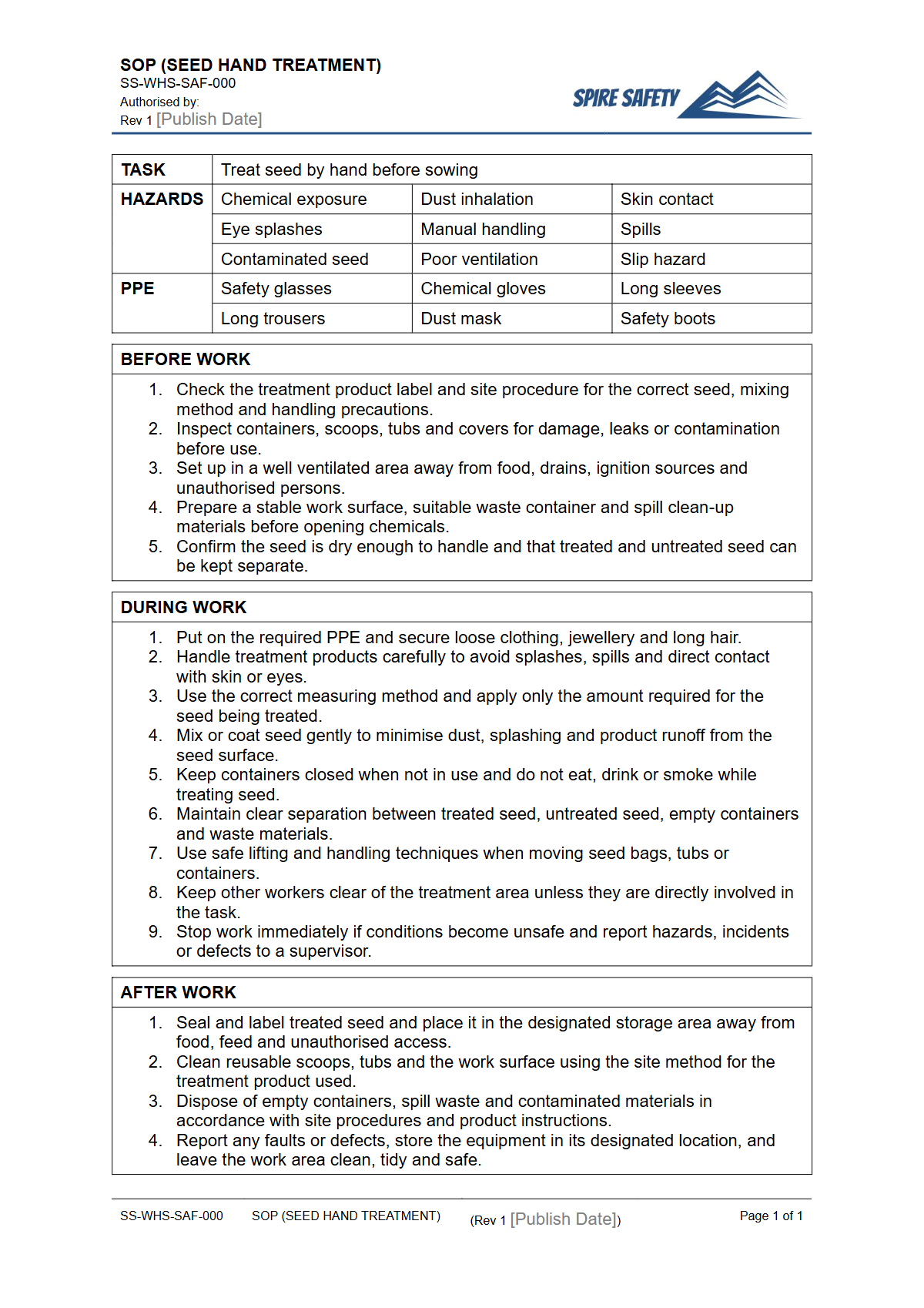
Handling and treating seeds with chemical products presents significant health and safety risks, including chemical exposure, respiratory sensitisation, and musculoskeletal injuries. This free Safe Operating Procedure (Seed Hand Treatment) Template provides a structured framework for documenting the required safety controls for this high-risk agricultural task.
It guides you in outlining the necessary steps, personal protective equipment (PPE), hazard controls, and emergency protocols to protect your workers.
The template is designed as a starting point, aligned with Australian WHS principles, to help you formalise your processes. A documented SOP is a critical component of any effective safety management system, ensuring tasks are performed consistently and safely by all personnel.
It also serves as a vital tool for worker training, inductions, and risk assessments. Implementing a clear SOP helps your organisation meet its duty of care to provide a safe working environment.
For other agricultural processes, you might find our FREE Grain Drill SOP Template useful.
Video walkthrough
How to use the Free Safe Operating Procedure (Seed Hand Treatment) Template
To use this resource, simply download the DOCX or PDF file. The DOCX version is fully editable, allowing you to tailor the content to your specific operational needs.
The SOP is broken down into logical sections, including required PPE, pre-operational checks, step-by-step instructions for the task, and emergency procedures. You should methodically work through each section, adding or removing details to reflect the exact chemicals, equipment, and environment at your workplace.
Important: Before you begin, it’s crucial to recognise that this is a template, not a finished document. We strongly advise that you edit this SOP to reflect your specific site conditions, chemicals used (referencing their Safety Data Sheets), equipment, and internal safety protocols.
A generic procedure is not sufficient; customisation is essential for it to be effective in your workplace. This process often runs parallel to developing procedures for related equipment, such as what is outlined in our FREE Planter SOP Template.
When to use it
A Safe Operating Procedure for seed hand treatment should be developed, implemented, and reviewed before any worker undertakes the task. It should be used as a primary reference document during worker training and for regular competency verification.
Supervisors can use the SOP as a checklist during work observations to ensure the agreed-upon safety measures are being followed correctly.
This document should also be reviewed and updated whenever there is a change in the process, such as the introduction of a new chemical, a change in equipment, or following an incident or near-miss. Regularly reviewing and updating your SOPs is a fundamental part of maintaining robust WHS management systems.
Who should use it
This SOP is intended for use by a range of personnel within an agricultural or horticultural business. This includes:
- Workers and farmhands: To understand and follow the safe steps required to perform the task.
- Supervisors and farm managers: To train workers, monitor compliance, and conduct workplace inspections.
- WHS Advisors and Safety Officers: To integrate the procedure into the broader safety management system and use it as a basis for risk assessments and incident investigations.
Ultimately, anyone involved in the procurement, handling, application, or disposal of seed treatment chemicals should be familiar with the contents of the finalised SOP. It ensures everyone has a clear, consistent understanding of the risks and control measures. A similar level of procedural detail is required for other common farming tasks, like those covered in our FREE Spreader SOP Template.
Periodic reviews ensure that your procedures remain current and effective. Engaging an external party to conduct WHS compliance auditing can provide valuable assurance that your documented systems are being implemented correctly on the ground.
This document is one of many tools designed to improve workplace safety. For more helpful documents, feel free to browse our complete free WHS resources library for other templates, checklists, and guides.
Common mistakes
Common mistakes to avoid
- Using incorrect or poorly fitted Personal Protective Equipment (PPE).
- Failing to read and understand the Safety Data Sheet (SDS) for the specific chemicals being used.
- Performing the task in a poorly ventilated area, such as a closed shed, increasing inhalation risk.
- Not customising the generic SOP to match the specific chemicals, equipment, and conditions of the workplace.
Legal references
Legal considerations
The following legal requirements may be relevant to this type of work.
- Work Health and Safety Act (Harmonised) — Provides the primary duties for protecting workers and other people from work health and safety risks.
- Work Health and Safety Regulations (Harmonised) — Sets out requirements supporting the management of workplace hazards and risks.
The following codes may be relevant to this type of work.
- Managing WHS Risks Code of Practice — Provides practical guidance on identifying hazards, assessing risks and applying effective controls.
- Work Health and Safety Consultation, Cooperation and Coordination Code of Practice — Provides practical guidance on consulting workers and coordinating with other duty holders.
- Managing the Work Environment and Facilities Code of Practice — Provides practical guidance on safe work environments, workplace facilities and related controls.
Did you know
Skin Absorption
The skin is the largest organ of the body, and many agricultural chemicals can be readily absorbed through it, entering the bloodstream and potentially causing systemic health effects. This is why chemical-resistant gloves and coveralls are so critical.
Ventilation is Key
Performing seed treatment in an open, well-ventilated area is one of the most effective ways to reduce the concentration of chemical vapours and dusts in the air, significantly lowering the risk of inhalation exposure.
FAQ
Frequently asked questions
01What Personal Protective Equipment (PPE) is required for hand treating seeds?
02How often should a Safe Operating Procedure for seed treatment be reviewed?
03Can this template be used for large-scale mechanical seed treatment?
04What should be included in the emergency procedures section of the SOP?
Share this resource
Free Safe Operating Procedure (Seed Hand Treatment) Template
Browse Categories
How To Use It
- 1Download and open in Word or PDF.
- 2Replace the placeholders with your business details.
- 3Get it reviewed by a WHS specialist before rollout.
Need it customised?
Our WHS consultants can adapt this template to your site, run a gap analysis, or audit what you already have in place.
Book a Free Consultation WHS consulting servicesor call 1300 156 382
Related templates
- Free Safe Operating Procedure (Seedling Handling) Template
- Free Safe Operating Procedure (Seedling Transplanting) Template
- Free Safe Operating Procedure (Self Retracting Lifeline) Template
- Free Safe Operating Procedure (Septic Tank Inspection) Template
- Free Safe Operating Procedure (Service Bay Cleaning) Template
- Free Safe Operating Procedure (Service Corridor Clean) Template