
Free Safe Operating Procedure (Seed Cleaning) Template
Standardise your agricultural processes with our comprehensive Safe Operating Procedure for seed cleaning.
Free Safe Operating Procedure (Seed Cleaning) Template
DOCX • 126 KB + PDF
Updated Oct 2026
No signup required
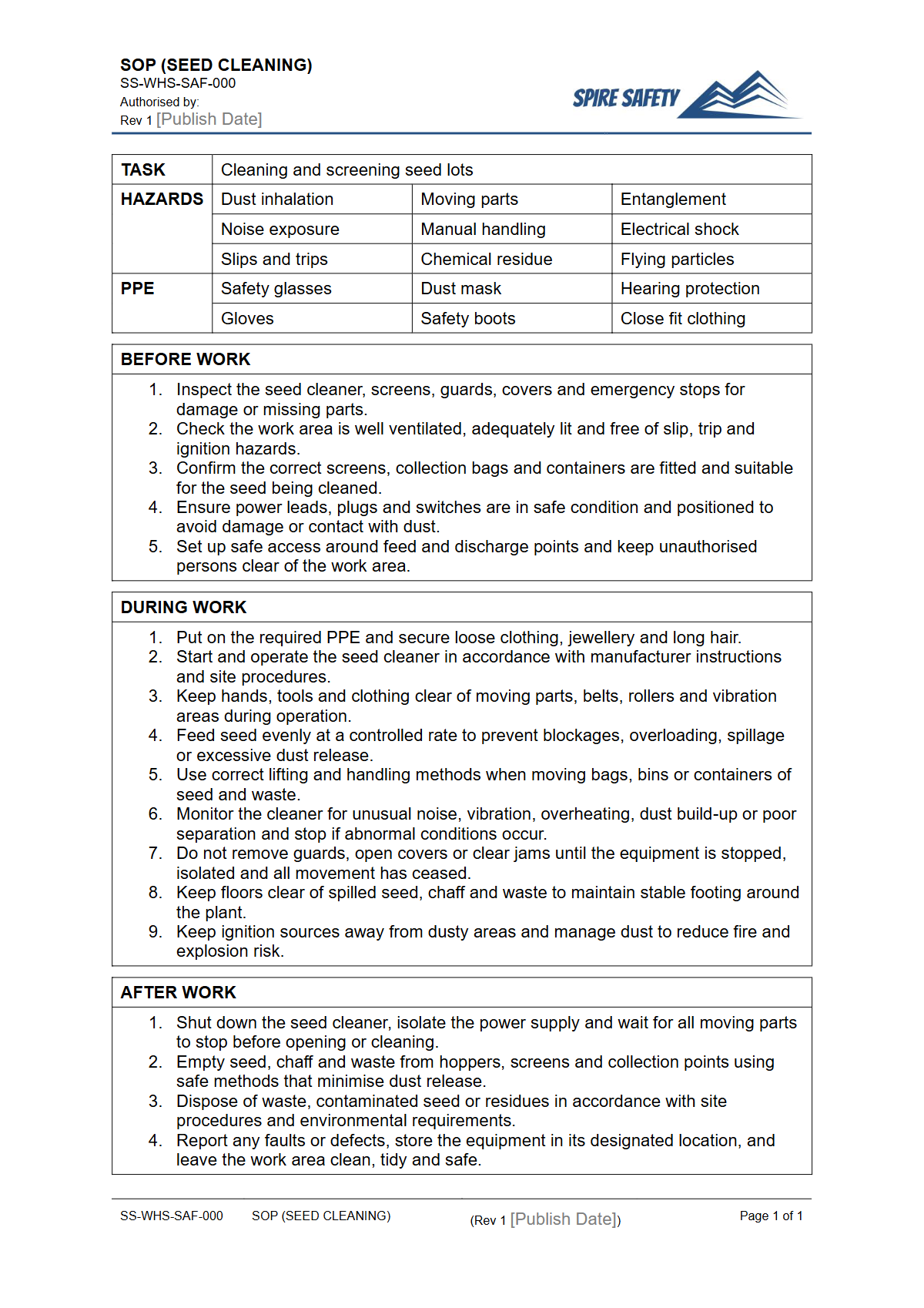
Purpose of the Free Safe Operating Procedure (Seed Cleaning) Template
Seed cleaning is a fundamental process in agriculture, but it involves significant risks that must be managed. This Free Safe Operating Procedure (Seed Cleaning) Template provides a structured framework for documenting the safest way to perform this task.
Using a formal SOP helps your organisation meet its primary duty of care under WHS legislation by outlining a clear, step-by-step process that minimises exposure to hazards. Common risks associated with seed cleaning include mechanical entanglement with augers or belts, respiratory illness from grain dust, noise-induced hearing loss, and ergonomic injuries from manual handling.
A well-defined SOP is a critical control measure that forms part of a broader safety strategy. It ensures all workers, including new and temporary staff, follow a consistent and safe method for operating machinery.
Implementing this procedure can significantly reduce the likelihood of incidents and injuries. For related agricultural processes, you might also find our Free Thresher SOP (Safe Operating Procedure) Template a useful reference for managing similar machinery risks.
Video walkthrough
How to use the Free Safe Operating Procedure (Seed Cleaning) Template
This template is provided in both DOCX and PDF formats for your convenience. The DOCX version is fully editable, allowing you to tailor it directly to your workplace's specific equipment, environment, and processes.
A generic document is not sufficient; you must adapt the content to reflect the reality of your operations. When customising, involve the workers who actually perform the task, as they have firsthand knowledge of the practical challenges and risks involved.
To effectively use this Safe Operating Procedure template:
- Identify the specific machine: Document the make, model, and unique features of your seed cleaning equipment.
- Consult the manufacturer's manual: Incorporate the manufacturer’s recommendations for safe operation, maintenance, and cleaning.
- Conduct a risk assessment: Use the SOP as a tool to support your WHS management systems, ensuring all identified hazards are controlled.
- Add site-specific details: Include instructions related to your particular layout, such as emergency stop locations, traffic management, and communication protocols.
- Review and approve: Have a competent person, such as a farm manager or WHS officer, review and approve the final document before it is implemented.
Note: This is a template only. It is not a complete or compliant Safe Operating Procedure. To be effective, we recommend you customise it to the specific machinery, personnel, and conditions of your workplace in consultation with your team.
When to use it
A Safe Operating Procedure for seed cleaning should be a living document that is integrated into your daily operations. It is not a 'set and forget' piece of paperwork.
It should be used during worker induction and training to ensure new team members understand the established safe method from day one. The SOP serves as a critical reference tool before starting a task, especially for complex or infrequently performed cleaning cycles.
It should also be a key document in regular safety talks and team meetings to reinforce safe work habits.
Furthermore, the SOP must be reviewed and updated following any incident or near-miss. This review process helps identify any gaps in the procedure that may have contributed to the event.
Regular reviews, ideally as part of your WHS compliance auditing schedule, are also essential to ensure the SOP remains current with any changes in equipment, legislation, or industry best practice.
Who should use it
This SOP is designed for use by a range of personnel within an agricultural business. Farm workers and machinery operators are the primary users, as it directs their actions to ensure tasks are completed safely.
They should be trained on the contents of the SOP and have easy access to it in their work area. Farm managers and supervisors are responsible for implementing the SOP, providing training, and ensuring the outlined procedures are followed consistently.
They use the document to monitor performance and enforce safety standards.
Work Health and Safety (WHS) officers or consultants will also find this template valuable. They can use it as a foundation for developing comprehensive safety documentation and for conducting risk assessments.
It provides a clear benchmark for what safe practice looks like, which is invaluable during safety audits and incident investigations. Using standardised documents like this SOP and our FREE Conveyer System SOP helps create a consistent approach to safety across all farm operations.
Common mistakes
Common mistakes to avoid
- Using a generic SOP without customising it for the specific make and model of the seed cleaner.
- Failing to adequately train workers on the procedure and confirm their understanding.
- Neglecting to include procedures for cleaning, maintenance, and clearing blockages.
- Not making the document easily accessible to workers in their immediate work area.
Legal references
Legal considerations
The following legal requirements may be relevant to this type of work.
- Work Health and Safety Act (Harmonised) — Provides the primary duties for protecting workers and other people from work health and safety risks.
- Work Health and Safety Regulations (Harmonised) — Sets out requirements supporting the management of workplace hazards and risks.
The following codes may be relevant to this type of work.
- Managing WHS Risks Code of Practice — Provides practical guidance on identifying hazards, assessing risks and applying effective controls.
- Work Health and Safety Consultation, Cooperation and Coordination Code of Practice — Provides practical guidance on consulting workers and coordinating with other duty holders.
- Managing the Work Environment and Facilities Code of Practice — Provides practical guidance on safe work environments, workplace facilities and related controls.
Did you know
Dust Explosions
Fine organic dust from grain and seed cleaning can form a combustible mixture in the air. When confined and introduced to an ignition source, this can result in a violent dust explosion, a significant risk in silos and enclosed processing areas.
Farmer's Lung
Inhaling dust from mouldy grain or hay can cause a serious allergic respiratory disease known as Farmer's Lung. Proper ventilation and the use of respiratory protective equipment (RPE) during seed cleaning are critical preventative measures.
FAQ
Frequently asked questions
01What are the main hazards involved in seed cleaning?
02Is a Safe Operating Procedure a legal requirement for seed cleaning in Australia?
03How often should a Seed Cleaning SOP be reviewed?
04Can this template be used for all types of seed cleaning machines?
Share this resource
Free Safe Operating Procedure (Seed Cleaning) Template
Browse Categories
How To Use It
- 1Download and open in Word or PDF.
- 2Replace the placeholders with your business details.
- 3Get it reviewed by a WHS specialist before rollout.
Need it customised?
Our WHS consultants can adapt this template to your site, run a gap analysis, or audit what you already have in place.
Book a Free Consultation WHS consulting servicesor call 1300 156 382
Related templates
- Free Safe Operating Procedure (Seed Hand Treatment) Template
- Free Safe Operating Procedure (Seedling Handling) Template
- Free Safe Operating Procedure (Seedling Transplanting) Template
- Free Safe Operating Procedure (Self Retracting Lifeline) Template
- Free Safe Operating Procedure (Septic Tank Inspection) Template
- Free Safe Operating Procedure (Service Bay Cleaning) Template