
Free Safe Operating Procedure (Security Patrol Handover) Template
Ensure a smooth and safe security shift change with our structured Safe Operating Procedure template. Download the free customisable DOCX and PDF now.
Free Safe Operating Procedure (Security Patrol Handover) Template
DOCX • 126 KB + PDF
Updated Oct 2026
No signup required
Purpose of the Free Safe Operating Procedure (Security Patrol Handover) Template
A structured security patrol handover is a critical control point for maintaining site safety and operational continuity. This Free Safe Operating Procedure (Security Patrol Handover) Template provides a clear, documented framework to ensure no vital information is lost between shifts.
Ineffective handovers can lead to overlooked security risks, safety hazards, and a breakdown in communication, potentially resulting in incidents, asset loss, or harm to personnel. Using this SOP helps standardise the process, ensuring all key information—from recent incidents to equipment status—is transferred accurately and consistently.
Implementing a formal SOP for this task establishes clear responsibilities and accountability for both outgoing and incoming security personnel. It serves as an essential tool for training new staff and a reference for experienced officers, reinforcing correct procedure every time.
A well-executed handover process is a fundamental part of a robust safety framework, demonstrating a commitment to proactive risk management. This process is a key element in building effective WHS management systems that protect people and property.
Video walkthrough
How to use the Free Safe Operating Procedure (Security Patrol Handover) Template
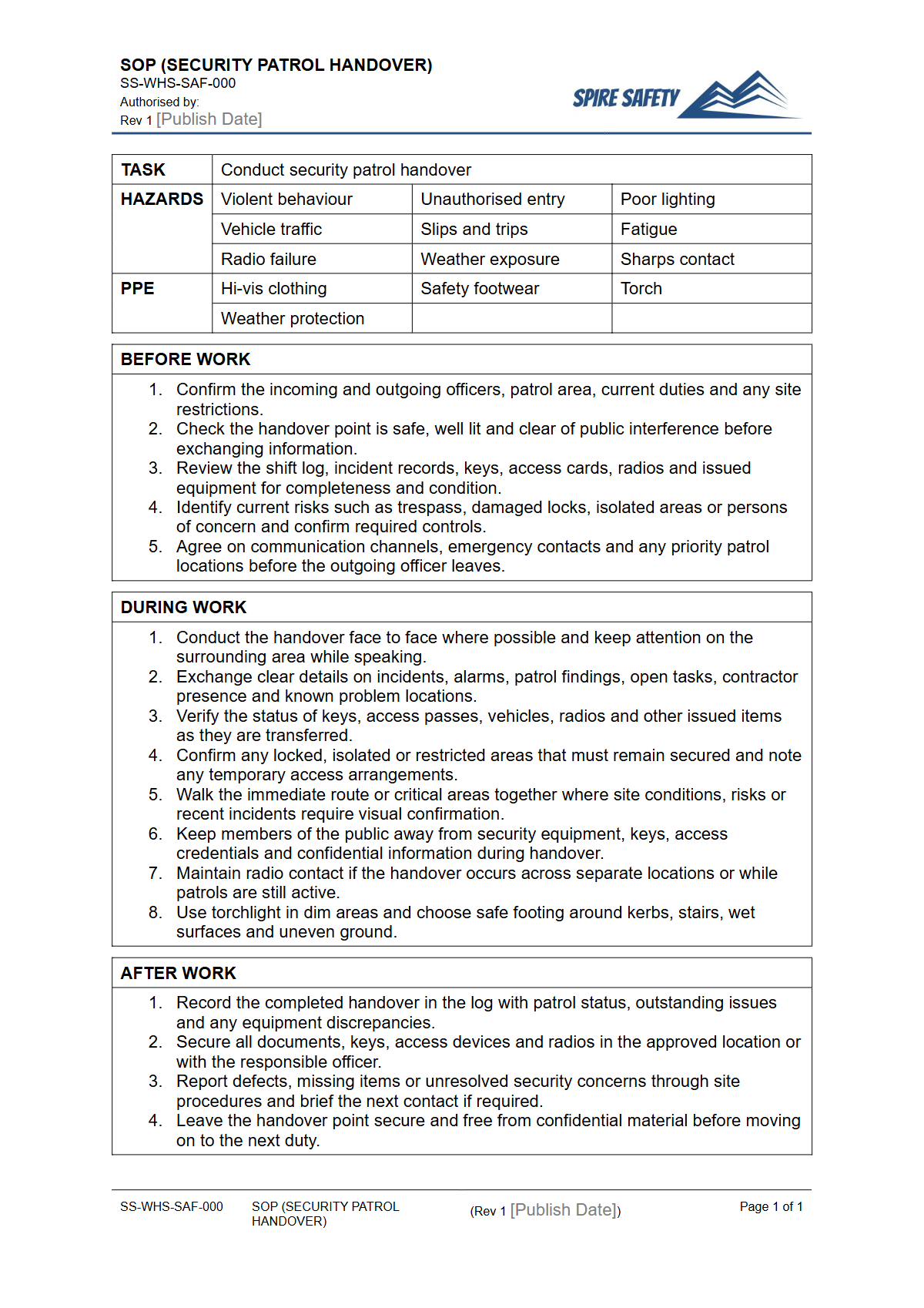
This template is provided in both DOCX and PDF formats to serve as a comprehensive starting point. The DOCX file is fully editable, allowing you to adapt the procedure to the specific context of your workplace.
It includes sections for site details, required personal protective equipment (PPE), a step-by-step handover process, and a sign-off area. You can add your company logo, modify risk controls, and detail site-specific information such as alarm codes, key locations, and emergency contacts.
Important: This is a template, not a finished document. To be effective, you must customise it to reflect the unique hazards, equipment, and operational requirements of your specific site.
We strongly recommend conducting a site-specific risk assessment to inform the customisation of this Safe Operating Procedure. If you require assistance tailoring this document to your organisation's needs, consider engaging professional WHS consulting services.
When to use this Safe Operating Procedure
This Safe Operating Procedure should be used at every security shift change without exception. Consistency is key to creating a reliable safety culture.
The formal handover process should be completed by the outgoing officer and verified by the incoming officer at the beginning and end of their respective shifts. Beyond routine shift changes, this document is also invaluable during non-standard situations, such as handing over responsibilities mid-shift due to an emergency, or when briefing personnel who are covering a shift at short notice.
It should also be reviewed and referenced after any security incident or near miss to ensure all relevant information is captured and passed on.
Who should use this Safe Operating Procedure
This SOP is primarily for security officers conducting patrols and handovers. It guides them through the required steps to ensure a complete and accurate transfer of information.
Security supervisors and managers also have a critical role. They are responsible for implementing the procedure, providing training to their teams, and ensuring it is followed correctly.
Supervisors should periodically observe the handover process and review completed forms to verify compliance and identify any areas for improvement. This kind of verification is a crucial part of an ongoing safety program and can be formalised through periodic WHS compliance auditing.
Key Elements of a Security Handover
A comprehensive security handover covers more than just a verbal update. It is a systematic process that ensures all aspects of the site's security status are communicated. Our template prompts users to consider the following key areas:
Site Status and Environmental Changes
Note any changes to the physical environment. This includes new or temporary hazards like construction work, malfunctioning lights in a specific area, blocked access routes, or unusual weather conditions affecting patrols.
While this SOP covers the handover process, patrols may need to inspect specific machinery; for sites with such equipment, separate procedures like a FREE Conveyer System SOP (Safe Operating Procedure) Template would be necessary to guide safe interaction.
Incidents and Observations
Document all security-related events from the shift, regardless of how minor they may seem. This includes alarms (even false ones), suspicious activity, unauthorised personnel attempts, safety breaches, and any communication received from clients or emergency services.
A detailed log provides the incoming shift with immediate context and heightened awareness.
Equipment and Asset Status
Account for all security equipment. This includes keys, access cards, communication radios, mobile phones, body-worn cameras, and patrol vehicles.
The SOP should guide a check to ensure all items are present, in their correct location, and in good working order. While a handover SOP covers the transfer of items, it differs from procedures for operating them; for instance, a site workshop would have its own Free Air Compressor SOP (Safe Operating Procedure) Template for specific machinery.
Tasks and Follow-up Actions
Clearly outline any tasks that are in progress or require follow-up by the next shift. This could include instructions to monitor a specific camera, conduct extra patrols in a certain area, or wait for a maintenance contractor.
This ensures continuity of operations and that important tasks are not forgotten. For a broader range of safety documents, you can browse our free WHS resources library.
Common mistakes
Common mistakes to avoid
- Conducting verbal-only handovers with no written record for verification.
- Rushing the process and failing to discuss details or ask clarifying questions.
- Forgetting to account for all keys, access cards, and communication equipment.
- Failing to update the handover procedure after a site change or security incident.
Legal references
Legal considerations
The following legal requirements may be relevant to this type of work.
- Work Health and Safety Act (Harmonised) — Provides the primary duties for protecting workers and other people from work health and safety risks.
- Work Health and Safety Regulations (Harmonised) — Sets out requirements supporting the management of workplace hazards and risks.
The following codes may be relevant to this type of work.
- Managing WHS Risks Code of Practice — Provides practical guidance on identifying hazards, assessing risks and applying effective controls.
- Work Health and Safety Consultation, Cooperation and Coordination Code of Practice — Provides practical guidance on consulting workers and coordinating with other duty holders.
- Managing the Work Environment and Facilities Code of Practice — Provides practical guidance on safe work environments, workplace facilities and related controls.
Did you know
Communication is Key
Studies in high-risk industries show that communication breakdowns during shift handovers are a significant contributing factor in up to 80% of preventable incidents.
Lone Worker Safety
A thorough handover is especially critical for lone worker security officers, as it is their primary source of information about potential risks they may face alone on their shift.
FAQ
Frequently asked questions
01What essential information should be included in a security patrol handover?
02Why is a formal handover procedure important for security teams?
03Who is responsible for completing the security handover SOP?
04How often should we review our security patrol handover SOP?
Share this resource
Free Safe Operating Procedure (Security Patrol Handover) Template
Browse Categories
How To Use It
- 1Download and open in Word or PDF.
- 2Replace the placeholders with your business details.
- 3Get it reviewed by a WHS specialist before rollout.
Need it customised?
Our WHS consultants can adapt this template to your site, run a gap analysis, or audit what you already have in place.
Book a Free Consultation WHS consulting servicesor call 1300 156 382
Related templates
- Free Safe Operating Procedure (Security Patrol) Template
- Free Safe Operating Procedure (Security Radio Check) Template
- Free Safe Operating Procedure (Security Shift Handover) Template
- Free Safe Operating Procedure (Security Tag Removal) Template
- Free Safe Operating Procedure (Seed Cleaning) Template
- Free Safe Operating Procedure (Seed Hand Treatment) Template