
Free Safe Operating Procedure (Security Patrol) Template
Download our free Safe Operating Procedure (Security Patrol) template to outline risks and controls for security personnel.
Free Safe Operating Procedure (Security Patrol) Template
DOCX • 126 KB + PDF
Updated Oct 2026
No signup required
Purpose of the Free Safe Operating Procedure (Security Patrol) Template
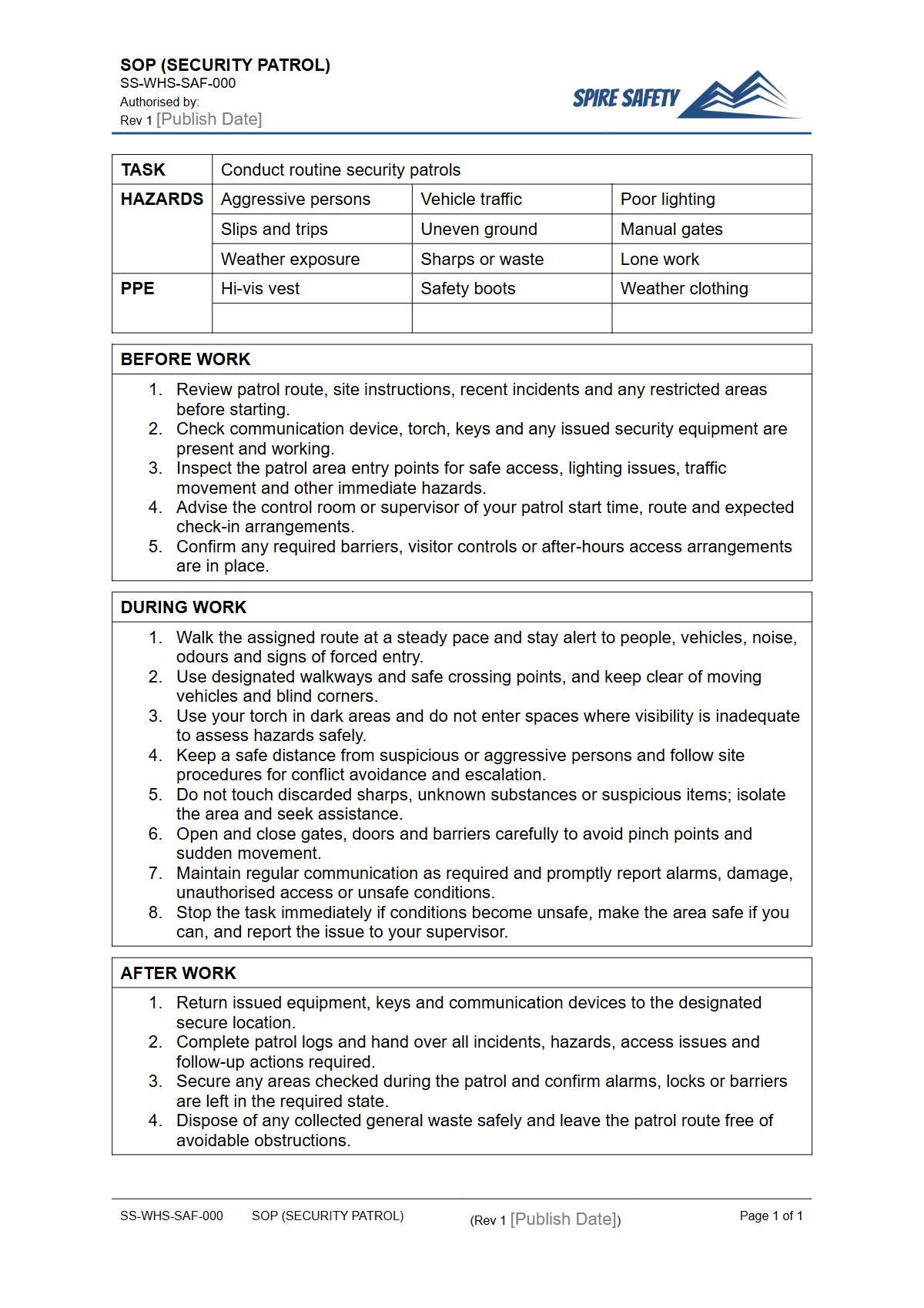
Security patrols are an essential function for many organisations, but the role carries inherent risks. This free Safe Operating Procedure (Security Patrol) template provides a structured framework for documenting the hazards and control measures associated with patrol duties.
It helps organisations meet their duty of care by establishing and communicating a clear, safe method of work for security personnel.
A well-defined SOP is crucial for managing common security risks such as aggression and violence from the public, lone worker situations, fatigue, vehicle incidents, and environmental hazards. By systematically outlining procedures for tasks like site inspections, emergency responses, and communication protocols, this document serves as a vital tool for training, risk management, and operational consistency.
Video walkthrough
How to use the Free Safe Operating Procedure (Security Patrol) Template
This Safe Operating Procedure template is provided in both DOCX and PDF formats for your convenience. To use it, simply download the file and open it in a compatible editor like Microsoft Word.
The document is structured with key headings that you can adapt to the specific requirements of your site and the duties of your security team. It is designed to be a starting point, aligned with Australian WHS principles.
Important: This is a template and must be customised for your workplace. You must consult with your security personnel and other relevant stakeholders to identify all site-specific hazards and develop appropriate control measures.
We are not liable for any incidents or compliance breaches that may arise from the use of this template. It is your responsibility to ensure the final document is comprehensive and suitable for your operational context.
Key Sections to Customise
- Site-Specific Hazards: Detail any unique risks present at your location, such as difficult terrain, hazardous materials, or areas with poor lighting or mobile reception.
- Patrol Routes: Include maps and clearly defined patrol routes, highlighting check-in points, duress alarm locations, and no-go zones.
- Emergency Contacts: List all relevant internal and external emergency contacts, including after-hours numbers for management, emergency services, and technical support.
- Task-Specific Procedures: Outline step-by-step instructions for key duties, such as locking and unlocking procedures, responding to alarms, and managing access for visitors or contractors.
Integrating this SOP into your company's overall safety framework is essential for its effectiveness. The procedures you define should align with and support your broader WHS management systems to ensure a cohesive approach to safety across the organisation.
When to use a Security Patrol Safe Operating Procedure
A Safe Operating Procedure for security patrols should be a living document used throughout the employment lifecycle. It is not a document to be filed and forgotten.
It should be used during the induction and training of all new security officers to establish clear expectations from day one. It also serves as a critical reference for regular refresher training and toolbox talks to reinforce safe work practices.
Furthermore, the SOP must be reviewed and updated following any incident, near-miss, or significant change in the work environment or procedures. Regular reviews, often as part of scheduled WHS compliance auditing, ensure the document remains relevant and effective at controlling risks.
Changes could include new construction on site, altered patrol routes, or new identified threats.
Who should use this Safe Operating Procedure
This document is intended for use by anyone responsible for the safety and management of security operations. This includes:
- Persons Conducting a Business or Undertaking (PCBUs): To help fulfil their primary duty of care to provide a safe work environment.
- WHS Managers and Safety Advisors: As a tool for implementing and monitoring safety protocols.
- Security Managers and Supervisors: For training their teams and managing day-to-day operations safely.
- Security Officers: As a direct guide for performing their duties safely and consistently.
Effective implementation requires consultation. The development and review of the SOP should involve the security officers who perform the patrols, as their firsthand experience is invaluable for identifying practical hazards and effective controls.
Duties may include end-of-day site lockdown, verifying that all high-value mobile plant such as a telehandler is secured and immobilised according to site rules.
On industrial sites, patrol duties may extend to monitoring the status of equipment. Procedures should detail how to safely observe and report on machinery hazards, such as ensuring a conveyer system is properly isolated before entering a restricted area.
Your procedure should detail responses to specific site hazards, from unauthorised personnel to incidents involving machinery like an air compressor left running unsupervised. Having these detailed responses ensures consistent and safe actions are taken by all staff. For more guidance and templates, you can browse our complete free WHS resources library.
Common mistakes
Common mistakes to avoid
- Creating a generic SOP that isn't customised with site-specific hazards and patrol routes.
- Failing to include clear, actionable emergency response and communication protocols.
- Neglecting to provide practical training on the SOP to all security personnel.
- Not reviewing and updating the SOP after an incident, near-miss, or change in workplace conditions.
Legal references
Legal considerations
The following legal requirements may be relevant to this type of work.
- Work Health and Safety Act (Harmonised) — Provides the primary duties for protecting workers and other people from work health and safety risks.
- Work Health and Safety Regulations (Harmonised) — Sets out requirements supporting the management of workplace hazards and risks.
The following codes may be relevant to this type of work.
- Managing WHS Risks Code of Practice — Provides practical guidance on identifying hazards, assessing risks and applying effective controls.
- Work Health and Safety Consultation, Cooperation and Coordination Code of Practice — Provides practical guidance on consulting workers and coordinating with other duty holders.
- Managing the Work Environment and Facilities Code of Practice — Provides practical guidance on safe work environments, workplace facilities and related controls.
Did you know
Lone Worker Risk
Working alone is a significant psychosocial hazard. Australian research indicates that workers in the security industry face a high risk of work-related violence and aggression, much of which occurs while working alone.
FAQ
Frequently asked questions
01What are the most common hazards for security patrols?
02How often should a Security Patrol SOP be reviewed?
03Is a Safe Operating Procedure a legal requirement for security work in Australia?
04Can this template be used for static guards as well as patrols?
Share this resource
Free Safe Operating Procedure (Security Patrol) Template
Browse Categories
How To Use It
- 1Download and open in Word or PDF.
- 2Replace the placeholders with your business details.
- 3Get it reviewed by a WHS specialist before rollout.
Need it customised?
Our WHS consultants can adapt this template to your site, run a gap analysis, or audit what you already have in place.
Book a Free Consultation WHS consulting servicesor call 1300 156 382
Related templates
- Free Safe Operating Procedure (Security Radio Check) Template
- Free Safe Operating Procedure (Security Shift Handover) Template
- Free Safe Operating Procedure (Security Tag Removal) Template
- Free Safe Operating Procedure (Seed Cleaning) Template
- Free Safe Operating Procedure (Seed Hand Treatment) Template
- Free Safe Operating Procedure (Seedling Handling) Template