
Free Safe Operating Procedure (Security Key Handover) Template
Download our free Safe Operating Procedure for security key handover, available as a customisable DOCX and PDF.
Free Safe Operating Procedure (Security Key Handover) Template
DOCX • 126 KB + PDF
Updated Oct 2026
No signup required
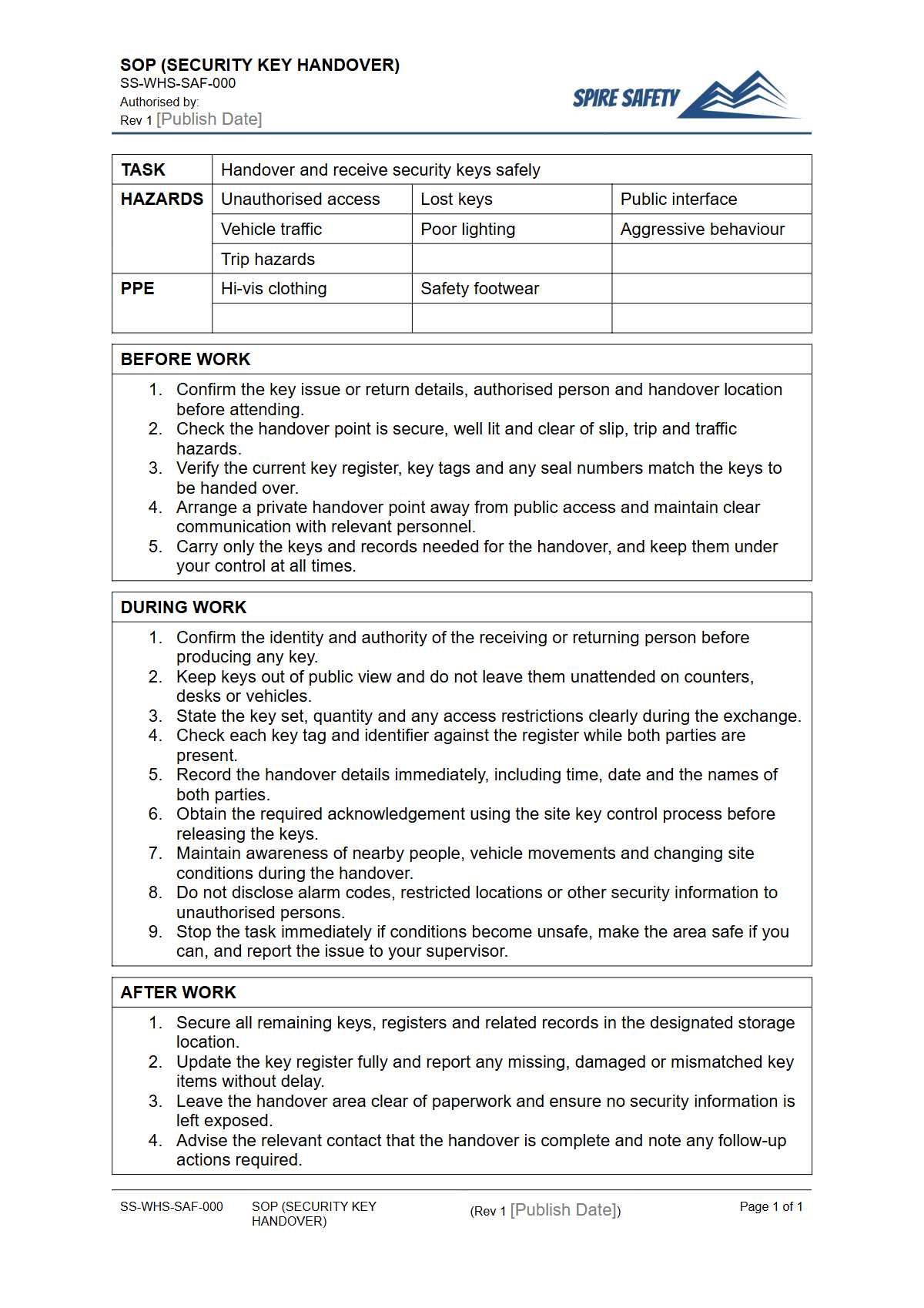
Purpose of the Free Safe Operating Procedure (Security Key Handover) Template
This Free Safe Operating Procedure (Security Key Handover) Template provides a structured framework for managing the issue, return, and tracking of physical keys and access devices within your workplace. A documented procedure is essential for maintaining building security, controlling access to restricted or hazardous areas, and protecting company assets.
By formalising the handover process, you create clear accountability and an auditable trail, which is a fundamental component of a robust security protocol.
Implementing a clear SOP for key management helps prevent unauthorised entry, reduces the risk of theft or damage, and ensures only trained and authorised personnel can access specific locations or machinery. This process is a key administrative control that integrates into your broader WHS management system, demonstrating a proactive approach to site safety and security.
Video walkthrough
How to use the Free Safe Operating Procedure (Security Key Handover) Template
Using this Safe Operating Procedure for security key handover is straightforward. Begin by downloading the template in your preferred format, either DOCX for easy editing or PDF for reference.
The document is structured with sections for purpose, responsibilities, step-by-step procedures for issuing and returning keys, and actions to take if a key is lost or stolen. You will need to fill in the specific details relevant to your business, such as key identification numbers, the locations they access, and the personnel authorised to handle them.
Important: This document is a template and must be customised to your workplace. We have provided a foundation aligned with Australian WHS principles, but it is your responsibility to adapt the content to reflect the specific key register, access levels, roles, and risks unique to your organisation.
Review the completed SOP with your management team and security personnel to ensure it is practical and effective. If you require assistance tailoring safety documents to your operations, consider our WHS consulting services.
When should a Key Handover SOP be used?
A formal key handover procedure should be followed consistently in any situation involving the transfer of access keys. This is not just a daily task but a critical security process. Key times to use this SOP include:
- At the beginning and end of shifts for roles that require specific access (e.g., opening or closing a facility).
- When issuing keys to new employees as part of their onboarding process.
- When providing temporary access to contractors, visitors, or maintenance staff.
- During an emergency where access needs to be transferred to responding personnel.
- When an employee changes roles and no longer requires access to certain areas.
- Upon the cessation of employment, to ensure all company keys are retrieved and accounted for.
Regularly reviewing your key log and handover process is also vital. This can form part of your internal safety reviews or a more formal WHS compliance auditing program to verify that procedures are being followed correctly.
Who is this procedure for?
This SOP is designed for use by any person or role with responsibility for the security and control of workplace keys. This often includes, but is not limited to:
- Security Managers and Personnel
- Office Managers and Administrators
- Building or Facility Managers
- Site Supervisors and Foremen
- Team Leaders or Department Heads
- Reception staff who may manage a key press
The principles in this document are adaptable across various industries. The procedure isn't just for office keys; it can be customised for securing access to specific equipment areas, such as a commercial kitchen with a deep fryer, a plant room, or a chemical storage cabinet.
Essentially, any worker tasked with issuing, receiving, or managing a key register will benefit from this structured procedure. Explore our free WHS resources library for more templates to support your safety systems.
Common mistakes
Common mistakes to avoid
- Failing to immediately retrieve keys and access cards from departing employees.
- Using a poorly-labelled or disorganised key storage system (e.g., keys on a hook with no tag).
- Not keeping the key register or logbook up to date with every transaction.
- Storing master or spare keys in an obvious or unsecured location like a desk drawer.
Legal references
Legal considerations
The following legal requirements may be relevant to this type of work.
- Work Health and Safety Act (Harmonised) — Provides the primary duties for protecting workers and other people from work health and safety risks.
- Work Health and Safety Regulations (Harmonised) — Sets out requirements supporting the management of workplace hazards and risks.
The following codes may be relevant to this type of work.
- Managing WHS Risks Code of Practice — Provides practical guidance on identifying hazards, assessing risks and applying effective controls.
- Work Health and Safety Consultation, Cooperation and Coordination Code of Practice — Provides practical guidance on consulting workers and coordinating with other duty holders.
- Managing the Work Environment and Facilities Code of Practice — Provides practical guidance on safe work environments, workplace facilities and related controls.
Did you know
Chain of Custody
A well-maintained key log establishes a 'chain of custody' for each key. This documented trail is crucial for investigations following a security incident, as it shows who had access to a specific area at a given time.
FAQ
Frequently asked questions
01What information should a key handover log include?
02Can I use this template for access cards and electronic fobs?
03How does this SOP relate to my Work Health and Safety duties?
04What should happen if a key is lost or stolen?
Share this resource
Free Safe Operating Procedure (Security Key Handover) Template
Browse Categories
How To Use It
- 1Download and open in Word or PDF.
- 2Replace the placeholders with your business details.
- 3Get it reviewed by a WHS specialist before rollout.
Need it customised?
Our WHS consultants can adapt this template to your site, run a gap analysis, or audit what you already have in place.
Book a Free Consultation WHS consulting servicesor call 1300 156 382
Related templates
- Free Safe Operating Procedure (Security Log Handover) Template
- Free Safe Operating Procedure (Security Patrol Handover) Template
- Free Safe Operating Procedure (Security Patrol) Template
- Free Safe Operating Procedure (Security Radio Check) Template
- Free Safe Operating Procedure (Security Shift Handover) Template
- Free Safe Operating Procedure (Security Tag Removal) Template