
Free Safe Operating Procedure (Security Door Cleaning) Template
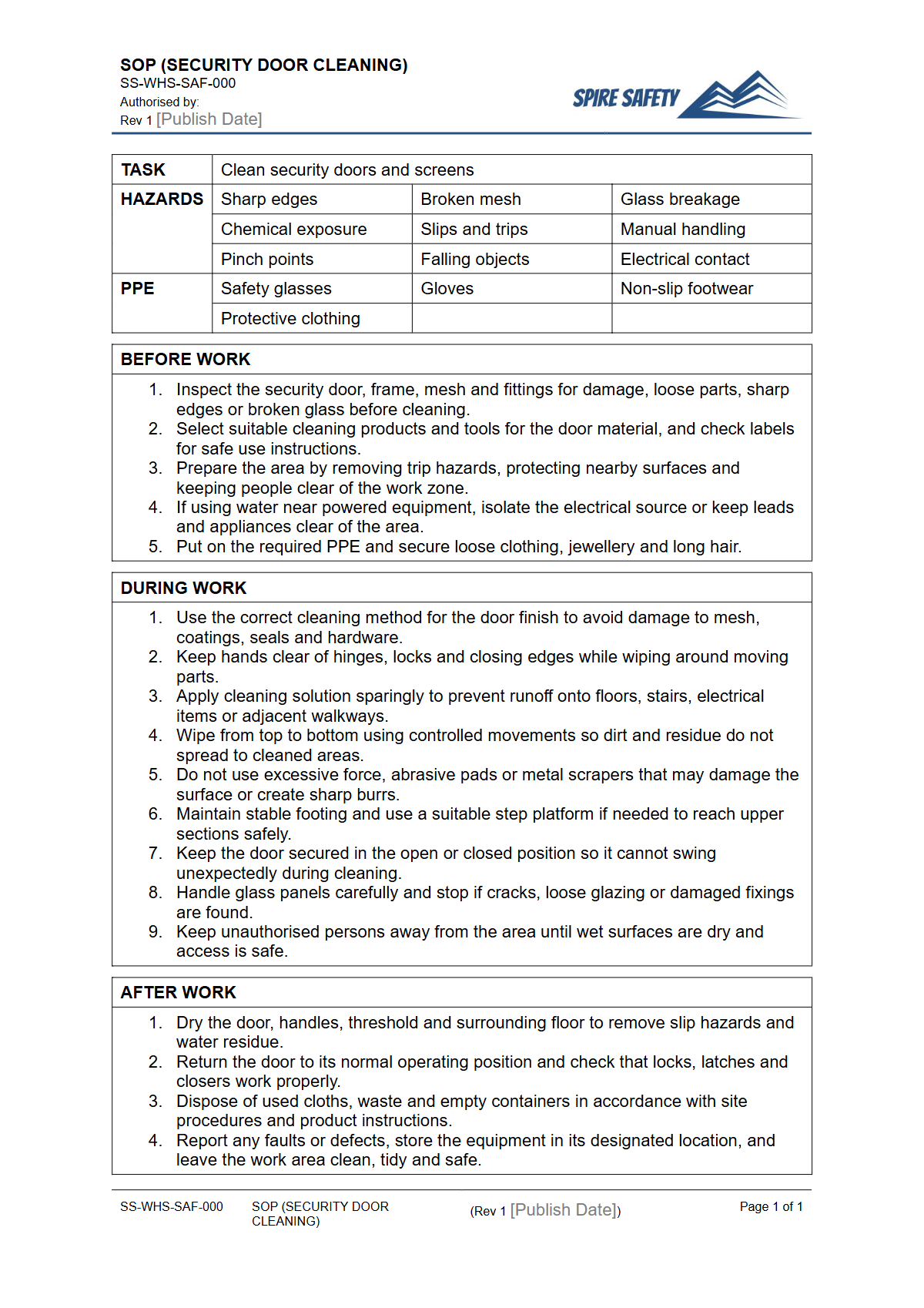
Download our free Safe Operating Procedure (Security Door Cleaning) template. This customisable DOCX helps you outline safe work steps for your team.
Free Safe Operating Procedure (Security Door Cleaning) Template
DOCX • 126 KB + PDF
Updated Oct 2026
No signup required
Purpose of the Free Safe Operating Procedure (Security Door Cleaning) Template
This Free Safe Operating Procedure (Security Door Cleaning) Template provides a structured framework for documenting the steps required to clean security doors safely and effectively. Proper procedures are essential for minimising risks such as exposure to cleaning chemicals, musculoskeletal injuries from awkward postures, and slips, trips, or falls.
Using a standardised SOP ensures that all workers follow the same safe method, promoting a consistent approach to workplace health and safety.
By clearly outlining hazards, required personal protective equipment (PPE), and emergency responses, this document serves as a vital tool for training and risk management. It forms part of your broader duty of care to provide a safe working environment.
Implementing robust procedures helps prevent incidents and demonstrates a commitment to a proactive safety culture. A thorough SOP is a key element within comprehensive WHS management systems, helping your organisation meet its safety obligations.
Video walkthrough
How to use the Free Safe Operating Procedure (Security Door Cleaning) Template
Our Safe Operating Procedure for security door cleaning is designed as a starting point. It should be downloaded and customised to reflect the specific hazards, equipment, and cleaning products used in your workplace.
A generic procedure cannot account for every unique variable on-site, such as the type of door, the environment, and the specific chemicals approved for use. Effective customisation involves a thorough risk assessment of the task in its actual context.
Important: We have developed this template as a guide based on common industry practices. You must consult with your workers and adapt the content to suit your specific operational needs and legal obligations.
This includes adding site-specific details, machine-specific instructions, and listing the exact PPE required. For assistance in tailoring this document or developing other complex procedures, consider engaging our WHS consulting services.
When to use this Safe Operating Procedure
A Safe Operating Procedure for security door cleaning should be developed and implemented before any workers undertake the task for the first time. It is a critical document for worker induction and training, ensuring they understand the approved method and associated risks from day one.
The SOP should also be used as a reference for refresher training and be readily accessible in the work area for easy consultation.
Furthermore, the SOP must be reviewed and updated regularly. A review is necessary whenever there is a change in the task, such as the introduction of new cleaning chemicals, new equipment, or a change in the work environment.
It must also be reviewed following any incident, near miss, or when a hazard is identified that was not previously considered. This continuous review process is often verified through WHS compliance auditing to ensure procedures remain current and effective.
Who should use this Safe Operating Procedure
This SOP is intended for use by multiple groups within an organisation. Primarily, workers who perform the cleaning tasks must be trained in and follow the procedure to ensure their own safety and the safety of others.
Team leaders and supervisors are responsible for implementing the SOP, providing training, and ensuring compliance on a day-to-day basis. They use it as a tool to monitor performance and enforce safe work practices.
Workplace Health and Safety (WHS) managers or coordinators will use this template to develop and formalise the procedure as part of the organisation's overall safety framework. Business owners and Persons Conducting a Business or Undertaking (PCBUs) are ultimately responsible for ensuring safe systems of work are in place, making this SOP a key document for fulfilling their duty of care. While this SOP is for cleaning, maintenance teams may also require procedures for other tasks, such as our circular saw SOP template.
A well-drafted SOP ensures everyone, from management to the person doing the job, has a clear understanding of how to perform the task safely. While specific to security doors, the principles can be adapted for other equipment-related tasks, such as those covered in our free Air Compressor SOP template. You can explore more examples in our complete free WHS resources library to build out your safety documentation.
Common mistakes
Common mistakes to avoid
- Using a generic downloaded template without customising it for site-specific equipment, chemicals, and hazards.
- Failing to consult with the workers who perform the cleaning task when drafting or reviewing the procedure.
- Not providing the specific Personal Protective Equipment (PPE) listed in the SOP, or failing to train workers on how to use it correctly.
- Treating the SOP as a 'set and forget' document instead of reviewing and updating it regularly.
Legal references
Legal considerations
The following legal requirements may be relevant to this type of work.
- Work Health and Safety Act (Harmonised) — Provides the primary duties for protecting workers and other people from work health and safety risks.
- Work Health and Safety Regulations (Harmonised) — Sets out requirements supporting the management of workplace hazards and risks.
The following codes may be relevant to this type of work.
- Managing WHS Risks Code of Practice — Provides practical guidance on identifying hazards, assessing risks and applying effective controls.
- Work Health and Safety Consultation, Cooperation and Coordination Code of Practice — Provides practical guidance on consulting workers and coordinating with other duty holders.
- Managing the Work Environment and Facilities Code of Practice — Provides practical guidance on safe work environments, workplace facilities and related controls.
Did you know
Chemical Safety Data Sheets (SDS)
Under WHS Regulations, a Safety Data Sheet (SDS) must be available for any hazardous chemical used in the workplace. The SOP should always reference the SDS for information on safe handling, storage, and first aid.
Consultation is Key
WHS laws require employers to consult with their workers on matters affecting their health and safety. Involving the people who actually perform the cleaning task is the best way to identify all the real-world hazards.
FAQ
Frequently asked questions
01What are the main hazards when cleaning security doors?
02Is a Safe Operating Procedure a legal requirement in Australia?
03How often should a security door cleaning SOP be reviewed?
04Can this SOP template be used for cleaning other doors or windows?
Share this resource
Free Safe Operating Procedure (Security Door Cleaning) Template
Browse Categories
How To Use It
- 1Download and open in Word or PDF.
- 2Replace the placeholders with your business details.
- 3Get it reviewed by a WHS specialist before rollout.
Need it customised?
Our WHS consultants can adapt this template to your site, run a gap analysis, or audit what you already have in place.
Book a Free Consultation WHS consulting servicesor call 1300 156 382
Related templates
- Free Safe Operating Procedure (Security Gate Operation) Template
- Free Safe Operating Procedure (Security Key Handover) Template
- Free Safe Operating Procedure (Security Log Handover) Template
- Free Safe Operating Procedure (Security Patrol Handover) Template
- Free Safe Operating Procedure (Security Patrol) Template
- Free Safe Operating Procedure (Security Radio Check) Template