
Free Safe Operating Procedure (Sealant Application) Template
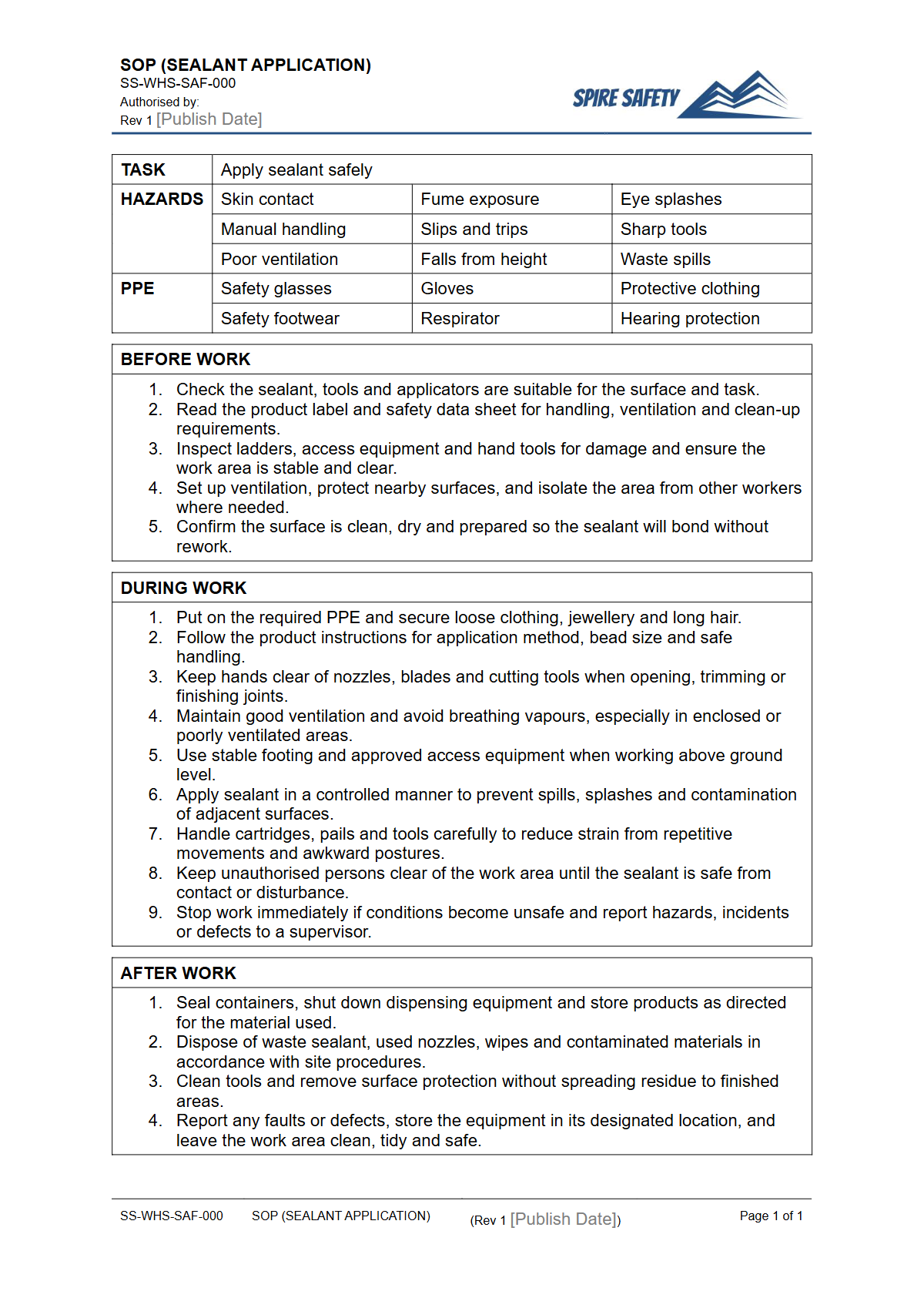
Clearly define the steps for safely applying sealants in your workplace. Download our free Safe Operating Procedure (Sealant Application) template today.
Free Safe Operating Procedure (Sealant Application) Template
DOCX • 126 KB + PDF
Updated Oct 2026
No signup required
Purpose of the Free Safe Operating Procedure (Sealant Application) Template
Applying sealants, while a common task in construction and maintenance, carries significant risks if not managed correctly. This Free Safe Operating Procedure (Sealant Application) Template provides a structured starting point for your organisation to document a safe system of work.
It is designed to help you identify hazards, implement risk controls, and outline clear, sequential instructions for workers. Using this template helps formalise your safety processes for tasks involving sealants, addressing risks such as chemical exposure, musculoskeletal strain, and skin irritation, in alignment with Australian WHS best practices.
Video walkthrough
How to use the Free Safe Operating Procedure (Sealant Application) Template
This document is provided in an editable DOCX format, along with a ready-to-print PDF. To use it effectively, you must adapt it to the specific context of your workplace. Follow these steps:
- Download the template and open the DOCX file.
- Thoroughly review each section, including Personal Protective Equipment (PPE), pre-operational checks, step-by-step procedures, and emergency response.
- Consult with workers who perform the task to ensure the procedure reflects the practical realities of the job.
- Modify the content to detail the specific types of sealants, tools (e.g., caulking guns, spatulas, pneumatic applicators), and work environments at your site.
- Add your company branding and review details.
- Finalise, approve, and communicate the SOP to all relevant personnel through training and toolbox talks.
Important: This is a generic template. We cannot know the specific hazards, equipment, or chemicals used in your business.
It is your responsibility as the PCBU (Person Conducting a Business or Undertaking) to customise this document to ensure it is suitable for your operations. If you require assistance with this process, our expert WHS consulting services can help tailor documents to your needs.
When to use it
A Safe Operating Procedure for sealant application should be developed and implemented before any worker undertakes the task. It serves as a critical training tool for new employees or those unfamiliar with the process.
The SOP should also be readily available at the point of work as a reference guide. It forms a key part of your safety framework and demonstrates due diligence in managing workplace risks. Integrating specific SOPs is a fundamental part of building comprehensive WHS management systems.
Who should use it
This SOP should be used by several key roles within an organisation:
- Workers and Contractors: To understand and follow the safe steps required for applying sealant, including selecting the right PPE and handling chemicals correctly.
- Supervisors and Managers: To train workers, supervise the task, and enforce the documented safety procedures. They are responsible for ensuring the SOP is understood and followed.
- WHS Managers and Advisors: To develop, review, and update the procedure as part of the overall safety management system. They ensure the SOP is aligned with legislative requirements and best practice.
Managing Specific Hazards
Sealant application presents several key hazards that your customised SOP must address. Chemical exposure is a primary concern, as many sealants emit Volatile Organic Compounds (VOCs) or contain isocyanates.
Your procedure must specify ventilation requirements (mechanical or natural) and the correct type of respiratory protection. Skin contact can lead to dermatitis or sensitisation, so defining the appropriate chemical-resistant gloves is essential.
For tasks involving pneumatic applicators, your procedures might also cross-reference your free Air Compressor SOP to cover equipment safety.
Integrating with Other High-Risk Tasks
In many construction and workshop environments, sealant application is just one of many tasks being performed. It's important that your safety procedures work together as a cohesive system.
For example, if workers are cutting materials before sealing joints, they will also need to follow procedures documented in a resource like our FREE Circular Saw SOP Template. By documenting each high-risk activity, you create a more robust safety culture where risks are managed systematically, not in isolation.
Use in Different Work Environments
The method of sealant application can vary significantly depending on the industry. In a manufacturing setting, this might be a repetitive task on a production line.
Here, ergonomic risks from sustained postures and repetitive motions are high. In such cases, your procedures should be developed alongside an ergonomic assessment.
For production lines, you may also need a Conveyer System SOP to manage associated risks. In a field maintenance role, workers face changing environmental conditions, which introduces different challenges that the SOP must account for.
This document is one of many templates available to help you build out your safety systems. We encourage you to explore our complete free WHS resources library for more templates, checklists, and guides to support your safety and compliance efforts.
Common mistakes
Common mistakes to avoid
- Applying sealant in a poorly ventilated area without adequate respiratory protection.
- Failing to properly prepare the surface before application, leading to adhesion failure and rework.
- Using incorrect or insufficient PPE, particularly chemical-resistant gloves and safety eyewear.
- Not checking the sealant's Safety Data Sheet (SDS) for specific handling and first aid information.
Legal references
Legal considerations
The following legal requirements may be relevant to this type of work.
- Work Health and Safety Act (Harmonised) — Provides the primary duties for protecting workers and other people from work health and safety risks.
- Work Health and Safety Regulations (Harmonised) — Sets out requirements supporting the management of workplace hazards and risks.
The following codes may be relevant to this type of work.
- Managing WHS Risks Code of Practice — Provides practical guidance on identifying hazards, assessing risks and applying effective controls.
- Work Health and Safety Consultation, Cooperation and Coordination Code of Practice — Provides practical guidance on consulting workers and coordinating with other duty holders.
- Managing the Work Environment and Facilities Code of Practice — Provides practical guidance on safe work environments, workplace facilities and related controls.
Did you know
VOCs and Health
Many common sealants release Volatile Organic Compounds (VOCs), which can cause both short-term effects like headaches and dizziness, and long-term health issues. Proper ventilation and RPE are critical controls.
Ergonomic Risk
Repetitive or sustained awkward postures during sealant application are a leading cause of musculoskeletal disorders in tradespeople. Job rotation and tool selection can help manage this risk.
FAQ
Frequently asked questions
01What should be included in a Sealant Application SOP?
02Is this template compliant with Australian WHS laws?
03How often should we review our Safe Operating Procedures?
04What are the most common hazards with sealant application?
Share this resource
Free Safe Operating Procedure (Sealant Application) Template
Browse Categories
How To Use It
- 1Download and open in Word or PDF.
- 2Replace the placeholders with your business details.
- 3Get it reviewed by a WHS specialist before rollout.
Need it customised?
Our WHS consultants can adapt this template to your site, run a gap analysis, or audit what you already have in place.
Book a Free Consultation WHS consulting servicesor call 1300 156 382
Related templates
- Free Safe Operating Procedure (Seaming Machine) Template
- Free Safe Operating Procedure (Section Roller) Template
- Free Safe Operating Procedure (Security Door Cleaning) Template
- Free Safe Operating Procedure (Security Gate Operation) Template
- Free Safe Operating Procedure (Security Key Handover) Template
- Free Safe Operating Procedure (Security Log Handover) Template