
Free Safe Operating Procedure (Scroll Saw) Template
Download our free Safe Operating Procedure (Scroll Saw) Template to document safe work methods. This customisable guide helps standardise scroll saw use.
Free Safe Operating Procedure (Scroll Saw) Template
DOCX • 126 KB + PDF
Updated Oct 2026
No signup required
Purpose of the Free Safe Operating Procedure (Scroll Saw) Template
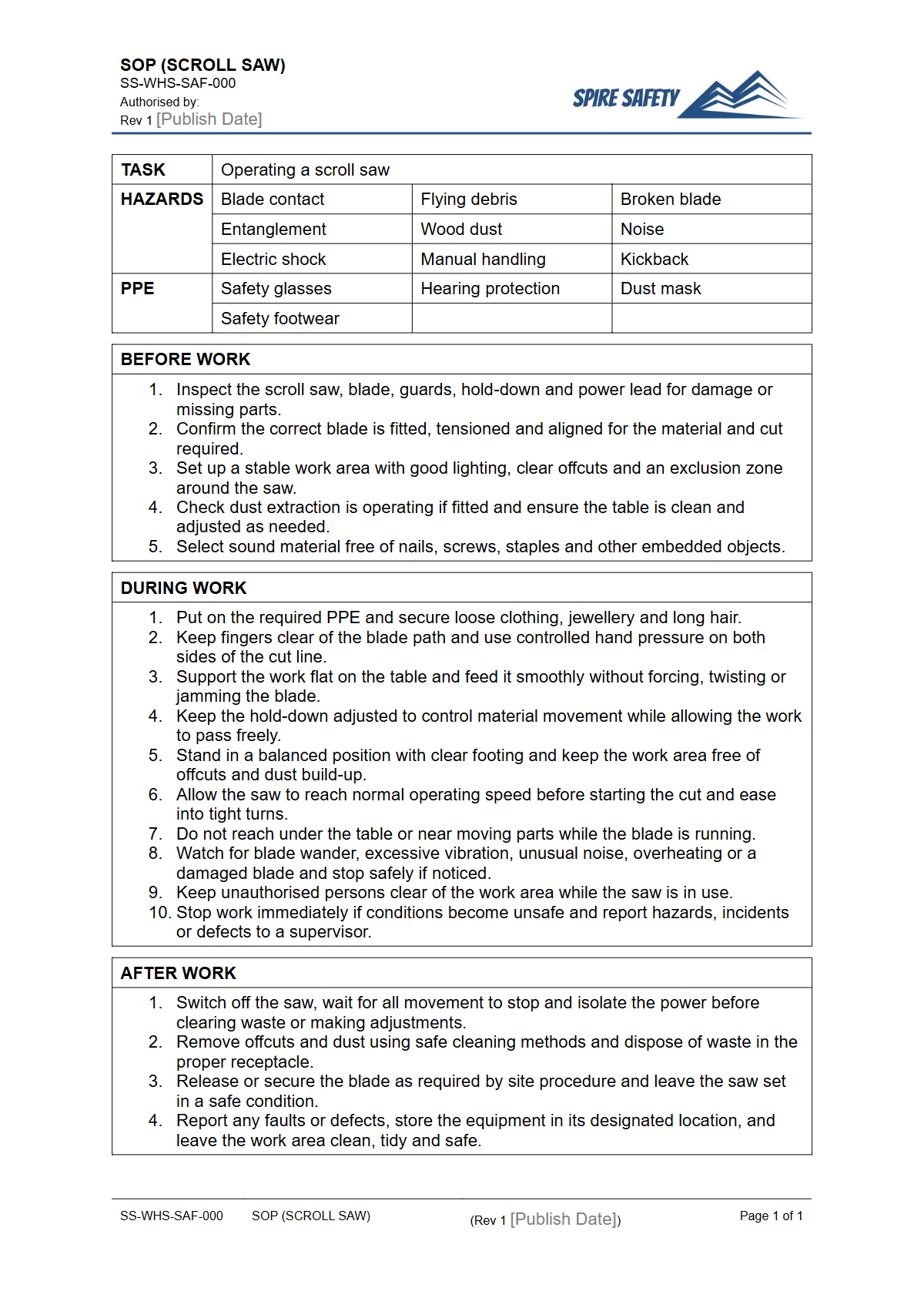
A Safe Operating Procedure (SOP) is an essential tool for managing health and safety risks associated with machinery. Our Free Safe Operating Procedure (Scroll Saw) Template provides a structured framework for your business to outline the recognised method for operating a scroll saw, minimising risks to workers.
Using a scroll saw introduces specific hazards, including contact with the moving blade, entanglement of hair or clothing, and inhalation of wood dust. This template helps you formalise procedures to control these risks, support worker training, and demonstrate compliance with your WHS duties.
Implementing a clear SOP ensures that all operators, regardless of experience level, follow a consistent, safety-focused process. It serves as a key administrative control measure, forming part of a comprehensive safe system of work.
By documenting pre-operational checks, step-by-step instructions, and emergency responses, you create a valuable reference for daily operations and a foundational document for your safety management system.
Video walkthrough
How to use the Free Safe Operating Procedure (Scroll Saw) Template
This resource is available as a DOCX file for easy customisation and as a PDF for straightforward distribution and printing. To get started, download the DOCX version and begin editing it to reflect your specific operational environment.
Similar to our free circular saw SOP template, this document is designed to be adapted.
Important: This is a template, not a completed Safe Operating Procedure. To be effective and support your WHS obligations, you must customise it with the details of your workplace.
We recommend you incorporate information such as the specific make and model of your scroll saw, the types of materials being cut, site-specific emergency contacts, and the required personal protective equipment (PPE). The final, customised document should be reviewed and approved by a competent person before being issued to workers.
What's included in the template?
Our scroll saw SOP template is structured to align with Australian WHS best practices and provides sections for you to detail:
- Required PPE: Specify mandatory equipment like safety glasses, hearing protection, and respiratory protection.
- Pre-Operational Safety Checks: List crucial checks for the blade, guards, work table, and power supply before use.
- Step-by-Step Operating Instructions: A logical sequence for performing the task, from setting up the workpiece to making the cut and shutting down the machine. Many workshops also rely on equipment covered by our Free Air Compressor SOP.
- Post-Operational Tasks: Outline requirements for cleaning the machine and the work area to prevent dust accumulation and fire risks.
- Potential Hazards and Control Measures: Document the specific risks and the controls your organisation has in place.
- Emergency Procedures: Detail the immediate actions to take in case of injury, blade breakage, or other emergencies.
When should a Scroll Saw Safe Operating Procedure be used?
An SOP for a scroll saw should be a living document integrated into your daily operations. It is not a document to be filed away and forgotten.
Use it as a central part of worker induction and onboarding for anyone who will operate the equipment. It should also be used for refresher training to ensure standards do not slip over time and as a reference before starting a non-routine or complex task.
Furthermore, in the event of an incident or near-miss involving a scroll saw, the SOP should be reviewed as part of the investigation to identify any gaps or areas for improvement. A well-maintained library of SOPs is a core component of robust WHS management systems.
Who is this Safe Operating Procedure for?
This template is designed for use by multiple roles within an organisation. A Person Conducting a Business or Undertaking (PCBU) is responsible for providing safe systems of work, and developing and implementing SOPs is a key part of fulfilling that duty.
Supervisors and managers should use the finalised SOP to train and supervise workers, ensuring the prescribed safety measures are followed consistently. They can also use it as a tool for conducting safety observations or competency assessments.
For workers, the SOP is a vital reference guide that clearly outlines the safest way to perform their tasks, empowering them to work safely and confidently. External auditors may also review such procedures during a formal WHS compliance audit.
By standardising the procedure for using a scroll saw, this document helps create a safer, more predictable work environment for everyone. To find other useful templates for your workplace, explore our complete free WHS resources library.
Common mistakes
Common mistakes to avoid
- Failing to adjust blade tension correctly, leading to frequent blade breakage or inaccurate cuts.
- Forcing the workpiece through the blade instead of guiding it gently, which can break the blade or cause loss of control.
- Using the wrong type or size of blade for the material thickness and type being cut.
- Neglecting to use a dust extraction system or wear appropriate respiratory protection when cutting materials that produce fine dust.
Legal references
Legal considerations
The following legal requirements may be relevant to this type of work.
- Work Health and Safety Act (Harmonised) — Provides the primary duties for protecting workers and other people from work health and safety risks.
- Work Health and Safety Regulations (Harmonised) — Sets out requirements supporting the management of workplace hazards and risks.
The following codes may be relevant to this type of work.
- Managing WHS Risks Code of Practice — Provides practical guidance on identifying hazards, assessing risks and applying effective controls.
- Work Health and Safety Consultation, Cooperation and Coordination Code of Practice — Provides practical guidance on consulting workers and coordinating with other duty holders.
- Managing the Work Environment and Facilities Code of Practice — Provides practical guidance on safe work environments, workplace facilities and related controls.
Did you know
Fine Blades
Scroll saw blades are extremely fine and can have up to 32 teeth per inch (TPI), allowing for intricate, curved cuts that are impossible with most other types of saws.
Not Just Wood
While commonly used for woodworking, scroll saws are versatile enough to cut other thin materials like plastic, bone, copper, and brass when fitted with the appropriate blade.
FAQ
Frequently asked questions
01What are the main hazards of using a scroll saw?
02Is a Safe Operating Procedure a legal requirement in Australia?
03How often should a scroll saw SOP be reviewed?
04Can I use this template for a band saw or other equipment?
Share this resource
Free Safe Operating Procedure (Scroll Saw) Template
Browse Categories
How To Use It
- 1Download and open in Word or PDF.
- 2Replace the placeholders with your business details.
- 3Get it reviewed by a WHS specialist before rollout.
Need it customised?
Our WHS consultants can adapt this template to your site, run a gap analysis, or audit what you already have in place.
Book a Free Consultation WHS consulting servicesor call 1300 156 382
Related templates
- Free Safe Operating Procedure (Scrubber Dryer) Template
- Free Safe Operating Procedure (Sealant Application) Template
- Free Safe Operating Procedure (Seaming Machine) Template
- Free Safe Operating Procedure (Section Roller) Template
- Free Safe Operating Procedure (Security Door Cleaning) Template
- Free Safe Operating Procedure (Security Gate Operation) Template