
Free Safe Operating Procedure (Scrubber Dryer) Template
Outline the safe operation of scrubber dryers with our structured template. Download your free Safe Operating Procedure in DOCX and PDF formats today.
Free Safe Operating Procedure (Scrubber Dryer) Template
DOCX • 126 KB + PDF
Updated Oct 2026
No signup required
Purpose of the Free Safe Operating Procedure (Scrubber Dryer) Template
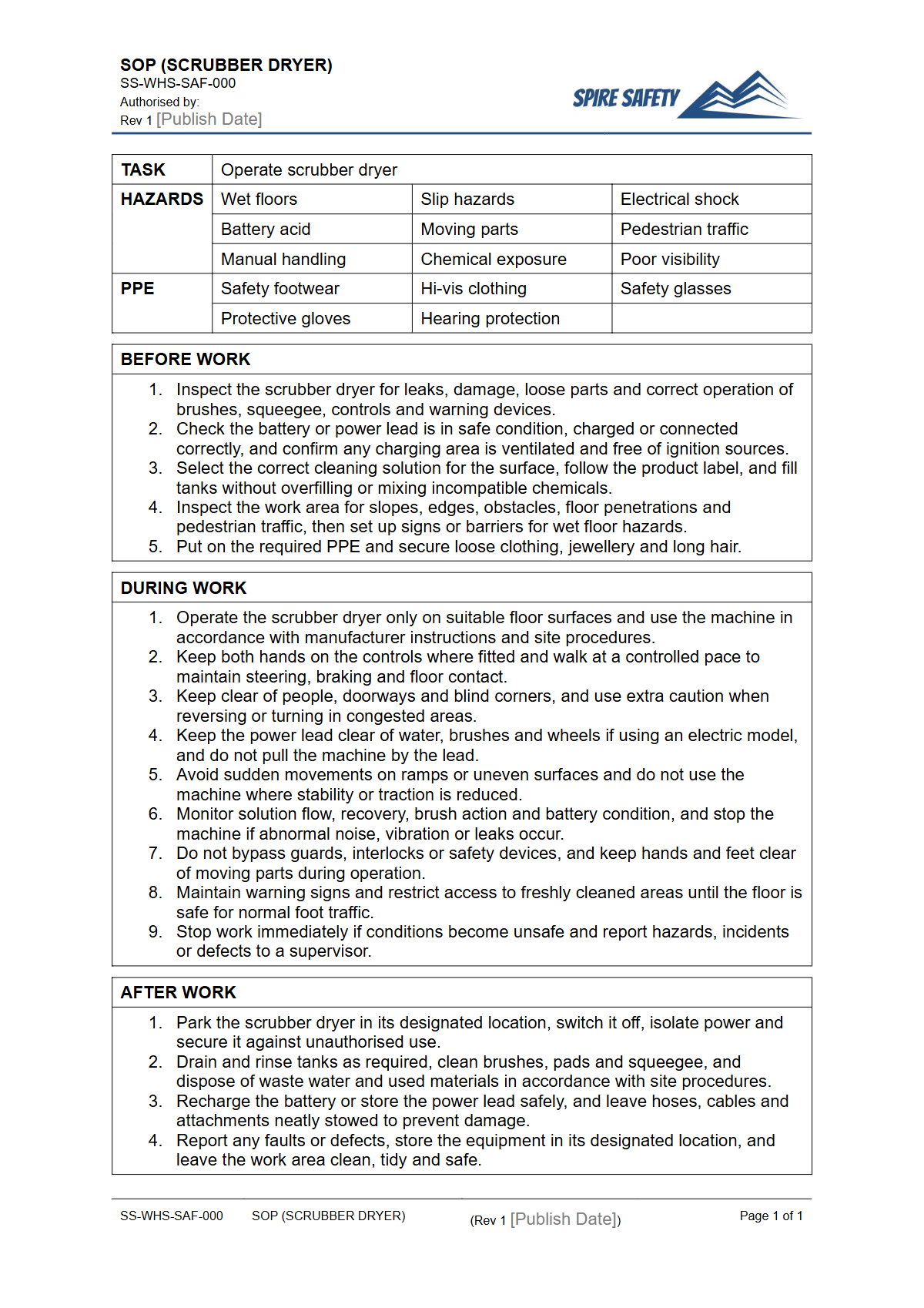
This Free Safe Operating Procedure (Scrubber Dryer) Template provides a structured framework for documenting the step-by-step process for safely operating industrial and commercial scrubber dryers. Using a well-defined SOP helps control common workplace hazards associated with this equipment, such as slips from wet floors, trips over power cords, electrical risks, and musculoskeletal strain.
It serves as a critical tool for training, risk management, and demonstrating a commitment to a safe system of work, forming a key part of your overall safety management efforts.
Implementing documented procedures is a fundamental aspect of maintaining workplace safety. This template assists your organisation in systematically identifying risks and outlining the necessary control measures for pre-operational checks, operation, and post-operational clean-up and storage.
This process helps ensure that all operators follow a consistent, safe method every time they use the equipment. Proper documentation also supports periodic reviews and updates, which are essential after any WHS compliance auditing activities identify gaps or opportunities for improvement.
Video walkthrough
How to use the Free Safe Operating Procedure (Scrubber Dryer) Template
This Safe Operating Procedure template is provided as a downloadable DOCX and PDF file, designed for easy customisation. To effectively use it, you must adapt the content to reflect the specific scrubber dryer models used at your site, your unique workplace environment, and any state-specific WHS regulations.
This includes adding site-specific details, identifying hazards unique to your operational areas, and listing the required Personal Protective Equipment (PPE).
Important: This document is a template, not a finished SOP. Your organisation is responsible for ensuring the final document is accurate and sufficient for your needs.
We strongly recommend that a competent person, in consultation with the machine operators and their supervisors, completes the customisation process. This collaborative approach ensures the procedure is practical, understood by those performing the task, and addresses the real-world risks they face. While this template is a great starting point, it should be integrated into your comprehensive WHS management systems.
Key Elements of a Scrubber Dryer Safe Operating Procedure
A robust SOP for a scrubber dryer should cover several key phases of operation to be effective. The template prompts you to detail the following critical areas:
- Pre-Operational Checks: Includes visual inspection of the machine for damage, checking the condition of brushes or pads, verifying the integrity of the power cord and plug, and ensuring all safety features like emergency stops are functional.
- Safe Operation: Outlines the correct sequence for starting and using the machine, techniques for manoeuvring in different environments, managing the power cord to prevent trip hazards, and procedures for refilling the solution tank and emptying the recovery tank. A similar level of detail is required when creating an SOP for a telehandler or other mobile plant.
- Hazard Controls: Specifies the use of warning signs for wet floors, procedures for managing public access to the cleaning area, and guidelines for noise and vibration exposure.
- Post-Operation Tasks: Details the steps for cleaning the machine, draining and rinsing tanks, inspecting components for wear, and correct battery charging and storage procedures.
When to use a Scrubber Dryer SOP
A Safe Operating Procedure for a scrubber dryer should be used whenever the equipment is operated. It serves as a primary reference document for training new employees and as a refresher for experienced operators.
It is particularly crucial during induction and competency assessments. The SOP should be readily accessible to all operators in the areas where the scrubber dryer is used and stored.
For other machinery like warehouse equipment, a specific conveyer system SOP would serve a similar purpose.
Who should use this Safe Operating Procedure
This SOP is intended for use by multiple roles within an organisation. Primary users are the operators of the scrubber dryer equipment.
Supervisors and managers should use it to conduct training, verify competency, and perform workplace inspections. WHS personnel and management will use the SOP as evidence of a safe system of work and as a component of the broader safety management framework.
This is similar to how our Safe Operating Procedure for general floor scrubber operation is used. You can explore our entire collection of templates in our free WHS resources library for more examples.
Common mistakes
Common mistakes to avoid
- Using the wrong cleaning chemical or an incorrect dilution ratio, which can damage surfaces or create hazards.
- Failing to conduct and document pre-operational checks, especially for electrical cord and plug integrity.
- Leaving floors wet without using highly visible warning signs, creating a serious slip hazard for others.
- Neglecting formal operator training and competency verification, assuming the task is 'common sense'.
Legal references
Legal considerations
The following legal requirements may be relevant to this type of work.
- Work Health and Safety Act (Harmonised) — Provides the primary duties for protecting workers and other people from work health and safety risks.
- Work Health and Safety Regulations (Harmonised) — Sets out requirements supporting the management of workplace hazards and risks.
The following codes may be relevant to this type of work.
- Managing WHS Risks Code of Practice — Provides practical guidance on identifying hazards, assessing risks and applying effective controls.
- Work Health and Safety Consultation, Cooperation and Coordination Code of Practice — Provides practical guidance on consulting workers and coordinating with other duty holders.
- Managing the Work Environment and Facilities Code of Practice — Provides practical guidance on safe work environments, workplace facilities and related controls.
Did you know
Slips, Trips, and Falls
Slips, trips, and falls are a leading cause of serious, preventable injuries in Australian workplaces. While scrubber dryers are used to improve floor safety, they can temporarily increase slip risks if wet areas are not properly signposted.
FAQ
Frequently asked questions
01What is a Safe Operating Procedure for a scrubber dryer?
02Who is responsible for writing a scrubber dryer SOP?
03Does this SOP template cover both walk-behind and ride-on models?
04How often should a scrubber dryer SOP be reviewed?
Share this resource
Free Safe Operating Procedure (Scrubber Dryer) Template
Browse Categories
How To Use It
- 1Download and open in Word or PDF.
- 2Replace the placeholders with your business details.
- 3Get it reviewed by a WHS specialist before rollout.
Need it customised?
Our WHS consultants can adapt this template to your site, run a gap analysis, or audit what you already have in place.
Book a Free Consultation WHS consulting servicesor call 1300 156 382
Related templates
- Free Safe Operating Procedure (Sealant Application) Template
- Free Safe Operating Procedure (Seaming Machine) Template
- Free Safe Operating Procedure (Section Roller) Template
- Free Safe Operating Procedure (Security Door Cleaning) Template
- Free Safe Operating Procedure (Security Gate Operation) Template
- Free Safe Operating Procedure (Security Key Handover) Template