
Free Safe Operating Procedure (Screw Gun) Template
Get a structured starting point for your workshop safety with our free Screw Gun Safe Operating Procedure template. Download the customisable DOCX now.
Free Safe Operating Procedure (Screw Gun) Template
DOCX • 126 KB + PDF
Updated Oct 2026
No signup required
Purpose of the Free Safe Operating Procedure (Screw Gun) Template
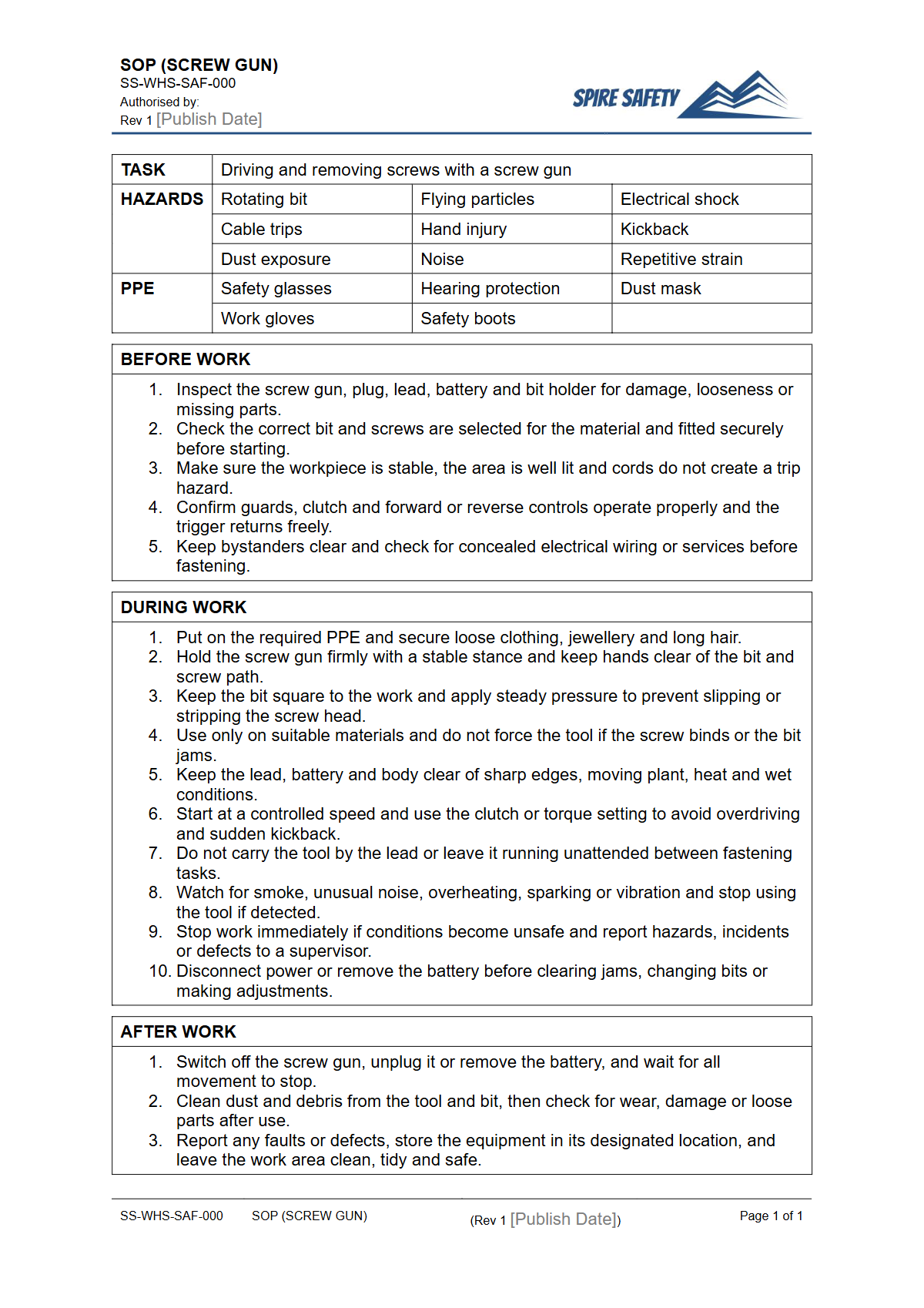
Using a screw gun, whether cordless, corded, or pneumatic, introduces several workplace hazards that must be managed. This Free Safe Operating Procedure (Screw Gun) Template provides a structured framework for documenting the required safety controls and work steps.
It is designed to help your organisation meet its duty of care by systematically identifying risks and outlining the safest way to perform tasks involving this common power tool. A documented SOP is a critical tool for worker training, competency assessments, and incident investigations.
Key hazards associated with screw gun operation include electric shock from damaged cords, ergonomic injuries from repetitive use or awkward postures, projectiles such as snapped bits or work material fragments, and entanglement of loose clothing or hair in moving parts. This template guides you in addressing these risks through pre-operational checks, personal protective equipment (PPE) requirements, and step-by-step instructions for safe use.
Properly implementing this Safe Operating Procedure helps standardise safe work practices across all teams and reduces the likelihood of injury.
Video walkthrough
How to use the Free Safe Operating Procedure (Screw Gun) Template
This Safe Operating Procedure template is provided in both DOCX and PDF formats. The DOCX version is fully editable, allowing you to tailor the content directly to your operational environment.
We recommend customising the document to include specific screw gun makes and models used on your site, the types of materials being worked on, and any unique environmental factors. While this template is aligned with Australian WHS practice, achieving compliance depends on its correct customisation and implementation.
Important: This is a template only. We've designed it to be a comprehensive starting point, but you must customise it with your specific site details, equipment models, tasks, and control measures to ensure it is effective for your workplace.
A generic procedure that doesn't reflect your actual work processes offers little practical safety value. If you need assistance tailoring this document, consider engaging specialist WHS consulting services.
When to use a Safe Operating Procedure
A Safe Operating Procedure for a screw gun should be consulted and followed during every phase of the tool's use. It is not a document to be filed away after induction. Its practical application includes:
- Before Starting Work: Workers must follow the pre-operational checklist within the SOP to inspect the tool for damage, ensure the battery is charged or the cord is safe, and verify that the correct bit is securely fitted.
- During Operation: The SOP outlines the correct body posture, grip, and method for applying pressure to prevent stripping screws and minimise ergonomic strain. It reinforces the mandatory use of PPE, such as safety glasses.
- After Use: The procedure details steps for cleaning the tool, removing the bit, and storing it correctly. For battery-powered models, it includes instructions for safe charging to prevent fire risk.
- Training and Competency: The SOP forms the basis for training new workers and for conducting regular competency verifications for experienced staff, ensuring everyone maintains the same high safety standard. The process is similar for other equipment, as shown in our free Circular Saw SOP.
Who should use this SOP
This document is intended for a range of personnel within any organisation that uses screw guns, particularly in sectors like construction, manufacturing, maintenance, and cabinet making. Key users include:
- Workers and Operators: The primary audience. The SOP serves as their direct guide for performing their tasks safely.
- Supervisors and Team Leaders: Responsible for ensuring workers understand and follow the SOP. They use it for toolbox talks, on-the-job training, and informal workplace inspections.
- WHS Managers and Advisors: These professionals use the template as a foundation for developing and integrating safety procedures into the organisation's broader comprehensive WHS management systems.
- Training Coordinators: Use the SOP to develop formal training programs and assessment criteria for verifying worker competency with power tools.
For operations involving pneumatic tools, the principles remain the same but require additional checks related to air supply and connectors. This is also covered in our Air Compressor SOP template, which can be used alongside this document.
By providing a clear, consistent set of instructions, this SOP helps embed a positive safety culture where correct, safe behaviour becomes second nature. Explore our free WHS resources library for more templates to support your safety management efforts.
Common mistakes
Common mistakes to avoid
- Using the wrong size or type of bit for the screw, leading to stripped heads and loss of control.
- Forgetting to conduct pre-start checks, especially inspecting power cords for damage or batteries for charge.
- Failing to wear mandatory PPE, particularly safety glasses, even for a 'quick job'.
- Applying excessive downward force or holding the tool at an awkward angle, increasing the risk of RSI and mistakes.
Legal references
Legal considerations
The following legal requirements may be relevant to this type of work.
- Work Health and Safety Act (Harmonised) — Provides the primary duties for protecting workers and other people from work health and safety risks.
- Work Health and Safety Regulations (Harmonised) — Sets out requirements supporting the management of workplace hazards and risks.
The following codes may be relevant to this type of work.
- Managing WHS Risks Code of Practice — Provides practical guidance on identifying hazards, assessing risks and applying effective controls.
- Work Health and Safety Consultation, Cooperation and Coordination Code of Practice — Provides practical guidance on consulting workers and coordinating with other duty holders.
- Managing the Work Environment and Facilities Code of Practice — Provides practical guidance on safe work environments, workplace facilities and related controls.
Did you know
Ergonomic Risk
Repetitive Strain Injury (RSI) from prolonged or awkward use of power tools like screw guns is a leading cause of musculoskeletal disorders among tradespeople. Correct posture and regular breaks are key preventative measures.
Projectile Hazard
The most common injury from screw guns involves projectiles. A worn or improperly seated bit can shatter or cause the screw head to strip, sending small, sharp metal fragments toward the operator's face and eyes.
FAQ
Frequently asked questions
01What should be included in a screw gun SOP?
02How often should screw gun SOPs be reviewed?
03Is a Safe Operating Procedure the same as a risk assessment?
04Can this screw gun SOP be used for all types of screw guns?
Share this resource
Free Safe Operating Procedure (Screw Gun) Template
Browse Categories
How To Use It
- 1Download and open in Word or PDF.
- 2Replace the placeholders with your business details.
- 3Get it reviewed by a WHS specialist before rollout.
Need it customised?
Our WHS consultants can adapt this template to your site, run a gap analysis, or audit what you already have in place.
Book a Free Consultation WHS consulting servicesor call 1300 156 382
Related templates
- Free 3D Printer SOP (Safe Operating Procedure) Template
- FREE Agricultural Equipment SOP (Safe Operating Procedure) Template
- Free Air Compressor SOP (Safe Operating Procedure) Template
- Free Angle Grinder SOP (Safe Operating Procedure) Template
- FREE Backhoe SOP (Safe Operating Procedure) Template
- FREE Baler SOP (Safe Operating Procedure) Template