
Free Safe Operating Procedure (Scaffold Hoist) Template
Download our free Safe Operating Procedure for scaffold hoists to formalise your safety protocols. This customisable template helps manage risks. Get yours now.
Free Safe Operating Procedure (Scaffold Hoist) Template
DOCX • 126 KB + PDF
Updated Oct 2026
No signup required
Purpose of the Free Safe Operating Procedure (Scaffold Hoist) Template
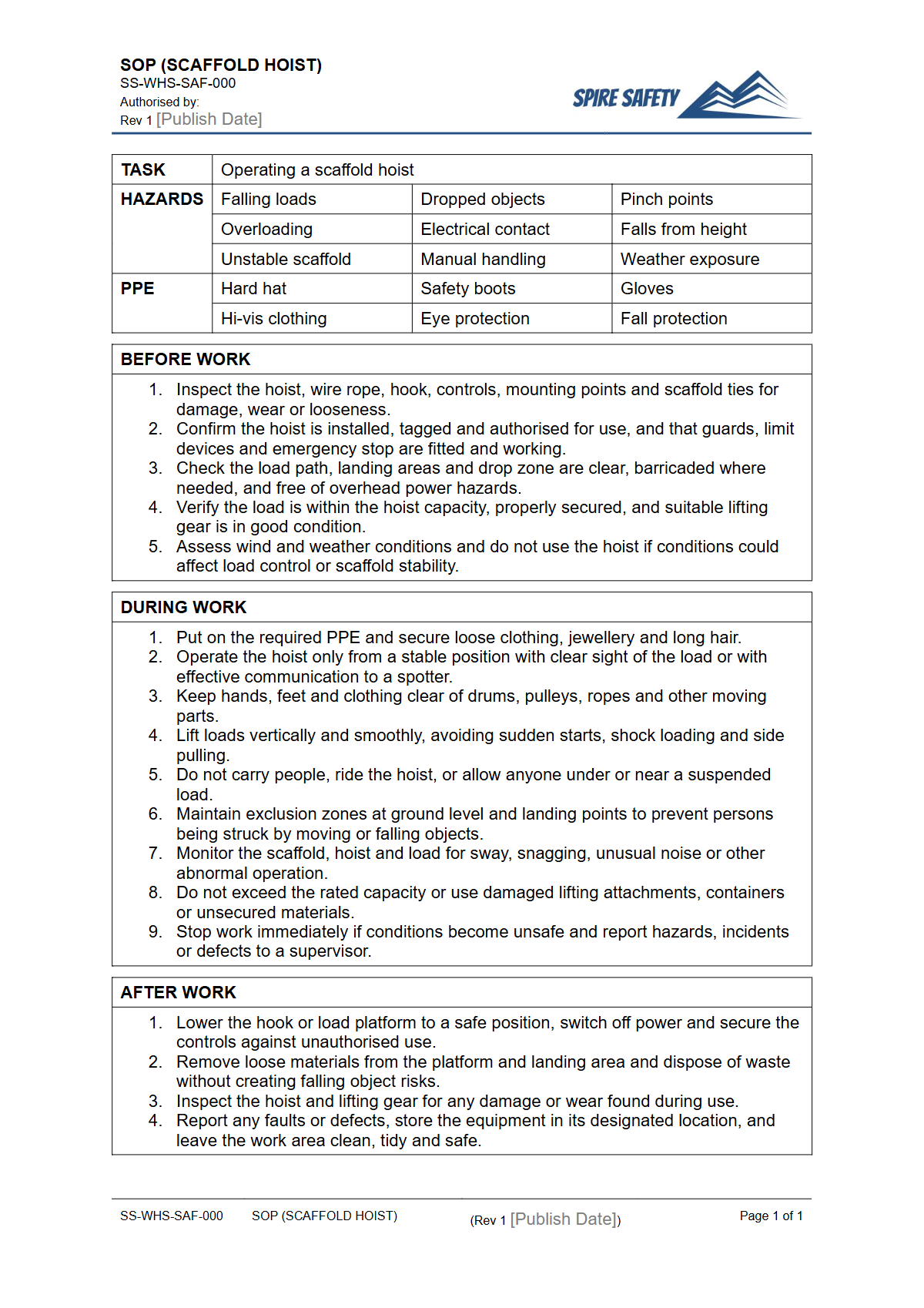
This Free Safe Operating Procedure (Scaffold Hoist) Template provides a structured framework for documenting the safe use of materials hoists on your worksite. A Safe Operating Procedure (SOP) is a critical document that outlines step-by-step instructions to help workers perform their tasks safely and consistently.
Using this template helps your organisation manage risks associated with lifting operations, reduce the chance of incidents, and demonstrate a commitment to workplace safety. It serves as an essential tool for training, competency assessment, and daily operational guidance.
Formalising your procedures for scaffold hoist use is a key part of any effective safety management plan. A well-drafted SOP ensures every operator understands the required checks, operational limits, and emergency responses.
Integrating documents like this into broader WHS management systems creates a robust safety culture and simplifies compliance activities.
Video walkthrough
How to use the Free Safe Operating Procedure (Scaffold Hoist) Template
To get started, download the template in your preferred format (DOCX for editing or PDF for reference). It is designed as a foundation, not a finished document.
You must review and customise every section to align with the specific equipment and environment at your workplace. This includes adding the make and model of your hoist, defining site-specific hazards, and listing the required personal protective equipment (PPE).
IMPORTANT: This document is a template only. We provide it as a starting point, but you must adapt it to your specific machinery, site conditions, and legal obligations.
Consult with operators and other relevant personnel during the drafting process to ensure the procedure is practical and effective. We are not liable for any incidents arising from the use of this template.
Key Sections to Customise
- Equipment Details: Enter the specific manufacturer, model, serial number, and Safe Working Load (SWL) of the hoist.
- Risk Assessment: Identify all potential hazards relevant to your site. This may include proximity to overhead power lines, unstable ground, public access areas, and interaction with other plant or vehicles. Similar considerations are needed when using other lifting equipment, as detailed in our free Telehandler SOP template.
- Pre-Operational Checks: Modify the checklist to match the manufacturer's recommendations for daily inspections. This should include checking ropes, controls, safety gates, limit switches, and structural integrity.
- Step-by-Step Operating Guide: Write clear, concise steps for the entire operation, from start-up and load handling to shutdown and securing the hoist.
- Emergency Procedures: Detail the exact steps to take in case of power failure, equipment malfunction, a dropped load, or other emergencies. Include emergency contact numbers and the location of first aid equipment.
When to use a Scaffold Hoist Safe Operating Procedure
An SOP for a scaffold hoist should be used as a primary reference document in several situations. It is mandatory for training new operators and conducting refresher courses for experienced workers.
The pre-start inspection checklist within the SOP must be completed before the first use of the hoist each day or at the beginning of each shift. The SOP should also be reviewed and updated after any incident or near-miss, or when changes are made to the equipment, work environment, or task.
For complex setups or high-risk environments, seeking guidance from a WHS consultant can ensure your procedure is comprehensive.
Who should use it
This Safe Operating Procedure is intended for all personnel involved with the use of a scaffold hoist. This includes, but is not limited to:
- Hoist Operators: To guide their daily work practices and ensure they follow safe, standardised steps.
- Supervisors and Site Managers: To enforce safety standards, conduct toolbox talks, and verify that operators are competent and following procedure.
- WHS/HSE Professionals: As a tool for risk management, incident investigation, and compliance auditing.
- Workers on Site: To understand the risks associated with overhead lifting and the importance of exclusion zones.
- PCBUs (Persons Conducting a Business or Undertaking): To help fulfil their primary duty of care under WHS legislation by providing safe systems of work for high-risk plant.
Standardising procedures for all types of site machinery is best practice. You can find similar templates for other common equipment, like our Air Compressor SOP, to build a consistent safety documentation library.
We encourage you to explore our complete free WHS resources library for more templates and checklists.
Common mistakes
Common mistakes to avoid
- Failing to conduct and document daily pre-start inspections.
- Overloading the hoist beyond its rated Safe Working Load (SWL).
- Operating the hoist in high winds or other adverse weather conditions.
- Not establishing and enforcing clear exclusion zones below the hoist's path of travel.
Legal references
Legal considerations
The following legal requirements may be relevant to this type of work.
- Work Health and Safety Act (Harmonised) — Provides the primary duties for protecting workers and other people from work health and safety risks.
- Work Health and Safety Regulations (Harmonised) — Sets out requirements supporting the management of workplace hazards and risks.
The following codes may be relevant to this type of work.
- Managing WHS Risks Code of Practice — Provides practical guidance on identifying hazards, assessing risks and applying effective controls.
- Work Health and Safety Consultation, Cooperation and Coordination Code of Practice — Provides practical guidance on consulting workers and coordinating with other duty holders.
- Managing the Work Environment and Facilities Code of Practice — Provides practical guidance on safe work environments, workplace facilities and related controls.
Did you know
Load Capacity is Key
Exceeding a scaffold hoist's Safe Working Load (SWL) is a primary cause of catastrophic failure. The SWL includes the weight of the barrow or bucket, not just the contents inside it.
Weather Watch
High winds can exert significant force on a scaffold hoist and its load, increasing the risk of instability or dropped objects. Hoist operations should be suspended in adverse weather conditions as per manufacturer guidelines.
FAQ
Frequently asked questions
01What is a scaffold hoist?
02Is a special licence required to operate a scaffold hoist in Australia?
03What is a Safe Work Method Statement (SWMS) and do I need one for a scaffold hoist?
04How often should a scaffold hoist be inspected?
Share this resource
Free Safe Operating Procedure (Scaffold Hoist) Template
Browse Categories
How To Use It
- 1Download and open in Word or PDF.
- 2Replace the placeholders with your business details.
- 3Get it reviewed by a WHS specialist before rollout.
Need it customised?
Our WHS consultants can adapt this template to your site, run a gap analysis, or audit what you already have in place.
Book a Free Consultation WHS consulting servicesor call 1300 156 382
Related templates
- Free Safe Operating Procedure (Scoreboard Cleaning) Template
- Free Safe Operating Procedure (Screen Printing) Template
- Free Safe Operating Procedure (Screening Plant Operation) Template
- Free Safe Operating Procedure (Screw Gun) Template
- Free Safe Operating Procedure (Scroll Saw) Template
- Free Safe Operating Procedure (Scrubber Dryer) Template